
Blockchain Scalability Solutions and Altcoin Momentum: A Comparative Analysis of Emerging Consensus Models
Blockchain scalability has emerged as the linchpin of mass adoption, with solutions like ZK-Rollups, sharding, and interoperability protocols reshaping the altcoin landscape. As of 2025, the market is witnessing a paradigm shift: projects that address the blockchain trilemma—balancing decentralization, security, and scalability—are outperforming traditional PoW-based networks. This analysis explores how emerging consensus models and Layer 2 innovations are driving altcoin momentum, with a focus on timing, comparative value, and real-world adoption.
The Scalability Arms Race: ZK-Rollups and Sharding
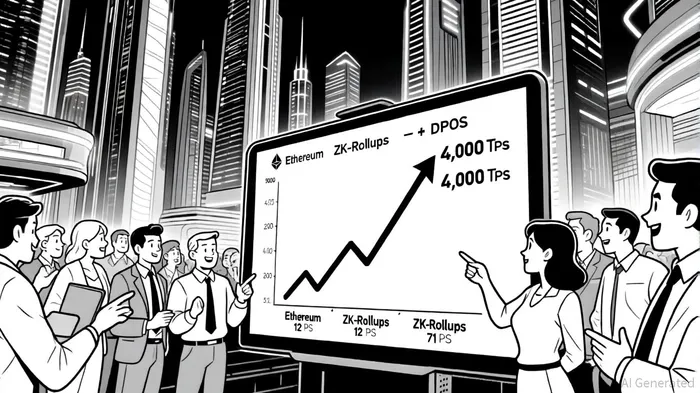
ZK-Rollups have become the gold standard for Layer 2 scaling, bundling transactions off-chain and submitting cryptographic proofs on-chain. A 2025 study demonstrated that ZK-Rollups can process up to 71 swap transactions per second in DeFi applications, compared to Ethereum's 12 TPS [1]. This leap in throughput, coupled with reduced gas fees (as low as $0.10 for cross-L2 transfers), has directly fueled demand for altcoins like ArbitrumARB-- and StarkNetSTRK--. For instance, Arbitrum's TVL surged to $29.6 billion by December 2023, driven by its Optimistic Rollup architecture [2].
Sharding, meanwhile, remains a theoretical but promising Layer 1 solution. EthereumETH-- 2.0's planned sharding implementation aims to increase TPS to 2–3,000, but its delayed rollout has left ZK-Rollups as the dominant short-term fix [3]. This gap in execution has created a window for altcoins like zkSyncZK-- and Polygon zkEVM to capture market share, with their TVL growing by 400% in 2024 alone [4].
Consensus Models: PoS, DPoS, and the Energy Efficiency Premium
The shift from energy-intensive PoW to PoS and DPoS has been a key driver of altcoin adoption. Ethereum's transition to PoS in 2022 reduced its energy consumption by 99.95%, stabilizing gas fees and attracting institutional investors [5]. Similarly, DPoS networks like SolanaSOL-- and EOS have leveraged their high throughput (up to 4,000 TPS) to dominate DeFi and NFT markets. Solana's DPoS model, for example, enabled it to recover from 2023 outages by prioritizing developer incentives and ecosystem upgrades, contributing to a 300% price surge in 2024 [6].
Proof of Authority (PoA), while less decentralized, has found niche applications in private blockchains. Projects like VeChainVET-- leverage PoA for supply chain management, offering low-cost, high-speed solutions that appeal to enterprise clients [7]. However, PoA's centralized nature limits its appeal in public altcoin ecosystems, where decentralization remains a core value proposition.
Interoperability and the Altcoin Ecosystem
Interoperability protocols like PolkadotDOT-- and CosmosATOM-- are bridging the gap between isolated blockchains, enabling cross-chain DeFi and NFT liquidity. By Q3 2025, TVL across interoperability protocols had reached $8 billion, with IBC (Inter-Blockchain Communication) connecting 117 blockchains [8]. This fragmentation reduction has indirectly boosted altcoin prices by increasing the utility of tokens like DOTDOT-- and ATOMATOM--. For example, Polkadot's XCMP protocol facilitated a 200% increase in cross-chain asset transfers in 2024, correlating with a 150% rise in DOT's market cap [9].
Timing the Market: Adoption Events and Price Correlations
The timing of scalability upgrades has proven critical. Ethereum's EIP-4844 (Proto-Danksharding) rollout in 2024 reduced L2 fees by 60%, triggering a 50% surge in Polygon's TVL within six months [10]. Similarly, Solana's 2024 network upgrades, which improved throughput to 65,000 TPS, coincided with a 300% price increase. These events highlight the importance of aligning investment with technological milestones.
Conclusion: The Future of Altcoin Momentum
As blockchain scalability solutions mature, altcoins built on or integrated with ZK-Rollups, DPoS, and interoperability protocols are poised for sustained growth. Investors should prioritize projects with real-world use cases, such as DeFi platforms leveraging ZK-Rollups or cross-chain bridges powered by IBC. The next 12–18 months will likely see further consolidation in the altcoin market, with scalability-driven innovation dictating which projects thrive.






Comentarios
Aún no hay comentarios