
Blockchain Scalability and Real-World Adoption in 2025: A Comparative Analysis of BlockDAG, Tron, Mantle, and Hedera
BlockDAG: The Hybrid Scalability Powerhouse
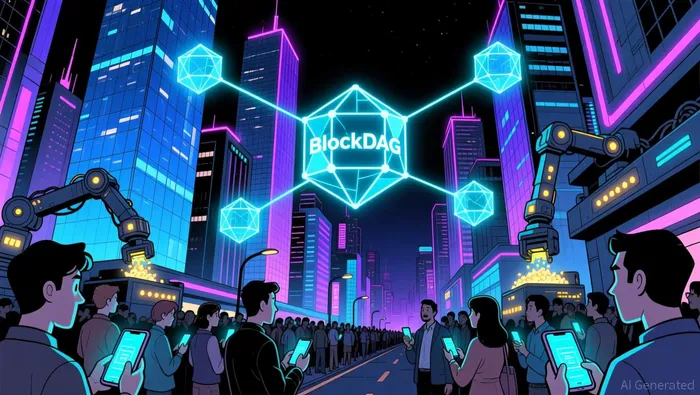
BlockDAG's hybrid architecture combines Proof-of-Work (PoW) with Directed Acyclic Graph (DAG) technology, enabling it to process up to 15,000 transactions per second (TPS) while maintaining energy efficiency through distributed mining units, according to a Top Crypto Performers of 2025 report. By 2025, the project has raised $435 million in its presale, with 3.5 million X1 mobile miners and 20,000 physical mining units deployed globally, per the same report. This decentralized infrastructure has attracted partnerships with Seattle-based sports teams, including the Seattle Seawolves (rugby) and Seattle Orcas (cricket), leveraging blockchain for fan engagement via NFTs and interactive content, as reported in a separate OpenPR release.
BlockDAG's real-world adoption is further bolstered by its mobile-first mining model, which democratizes participation and reduces reliance on energy-intensive data centers. However, its PoW component remains a potential scalability bottleneck compared to purely DAG-based systems.
Tron: User Engagement Outpaces Institutional Adoption
Tron (TRX) has seen a 174% month-over-month surge in decentralized exchange (DEX) volumes and a 13.4% increase in active addresses in October 2025, according to the Top Crypto Performers of 2025 report. Its focus on user-centric applications, such as decentralized social media and gaming, has driven engagement but left it lagging in institutional partnerships. While Tron's Delegated Proof-of-Stake (DPoS) consensus allows for high throughput, critics argue its centralization risks undermine long-term credibility, as noted in the same report.
Despite strong on-chain activity, Tron's price has stagnated amid broader market uncertainty, raising questions about whether user growth translates to token value. For TronTRX-- to compete in 2025, it must bridge the gap between mass adoption and enterprise-grade security, according to the Top Crypto Performers of 2025 report.
Mantle: Bridging Traditional Finance and Web3
Mantle has positioned itself as a modular Layer 2 solution built on Ethereum's ecosystem, prioritizing real-world asset (RWA) tokenization and banking integrations, according to the Top Crypto Performers of 2025 report. Its architecture allows developers to deploy scalable applications without compromising complexity, making it a bridge between traditional finance and decentralized infrastructure.
By 2025, Mantle has partnered with multiple traditional financial institutions to tokenize real estate, commodities, and securities, as reported in the same report. This focus on RWA aligns with growing institutional interest in blockchain, though its reliance on Ethereum's base layer could limit standalone scalability. Mantle's success hinges on its ability to abstract complexity while maintaining Ethereum's security guarantees, per the Top Crypto Performers of 2025 report.
Hedera: Hashgraph's Enterprise-Grade Efficiency
Hedera (HBAR) continues to attract institutional attention with its Hashgraph consensus model, which delivers 10,000 TPS at a fraction of the energy cost of PoW systems, according to the Top Crypto Performers of 2025 report. In 2025, a new HBAR-linked ETF has drawn $44 million in inflows, signaling growing trust in its enterprise-grade capabilities, as noted in the same report.
Hedera's partnerships with global enterprises-including supply chain and identity verification projects-highlight its strength in cost efficiency and regulatory compliance, per the Top Crypto Performers of 2025 report. However, its consensus model's patent restrictions and centralized node governance remain contentious, potentially deterring open-source developers, as reported in the Top Crypto Performers of 2025 report.
Comparative Analysis: Scalability, Efficiency, and Adoption
| Protocol | TPS | Consensus | Energy Efficiency | Key Partnerships |
|---|---|---|---|---|
| BlockDAG | 15,000 | PoW + DAG | High (mobile mining) | Seattle sports teams |
| Tron | ~2,000 | DPoS | Moderate | N/A |
| Mantle | Varies | Ethereum-based | High | RWA tokenization |
| Hedera | 10,000 | Hashgraph | Very high | Enterprise ETFs |
BlockDAG and HederaHBAR-- lead in scalability and energy efficiency, while Mantle and Tron excel in specific use cases (RWA and user engagement, respectively). However, enterprise partnerships remain a differentiator for Hedera and BlockDAG, with Tron's grassroots adoption and Mantle's institutional bridges offering complementary strengths.
Investment Outlook
For investors, the 2025 blockchain landscape is defined by divergent strategies:
- BlockDAG and Hedera are strong candidates for long-term infrastructure bets, given their hybrid architectures and institutional traction, as noted in the Top Crypto Performers of 2025 report.
- Mantle offers a bridge to traditional finance, appealing to investors seeking RWA-driven growth.
- Tron remains a high-risk, high-reward play, dependent on its ability to convert user engagement into token value, per the Top Crypto Performers of 2025 report.
As blockchain scalability becomes a commodity, real-world adoption-whether through sports fandom, RWA, or enterprise solutions-will determine which protocols dominate the next decade.







Comentarios
Aún no hay comentarios