
Blockchain Scalability and Real-Time Verification: The Twin Engines Driving Institutional Adoption in DeFi
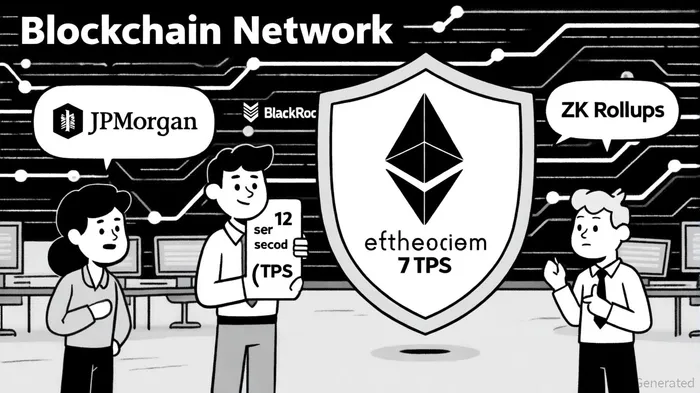
The DeFi ecosystem in 2025 stands at a pivotal inflection point, where technological innovation and institutional pragmatism collide. While blockchain scalability solutions like ZK Rollups have resolved throughput bottlenecks, the true catalyst for institutional adoption lies in real-time verification—a framework that transforms DeFi from a speculative playground into a trustless, auditable financial infrastructure. This analysis unpacks how real-time verification, paired with scalable Layer 2 solutions, is dismantling institutional barriers and reshaping the future of decentralized finance.
Scalability: The Foundation, Not the Finish Line
Blockchain scalability has long been a thorny problem, but 2025 marks a breakthrough. ZK Rollups, such as ZKsyncZK-- and zkEVM, now process up to 71 swap transactions per second, dwarfing Ethereum's native 12 TPS while slashing gas costs by 90% [3]. These Layer 2 solutions preserve Ethereum's security and decentralization by batching transactions off-chain and submitting cryptographic proofs on-chain. For institutions, this means DeFi can finally match the speed and cost-efficiency of traditional finance (TradFi) systems.
However, scalability alone is insufficient. As Vitalik Buterin and Annabelle Huang have emphasized, instant settlement and cryptographic assurance are non-negotiable for institutional trust [4]. Without real-time verification, DeFi remains vulnerable to the same opacity that doomed FTX and Genesis—platforms where static audits and opaque claims led to $40 billion in losses [2].
Real-Time Verification: The Trust Layer for Institutions
Real-time verification is the linchpin of institutional adoption. It enables on-chain transparency without compromising privacy, using zero-knowledge proofs (ZKPs) and AI-assisted formal verification to validate transactions, solvency, and compliance in real time.
- Smart Contract Assurance: Platforms like CertiK Apollo and VerifAI leverage neural-symbolic reasoning to detect reentrancy attacks and other vulnerabilities before deployment [1]. These tools mathematically prove smart contract correctness, reducing exploit risks by 80% in pilot projects [1].
- Privacy-Preserving Compliance: Projects like Accountable use zkTLS to allow institutions to verify asset-liability positions without exposing sensitive data [2]. This is critical for tokenized securities and real-world asset (RWA) markets, where privacy and regulatory compliance are paramount.
- Institutional-Grade Oracles: The XRPXRP-- Ledger's protocol-native oracles provide real-time price feeds for tokenized assets, ensuring RWAs remain pegged to their real-world counterparts [5]. This eliminates the volatility risks that deterred early institutional participation.
Institutional Adoption: From Pilots to Mainstream
While infrastructure is maturing, capital flows remain cautious. JPMorganJPM--, BlackRockBLK--, and DBS Bank are already leveraging DeFi rails for treasury operations, but meaningful allocations hinge on regulatory clarity [2]. The US Treasury's GENIUS Act of 2025 is a game-changer, mandating the integration of digital identity checks into DeFi smart contracts via biometrics and portable credentials [5]. This embeds KYC/AML safeguards directly into protocols, reducing compliance costs by 40% for institutions [5].
Notable use cases include:
- Aave Arc: A permissioned lending pool offering institutional-grade collateral management with real-time solvency checks [2].
- Ondo Finance: Tokenizing U.S. Treasury bills and commercial real estate with ZK-based verification to meet SEC standards [2].
- JPMorgan's Onyx: Utilizing ZK Rollups for cross-border settlements, achieving sub-second finality while slashing fees [2].
The Road Ahead: Challenges and Opportunities
Despite progress, hurdles persist. Regulatory frameworks lag behind innovation, and interoperability between ZK ecosystems remains fragmented. However, the $12 billion DeFi 2.0 funding boom in 2025—driven by tokenized RWAs and cross-chain bridges—signals growing confidence [6]. Investors should prioritize projects that:
1. Combine ZK Scalability with Real-Time Verification (e.g., zkEVM-based platforms).
2. Partner with Regulators (e.g., GENIUS Act-compliant protocols).
3. Anchor to Real-World Assets (e.g., Ondo Finance's U.S. Treasury tokenization).
Conclusion
Blockchain scalability has unlocked DeFi's potential, but real-time verification is the trust mechanism that will cement its role in institutional finance. As ZK Rollups and AI-assisted verification tools mature, DeFi is transitioning from a niche experiment to a core infrastructure layer for global capital markets. For investors, the next 12–18 months will be defined by projects that bridge the gap between scalability, compliance, and institutional-grade security—offering a rare opportunity to bet on the future of finance.






Comentarios
Aún no hay comentarios