
Blockchain's Role in Revolutionizing Institutional Debt Markets: JPMorgan and State Street's On-Chain Debt Issuance as a Catalyst for Real-World Asset Tokenization and Market Efficiency
The institutional debt market, long characterized by opaque processes, delayed settlements, and high operational costs, is undergoing a seismic shift driven by blockchain technology. At the forefront of this transformation are JPMorganJPM-- and State StreetSTT--, whose collaboration on blockchain-based debt issuance is redefining the landscape of real-world asset (RWA) tokenization and market efficiency. By leveraging JPMorgan's Digital Debt Service platform, these institutions are not only streamlining traditional workflows but also unlocking new paradigms of liquidity, transparency, and accessibility.
A New Era of Debt Issuance: JPMorgan and State Street's Strategic Collaboration
JPMorgan's Digital Debt Service, a blockchain-powered platform, has emerged as a cornerstone for institutional-grade tokenized debt issuance. State Street, the first third-party custodian to integrate with the platform, now offers custody services for tokenized debt securities, enabling institutional clients to manage the entire lifecycle of blockchain-based instruments. This partnership is exemplified by the $100 million commercial paper issuance by Oversea-Chinese Banking Corporation (OCBC) in August 2025, where State Street Investment Management acted as the anchor investor. The transaction, settled in under a minute via on-chain processing, underscores the platform's ability to modernize short-term debt markets.
The integration of blockchain into debt issuance addresses critical pain points in traditional systems. For instance, smart contracts automate corporate actions such as interest payments and redemptions, reducing manual intervention and counterparty risk. Additionally, the platform supports delivery-versus-payment (DvP) settlements, including T+0 options, which eliminate the multi-day delays inherent in conventional markets. These advancements are not merely incremental but represent a fundamental reimagining of capital market infrastructure.
Case Study: OCBC's Tokenized Commercial Paper and Efficiency Gains
OCBC's blockchain-powered $1 billion U.S. commercial paper (USCP) program, facilitated by JPMorgan's Digital Debt Service, serves as a landmark case study in market efficiency. By tokenizing its USCP, OCBC achieved near-instantaneous settlement, with funds received within minutes of transaction completion. This contrasts sharply with traditional USCP markets, where settlements can take up to two days. The program also reduced reliance on intermediaries and legacy systems, streamlining operations while maintaining top-tier credit ratings (P-1 from Moody's and F1+ from Fitch).
According to State Street's 2025 Digital Assets Outlook, nearly half of institutional investors anticipate cost savings exceeding 40% through blockchain adoption, driven by increased transparency and reduced administrative overhead. For OCBC, the tokenized USCP program complements its existing $25 billion conventional USCP offering, providing a scalable, resilient alternative in a volatile macroeconomic environment.
Real-World Asset Tokenization: Unlocking Liquidity and Institutional Adoption
The broader implications of JPMorgan and State Street's initiatives lie in the tokenization of real-world assets. By digitizing debt instruments, institutions can fractionalize ownership, enabling broader participation in markets traditionally reserved for large players. This democratization of access is particularly impactful in illiquid asset classes, where tokenization can enhance liquidity and price discovery.
Institutional adoption is accelerating: over half of institutional investors now expect 10–24% of their investments to be tokenized by 2030. This shift is driven by the tangible benefits of blockchain, including 24/7 market access, programmable smart contracts, and immutableIMX-- record-keeping. 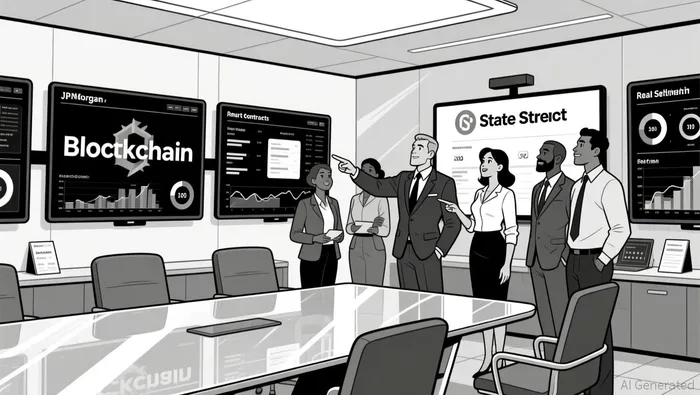 For example, the OCBC program's on-chain lifecycle management-from issuance to servicing-demonstrates how tokenization can reduce operational complexity while enhancing trust.
The Path Forward: A Convergence of Traditional and Decentralized Finance
JPMorgan and State Street's initiatives signal a broader convergence of traditional finance and decentralized technologies. As blockchain infrastructure matures, the barriers to institutional adoption-such as regulatory uncertainty and interoperability challenges-are being addressed through partnerships with trusted custodians and credit rating agencies. The success of the OCBC program, in particular, highlights the viability of tokenized debt as a mainstream financial instrument, paving the way for similar applications in corporate bonds, real estate, and infrastructure.
For investors, the implications are clear: blockchain is not a speculative experiment but a proven catalyst for efficiency and innovation. As more institutions embrace tokenization, the debt markets will likely see a paradigm shift toward faster, cheaper, and more inclusive systems. The collaboration between JPMorgan and State Street is not just a case study-it is a blueprint for the future of capital markets.







Comentarios
Aún no hay comentarios