
Blockchain Resilience and Governance: Lessons from Polygon's Hard Fork and Its Impact on Investor Confidence
Blockchain networks thrive on two pillars: technical resilience and robust governance. When critical bugs strike, the ability of a protocol to respond swiftly and transparently can determine not only its operational continuity but also its long-term value proposition. The recent Polygon hard fork incident in 2024 offers a compelling case study in how blockchain ecosystems navigate crises, restore trust, and influence investor sentiment.
The Polygon Hard Fork: A Test of Resilience
In late 2024, Polygon's proof-of-stake (PoS) chain faced a critical finality bug that caused transaction delays of 10–15 minutes, disrupting checkpoint confirmations and validator synchronization [1]. The issue stemmed from a misconfiguration in the consensus mechanism's finality logic, triggered by a faulty milestone proposal. Polygon's governance team executed a hard fork within hours, upgrading Bor (block production layer) to v2.2.11-beta2 and Heimdall (consensus layer) to v0.3.1 [2]. This rapid response restored normal transaction processing and checkpoint finalization, showcasing the network's capacity for agile problem-solving.
The incident highlighted the fragility of even well-established blockchain systems. As Polygon CEO Sandeep Nailwal noted, such “growing pains” are inevitable during protocol evolution but underscore the importance of maintaining robust contingency plans [1]. The successful hard fork demonstrated Polygon's commitment to prioritizing finality—a cornerstone of blockchain security—and its ability to execute upgrades without prolonged downtime.
Governance as a Confidence Builder
Polygon's governance response was pivotal in mitigating investor anxiety. Transparent communication from the Polygon Foundation, including real-time updates on the fork's progress, reassured stakeholders that the issue was being addressed proactively [2]. This openness contrasted with past incidents where opaque governance processes eroded trust in other blockchain projects.
The hard fork also aligned with Polygon's broader roadmap, including the earlier Heimdall v2 upgrade in July 2024, which modernized the network's architecture to enhance throughput and resilience [3]. By framing the 2024 fork as part of a continuous improvement cycle, Polygon reinforced its narrative of iterative innovation. Such governance transparency is critical in an industry where technical complexity often breeds uncertainty.
Market Reactions: Short-Term Volatility, Long-Term Optimism
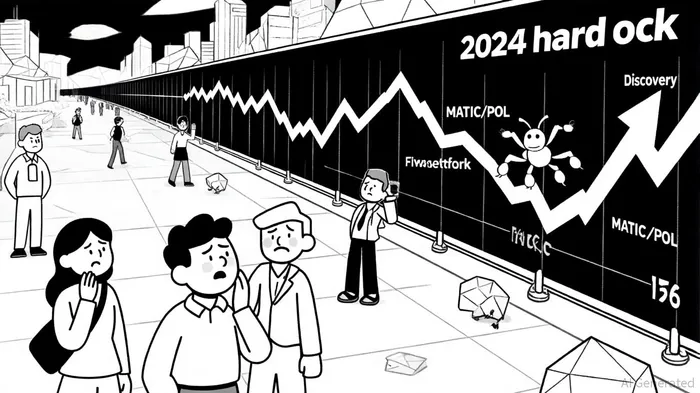
The MATIC token experienced mixed price movements during the incident. While the broader market correction led to a 1.31% decline in MATIC's price, the token outperformed many altcoins in the Smart Contract Platforms category, rising 12% over a month [4]. Analysts attributed this resilience to Polygon's proactive governance and the anticipation of future upgrades like the Katana chain and zkEVM deployment [4].
However, the transition from MATIC to Polygon's new native token, POL, introduced short-term volatility. POL's price dropped 4% during the finality delays but later stabilized as confidence in the network's recovery grew [5]. This duality—short-term jitters versus long-term optimism—reflects the dual nature of investor sentiment in blockchain ecosystems.
The Road Ahead: Governance as a Value Driver
Polygon's experience underscores a key investment thesis: blockchain networks that prioritize resilience and transparent governance are better positioned to retain and grow investor confidence. The Heimdall v2 upgrade, for instance, not only addressed the 2024 bug but also laid the groundwork for GigaGas-level performance, a critical factor for scaling decentralized finance (DeFi) and enterprise use cases [1].
For investors, the lesson is clear: token value is inextricably linked to the underlying network's ability to adapt. As Polygon's roadmap unfolds, with milestones like POL's full integration and zkEVM adoption, the interplay between technical execution and governance will remain central to its valuation.
Conclusion
Blockchain networks are only as strong as their ability to withstand and learn from crises. Polygon's 2024 hard fork exemplifies how swift governance action, transparent communication, and a focus on long-term upgrades can turn a technical setback into a confidence-building exercise. For investors, this incident reaffirms that resilience and governance are not just operational metrics—they are value drivers in the volatile world of crypto.






Comentarios
Aún no hay comentarios