
Blockchain Policy Evolution in 2025: Regulatory Momentum and Institutional Adoption Reshape Crypto Markets
Regulatory Clarity as a Catalyst for Institutional Adoption
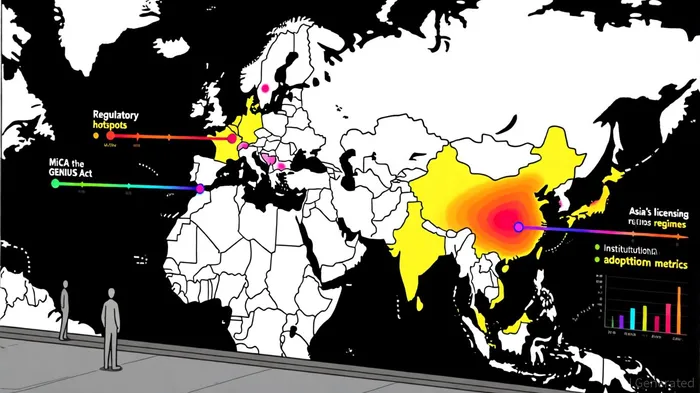
The European Union's Markets in Crypto-Assets (MiCA) regulation, fully effective since January 2025, has become a cornerstone of institutional confidence. By harmonizing rules across 27 member states and distinguishing between E-Money Tokens (EMTs) and Asset-Referenced Tokens (ARTs), MiCA has reduced jurisdictional arbitrage while fostering an 18% year-on-year increase in euro-denominated stablecoin usage, according to a PwC report. Complementing this, the Digital Operational Resilience Act (DORA) has elevated cybersecurity standards, ensuring institutional-grade safeguards for digital asset custodians, as noted in a Bolder Group snapshot.
In the U.S., the Trump administration's pro-crypto agenda has accelerated adoption through the GENIUS Act, which mandates 1:1 asset backing for stablecoins and clarifies their legal status, according to a Crypto.com guide. This federal framework, coupled with the SEC's pivot toward innovation-friendly oversight, has spurred a 400% surge in institutional investment flows since early 2024, per a PowerDrill analysis. BlackRock's BitcoinBTC-- ETF (IBIT), for instance, now manages $50 billion in assets under management (AUM), capturing nearly half of the market share, according to a RiskWhale analysis.
Asia's financial hubs, particularly Hong Kong and Singapore, have mirrored this momentum. By implementing crypto exchange licensing regimes and stablecoin frameworks, these jurisdictions have attracted over $12 billion in institutional capital in 2025 alone, according to a Thomas Murray report.
Market Infrastructure and Case Studies
The tokenization of real-world assets (RWAs) has emerged as a critical driver of institutional adoption. MicroStrategy's $2.5 billion Bitcoin allocation in 2024, for example, has inspired a wave of corporate treasury strategies, with firms like Windtree Therapeutics and Sharps Technology diversifying into BNBBNB-- and SolanaSOL--, according to the PowerDrill analysis. Meanwhile, the approval of EthereumETH-- and altcoin ETFs has expanded institutional portfolios beyond Bitcoin, with Grayscale's Ethereum Trust (ETHE) seeing a 220% inflow in Q3 2025, as noted in the Thomas Murray report.
Challenges and Cross-Border Dynamics
Despite this progress, regulatory fragmentation persists. The U.S. and EU, while aligned on stablecoin oversight, differ in approaches to DeFi and staking products, complicating cross-border operations for firms like CoinbaseCOIN-- and Binance, as highlighted in the RiskWhale analysis. Additionally, market volatility remains a concern: BlackRock's IBIT recently experienced a $333 million outflow following a sharp Bitcoin price correction, according to the PowerDrill analysis.
Future Outlook
As 2025 progresses, the focus will shift to harmonizing global standards. The EU's transitional period for MiCA compliance until mid-2026 offers a window for firms to adapt, while the U.S. may leverage its GENIUS Act to solidify its leadership in stablecoin innovation. Emerging markets, including the UAE and South Africa, are also positioning themselves as regulatory sandboxes, with Dubai's Virtual Assets Regulatory Authority (VARA) attracting $3.2 billion in institutional capital in 2025, per the Thomas Murray report.
For investors, the key takeaway is clear: regulatory clarity is no longer a barrier but a multiplier. As institutional-grade infrastructure-blockchain analytics, custody solutions, and interoperable platforms-matures, digital assets are poised to become a core component of diversified portfolios.





Comentarios
Aún no hay comentarios