
Blockchain as a National Security Infrastructure in the AI-Driven Era
The intersection of artificial intelligence (AI) and quantum computing is reshaping the global cybersecurity landscape, creating both unprecedented risks and transformative opportunities. As these technologies mature, they are accelerating institutional adoption of tamper-proof, decentralized systems-particularly blockchain and zero-knowledge proofs (ZKPs)-to safeguard national security infrastructure. For investors, this convergence represents a critical inflection point: early strategic investment in foundational blockchain infrastructure and quantum-resistant solutions could yield outsized returns amid a rapidly evolving regulatory and technological environment.
The Quantum Threat and the Blockchain Imperative
Quantum computing poses an existential risk to traditional cryptographic systems, including those underpinning blockchain networks. Public-key cryptography, which secures systems like BitcoinBTC-- and EthereumETH--, is vulnerable to quantum decryption, a threat that has spurred urgent development of post-quantum cryptography (PQC) standards. The U.S. National Security Agency (NSA) has explicitly endorsed PQC over quantum key distribution (QKD) due to the latter's high infrastructure costs and integration challenges according to NSA reports. Meanwhile, enterprises like IBMIBM-- and cloud providers such as AWS are already integrating PQC into their offerings, signaling a shift toward quantum-safe infrastructure as demonstrated by industry leaders.
Blockchain's decentralized architecture inherently resists tampering, making it a natural candidate for national security applications. However, its cryptographic foundations must evolve to withstand quantum threats. This has led to the rise of quantum-resistant consensus algorithms and ZKPs, which enable privacy-preserving validation without relying on quantum-vulnerable methods according to recent research. For example, zk-STARKs-a quantum-resistant variant of ZKPs-are being adopted to secure blockchain transactions while maintaining scalability as highlighted in case studies.
AI-Driven Cyber Threats and the Rise of Zero-Knowledge Proofs
AI is amplifying cyber threats through sophisticated attacks like deepfake phishing and AI-powered ransomware, but it is also enhancing defensive capabilities. AI-driven security operations centers (SOCs) have reduced incident response times by 40%, demonstrating the technology's dual role in threat mitigation. In parallel, ZKPs are emerging as a critical tool for privacy-preserving AI applications. A 2025 study highlights how ZKPs can verify decentralized machine learning (DML) computations without exposing sensitive data, a use case with direct relevance to national security applications such as AI-assisted healthcare diagnostics and fraud detection.
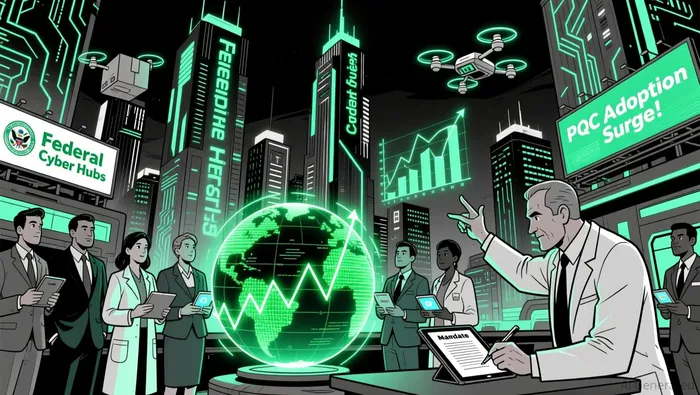
The integration of ZKPs into consensus algorithms like Raft further underscores their versatility in protecting distributed systems as shown in technical analyses. As governments and enterprises prioritize data privacy and compliance, ZKP-based solutions are gaining traction in sectors ranging from finance to critical infrastructure.
Regulatory Shifts and Geopolitical Dynamics
Global regulatory frameworks are rapidly adapting to quantum and AI-driven threats. The U.S. National Institute of Standards and Technology (NIST) is spearheading the standardization of quantum-resistant algorithms, with a 2025 deadline for ZKP standardization according to industry forecasts. Meanwhile, geopolitical tensions are driving divergent approaches to PQC. China's Institute of Commercial Cryptography Standards (ICCS) and Russia's national working groups are developing indigenous quantum-resistant standards, reflecting a broader trend of cryptographic sovereignty as reported by experts.
The U.S. has emphasized international collaboration through its 2023 International Cyberspace & Digital Policy Strategy, advocating for open, secure digital ecosystems according to official documents. However, the lack of uniform global adoption of PQC standards creates both risks and opportunities for investors. Startups like QuSecure and Project Eleven, which focus on quantum-resistant solutions, are attracting significant funding as nations race to future-proof their infrastructure as noted in industry reports.
Market Growth and Investment Opportunities
The market for quantum-resistant and ZKP-based blockchain infrastructure is experiencing exponential growth. The global PQC market is projected to expand from $357.6 billion in 2024 to $9,980.2 billion by 2034, driven by federal cybersecurity mandates and enterprise adoption according to market analysis. Similarly, the ZKP-based blockchain infrastructure market is expected to grow at a 22.1% CAGR, reaching $7.59 billion by 2033 according to industry projections.
Investment in quantum-resistant blockchain startups has surged, with companies like QANplatform and Sitehop securing tens of millions in funding to develop secure, scalable solutions as reported by financial sources. The Total Value Locked (TVL) in ZK-based rollups has already surpassed $28 billion, signaling strong institutional confidence according to blockchain analytics. For investors, early-stage participation in these projects offers exposure to a market poised for decades of growth.
Strategic Considerations for Investors
- Regulatory Alignment: Prioritize investments in projects aligned with emerging PQC and ZKP standards, particularly those supported by NIST or the NSA.
- Geopolitical Diversification: Consider the geopolitical implications of PQC adoption, as nations like China and Russia develop independent standards.
- Scalability and Utility: Focus on solutions with clear enterprise use cases, such as ZKP-enabled AI verification or quantum-resistant smart contracts.
- Infrastructure Resilience: Target projects addressing computational overhead and hardware limitations, which remain barriers to widespread ZKP adoption as highlighted in technical assessments.
Conclusion
The convergence of AI and quantum computing is not merely a technological shift-it is a redefinition of national security infrastructure. Blockchain and ZKP solutions are emerging as foundational tools to counter these threats, supported by rapid regulatory evolution and explosive market growth. For investors, the window to capitalize on this transformation is narrowing. Strategic investment in quantum-resistant and privacy-preserving blockchain infrastructure today could position portfolios to reap outsized returns as global institutions race to secure their digital future.







Comentarios
Aún no hay comentarios