
Blockchain Innovation 2025: How BlockDAG Challenges Legacy Giants Like Ethereum and Uniswap
Ethereum's Pectra Upgrade: Incremental Progress Amid Stagnant Growth
Ethereum's May 2025 Pectra upgrade marked a pivotal step in its roadmap, introducing 11 Ethereum Improvement Proposals (EIPs) to enhance scalability and staking efficiency. Key changes include EIP-7251, which increased the maximum validator balance from 32 ETH to 2,048 ETH, as detailed in a CoinMetrics analysis, and EIP-7594, which boosted blob throughput to support Layer-2 (L2) solutions, according to a Benzinga report. These upgrades reduced L2 transaction costs by 90%, a point highlighted in a CoinEdition analysis, yet Ethereum's market capitalization remains stagnant at $222 billion, with a 0.5% price decline since March 2025, as noted in Crypto-Reporter coverage (https://www.crypto-reporter.com/news/blockdag-beta-testnet-sets-15k-tps-benchmark-while-ethereum-price-drops-0-5-and-etc-slides-6-7-94165/).
While Ethereum's economic model shifted from deflationary to inflationary post-Pectra, as discussed in a TechBullion analysis, its dominance in DeFi and real-world asset (RWA) tokenization persists. However, scalability challenges linger: even with L2 solutions like OptimismOP-- and ArbitrumARB--, Ethereum processes only 30–40 transactions per second (TPS), far below BlockDAG's 15,000 TPS benchmark noted in industry coverage and summarized in an OKX article. This throughput gap raises questions about Ethereum's ability to compete with newer protocols in high-volume use cases.
Uniswap's Q4 2025 Surge: DeFi's Resilient Powerhouse
Uniswap (UNI) has redefined decentralized exchange (DEX) dynamics in 2025. As of October 2025, its Total Value Locked (TVL) stands at $4.5 billion, with v4 surpassing $1 billion in TVL in just 177 days-outpacing v3's growth rate, per CoinLaw stats. The protocol's Layer-2 adoption is equally impressive: 72% of TVL and 67.5% of daily volume now reside on L2 chains like Base, as documented in a TokenCurrents report.
UNI's price surged 80.44% in a 30-day period, reaching an all-time high of $44.92 before correcting to $9.93, according to a BeInCrypto report. This volatility reflects both institutional interest and the token's role in governance. A recent proposal to redistribute fees to UNIUNI-- holders gained widespread support, signaling a shift toward community-driven value capture, as noted in a Changelly overview. However, Uniswap's reliance on Ethereum's infrastructure exposes it to network congestion and gas fee fluctuations-a vulnerability BlockDAG aims to exploit.
BlockDAG's Rise: A Scalability-Driven Disruptor
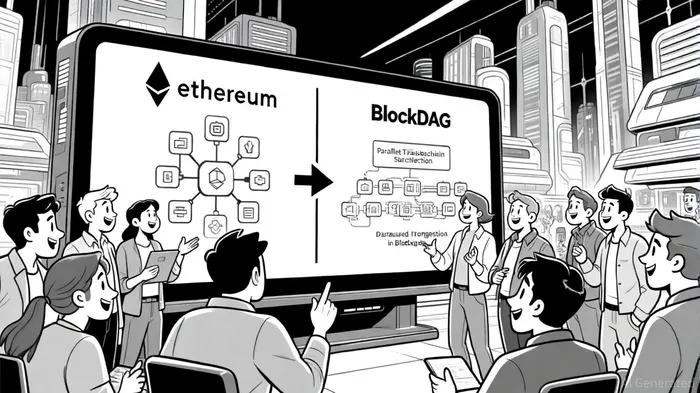
BlockDAG's hybrid DAG + Proof-of-Work (PoW) architecture has positioned it as a scalability champion. By August 2025, the protocol's Beta Testnet achieved 15,000 TPS, with 200 nodes activated and 100 wallets onboarded, according to Crypto-Reporter coverage (https://www.crypto-reporter.com/news/blockdag-beta-testnet-sets-15k-tps-benchmark-while-ethereum-price-drops-0-5-and-etc-slides-6-7-94165/). Its EVM compatibility has attracted 300+ dApps and 4,500 developers, enabling seamless migration from Ethereum, as detailed in a Bitget report.
Financially, BlockDAG's presale raised $415 million by October 2025, with a 2,660% ROI for early investors, according to Blockonomi coverage. Despite mainnet delays-pushed to late September or October 2025-the project secured 20 exchange listings, including MEXC and BitMart, ensuring liquidity from launch, per the BlockNavi timeline. Critics question its execution risks, but the protocol's strategic partnerships (e.g., BWT Alpine Formula 1 Team) and robust mining ecosystem (20,000+ ASIC miners) underscore its real-world traction, as covered in a Crypto-Reporter piece (https://www.crypto-reporter.com/news/blockdag-ethereum-dogecoin-the-race-for-the-best-crypto-for-2025-113129/).
Market Dynamics: Legacy vs. Innovation
The clash between legacy projects and BlockDAG is not just technical but economic. Ethereum's institutional appeal-$17.6 billion locked in treasuries-is reported in a CoinLineup article, contrasting with BlockDAG's retail-driven presale frenzy. Meanwhile, Uniswap's TVL growth (up 40.2% in Q3 2025) is documented in the CoinGecko report, demonstrating DeFi's resilience, but its reliance on Ethereum's L2s leaves it vulnerable to Layer-1 bottlenecks.
BlockDAG's ROI metrics are equally compelling. With a projected 2,660% return by 2027, per a CryptoDaily analysis, it outpaces Ethereum's 68.5% Q3 2025 gain noted in a KanalCoin analysis. However, its mainnet delays and unproven DAG-PoW hybrid model introduce execution risk-a factor investors must weigh against its scalability advantages.
Conclusion: Navigating the 2025 Blockchain Showdown
The blockchain space in 2025 is a battleground of innovation and legacy. Ethereum's Pectra upgrade and Uniswap's DeFi dominance reflect the strength of established ecosystems, but BlockDAG's scalability and ROI metrics signal a paradigm shift. For investors, the key lies in balancing Ethereum's institutional credibility with BlockDAG's disruptive potential-and Uniswap's liquidity-driven growth.
As the crypto market approaches $4.0 trillion in capitalization, noted in a Coindoo roundup, the winners will be those who adapt to throughput demands and user experience. BlockDAG's 15,000 TPS and EVM compatibility position it to capture market share, but Ethereum's first-mover advantage and Uniswap's governance innovation cannot be ignored. The next 12 months will determine whether legacy projects can evolve or if DAG-based protocols will redefine the blockchain landscape.






Comentarios
Aún no hay comentarios