
Blockchain Infrastructure Innovation: How the Monad Foundation is Shaping the Future of DeFi and Enterprise Adoption
The blockchain industry in 2025 is witnessing a paradigm shift in infrastructure innovation, driven by platforms that address the scalability and cost challenges stifling mass adoption. At the forefront of this movement is the Monad Foundation, a project that has redefined the boundaries of Layer-1 (L1) blockchain performance while fostering a vibrant ecosystem for decentralized finance (DeFi) and enterprise use cases. With a $225 million Series A funding round and a testnet capable of processing 10,000 transactions per second (TPS), Monad is positioning itself as a critical player in the next phase of blockchain evolution, according to a Cicada Ventures report.
Enterprise Adoption: A New Era of Scalability
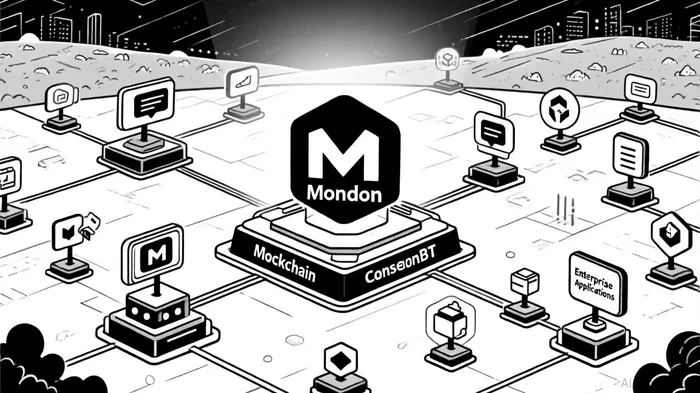
Monad's appeal to enterprises lies in its ability to combine EVM compatibility with unprecedented throughput. Traditional Ethereum-based networks struggle with scalability, but Monad's four core innovations-parallel execution, asynchronous execution, MonadBFT consensus, and MonadDB-enable sub-second finality and 10,000 TPS without compromising security, according to a BeinCrypto article. This performance is particularly attractive for institutions seeking to deploy stablecoin payment rails and high-frequency financial applications.
A pivotal development in 2025 was the acquisition of Portal Labs, a fintech firm specializing in stablecoin infrastructure. By integrating Portal's expertise, the Monad Foundation has accelerated the adoption of stablecoin payments for businesses and financial institutions, following a Blockhead report. Raj Parekh, Portal's CEO, now leads these initiatives, signaling a strategic focus on bridging blockchain with traditional finance. According to CoinDesk, enterprises are increasingly viewing Monad as a superior alternative to existing solutions, particularly for use cases requiring low-cost, high-speed transactions.
DeFi Ecosystem: Innovation at Scale
The DeFi landscape on Monad has flourished, with over 210 projects building on its platform in 2025, according to a CoinDesk article. These include:
- aPriori, a liquid staking protocol that merges staking rewards with MEV (maximal extractable value) strategies.
- Bean Exchange, a decentralized exchange (DEX) offering gamified perpetual and spot trading.
- Demask Finance, an NFT automated market makerMKR-- (AMM) streamlining token and NFT trading.
- Mace, a DEX aggregator enhancing price efficiency through cross-chain liquidity aggregation.
These projects leverage Monad's low gas fees and parallel execution to deliver user experiences that rival centralized platforms. The public testnet, launched in February 2025, has already processed 2 billion transactions, demonstrating the network's real-world viability, the CoinDesk article reports. Furthermore, initiatives like the $1 million "Monad Madness" competition and $30 million in ecosystem funding have incentivized developers to build on the platform.
Technical Foundations: Solving the Scalability Trilemma
Monad's technical architecture is a key differentiator. Unlike traditional blockchains that prioritize security and decentralization at the expense of scalability, Monad achieves all three through:
1. Parallel Execution: Processes multiple transactions simultaneously, reducing congestion.
2. Asynchronous Execution: Decouples consensus from execution, optimizing throughput.
3. MonadBFT: A consensus mechanism that finalizes blocks in one second, outperforming Ethereum's 12–14 seconds.
4. MonadDB: A state storage engine optimized for parallelism, enabling efficient data retrieval.
These innovations have attracted attention from both developers and institutional investors. The BeinCrypto article noted that Monad's testnet demonstrated 334 million RPC requests in 12 hours, validating its capacity to handle enterprise-grade workloads.
Funding and Ecosystem Growth: A $244M Bet on the Future
The Monad Foundation's financial backing underscores its potential. With $244 million in total funding-including a $225 million Series A led by top-tier venture firms-the project has the resources to scale rapidly. This capital has been allocated to:
- Ecosystem grants for developers and startups.
- Airdrop campaigns targeting DeFi and NFT communities to drive user adoption.
- Strategic acquisitions like Portal Labs to expand enterprise reach.
The foundation's commitment to decentralization is also evident. Over 210 projects are already building on Monad, with a focus on DeFi, gaming, and NFTs. This ecosystem growth is further amplified by the MON airdrop, which has incentivized participation from high-profile communities like Hyperliquid and Phantom Wallet.
Future Outlook: Mainnet Launch and Market Positioning
As the blockchain prepares for its mainnet launch in late 2025, the ecosystem is gaining momentum. Developers are positioning Monad as a viable alternative to SolanaSOL-- and EthereumETH-- L1s, citing its EVM compatibility and performance metrics. Meanwhile, institutional players are exploring its potential for stablecoin issuance and cross-border payments, as highlighted in the Cicada report.
A critical milestone will be the October 28 airdrop reveal, which could further catalyze adoption. If the mainnet delivers on its testnet promises, Monad could disrupt the current L1 landscape by offering a scalable, cost-effective infrastructure for both DeFi and enterprise applications.
Conclusion
The Monad Foundation represents a pivotal innovation in blockchain infrastructure, addressing the scalability bottlenecks that have long hindered mass adoption. By combining cutting-edge technology with strategic enterprise partnerships and a thriving DeFi ecosystem, it is well-positioned to become a cornerstone of the next-generation blockchain economy. For investors, the project's $244 million funding, 10,000 TPS performance, and growing institutional interest make it a compelling case study in infrastructure-driven disruption.






Comentarios
Aún no hay comentarios