
Blockchain-Driven Tokenization of Debt: A New Era for Institutional Capital Markets
Blockchain-driven tokenization of debt is no longer a speculative concept-it's a structural shift reshaping institutional capital markets. In 2025, major financial institutions, regulators, and investors are embracing blockchain to tokenize debt instruments, real-world assets (RWAs), and even U.S. treasuries. This transition is driven by a confluence of technological innovation, regulatory clarity, and the urgent need for efficiency in a post-pandemic, post-interest-rate-hike world.
Strategic Adoption: From Experimentation to Institutional Mainstream
The strategic adoption of blockchain in debt markets is accelerating, with J.P. Morgan leading the charge. In a landmark transaction, the bankBANK-- issued a $50 million commercial paper on the SolanaSOL-- blockchain for Galaxy Digital Holdings, with Coinbase GlobalCOIN-- and Franklin Templeton as purchasers. This move underscores blockchain's ability to streamline complex debt issuance, reduce settlement times from days to minutes, and ensure compliance in a fragmented regulatory landscape.
Tokenized U.S. treasuries have further cemented blockchain's role in institutional finance. As of October 2025, tokenized RWA value has surged to $33 billion, with these instruments offering real-time settlement, lower transaction costs, and global liquidity. BlackRock's USD Institutional Digital Liquidity Fund, launched in 2024, attracted over $500 million in assets under management within months, proving that institutional investors are not just watching the space-they're betting on it.
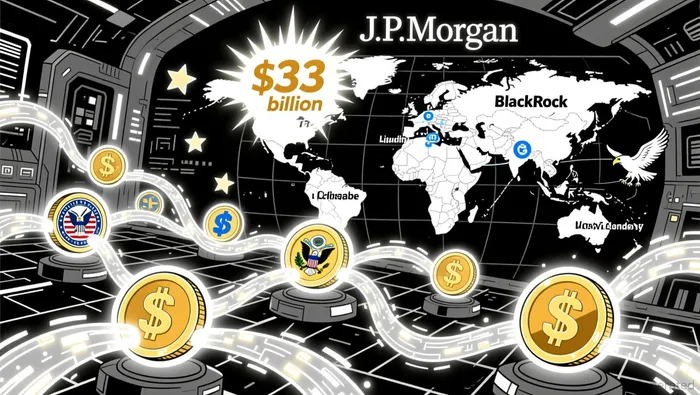
Regulatory tailwinds are amplifying this momentum. In North America, the SEC, OCC, and CFTC have shifted from restrictive guidance to creating clearer frameworks for digital assets. This shift has enabled institutions to navigate compliance risks while exploring tokenized products, from money market funds to bitcoinBTC-- ETFs.
Scalability Challenges: Public vs. Private Chains and Interoperability
Despite rapid adoption, scalability remains a critical hurdle. Institutions face a key choice: public blockchains like EthereumETH--, which offer composability and transparency but struggle with throughput and privacy, or permissioned chains like JPMorgan's Quorum and Société Générale's FORGE, which prioritize compliance and controlled access. The hybrid model-leveraging public chains for liquidity and private chains for regulatory compliance-is emerging as a pragmatic solution.
Interoperability is another thorn in the side of tokenization. Fragmented platforms hinder seamless value transfer, and price divergences in stablecoins like USDCUSDC-- and USDTUSDT-- across blockchains reveal the fragility of current systems. To address this, partnerships like Ownera and the Hedera Foundation are building protocols to connect institutional-grade tokenized asset platforms. Similarly, DTCC is integrating tokenization with traditional infrastructure to ensure compatibility with existing collateral and margin processes.
High implementation costs and legal uncertainties also linger. For instance, frameworks for token transfers and security interests remain inconsistent globally. However, initiatives like the EU's MiCA and the UK's Digital Securities Sandbox are laying the groundwork for standardized, cross-border tokenized asset ecosystems.
Solutions: Custody, Standards, and the Role of Regulated Infrastructure
Operational risks-smart contract bugs, custodial gaps, and interoperability issues-are being mitigated by regulated custodians like Anchorage. These firms provide auditable custody solutions, ensuring institutional-grade security for tokenized assets.
Standardization is equally critical. A 2025 report by Fireblocks, Centrifuge, and BlockTower Credit emphasizes the need for common data formats, custody protocols, and value chains for credit assets. Without such standards, tokenization will remain siloed, limiting its potential to transform capital markets.
The Future: A Structural Transformation of Finance
Blockchain-driven debt tokenization is not just a technological upgrade-it's a structural reimagining of financial systems. By enabling real-time settlement, fractional ownership, and global accessibility, tokenization is unlocking liquidity in previously illiquid markets, from real estate to private credit. Santander's $20 million blockchain-issued bond and New York's tokenized hotel project exemplify how this technology is democratizing access to institutional-grade investments.
For investors, the implications are clear: blockchain is becoming a foundational layer of capital markets. Early adopters-banks, asset managers, and tech platforms-are positioning themselves to capture value in a system where speed, transparency, and compliance are non-negotiable.
Conclusion
The tokenization of debt marks a pivotal moment in institutional finance. While challenges like scalability and interoperability persist, the pace of innovation and regulatory alignment suggests these barriers will be overcome. As blockchain transitions from a niche experiment to a core infrastructure component, investors who understand its strategic value will be well-positioned to capitalize on the next era of capital markets.





Comentarios
Aún no hay comentarios