
Blockchain-Driven Prediction Markets: Redefining Fan Engagement and Sports Betting in the NBA Era
Thompson's Bet on Blockchain: A New Era for Fan Interaction
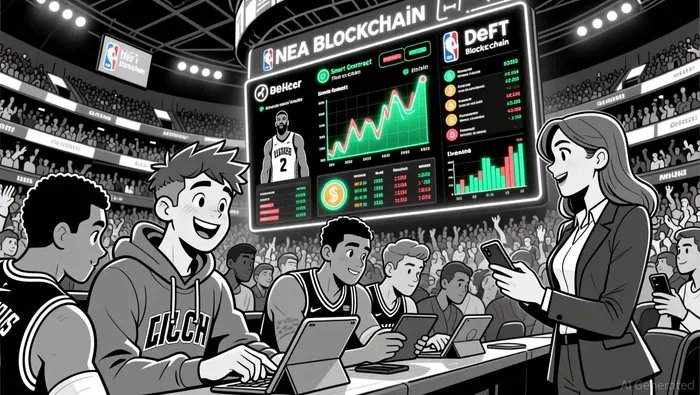
Tristan Thompson's involvement with Basketball.fun-a blockchain-driven platform allowing users to speculate on NBA talent-highlights his belief in the sector's potential to redefine fan interaction. By leveraging blockchain's transparency and real-time data capabilities, Basketball.fun transforms passive viewership into active participation, enabling fans to trade predictions on player performance and team dynamics according to Forbes. Thompson envisions a future where prediction markets become as ubiquitous in sports broadcasts as traditional odds, potentially boosting viewership and monetizing fan enthusiasm according to Decrypt.
His optimism extends beyond sports. Thompson has publicly predicted BitcoinBTC-- could reach $150,000 by 2025, citing growing institutional adoption and macroeconomic tailwinds according to Bitget. While his crypto forecast is speculative, it underscores a broader trend: athletes and entertainers are increasingly aligning with blockchain-driven ventures, recognizing their disruptive potential in both finance and culture.
Growth Drivers: Partnerships and Innovation Beyond Fan Engagement
The expansion of blockchain prediction markets is being fueled by strategic partnerships with major sports leagues and fintech platforms. The UFC and NHL, for instance, have embraced these tools to enhance fan interaction. UFC parent company TKO Group Holdings partnered with Polymarket to introduce a Fan Prediction Scoreboard during live events, allowing viewers to forecast fight outcomes in real time. This innovation not only deepens engagement but also provides real-time sentiment data for broadcasters and advertisers.
Similarly, PrizePicks-a leader in daily fantasy sports-has integrated prediction markets into its app via Polymarket and Kalshi, broadening its appeal to a new demographic of financially savvy users. PrizePicks launched prediction markets with Kalshi, further demonstrating the sector's mainstream adoption. These partnerships illustrate a shift from speculative tools to mainstream financial products, with platforms leveraging blockchain to offer transparent, tamper-proof contracts.
The NHL's collaboration with Polymarket further demonstrates the sector's maturation. By embedding prediction markets into broadcasts, the league is creating a hybrid model where fans can both watch and wager, blurring the lines between entertainment and investment according to Decrypt. For investors, these developments suggest a growing acceptance of blockchain as a tool for monetizing fan loyalty and data-driven insights.
Regulatory Challenges: A Patchwork of Legal Frameworks
Despite the sector's momentum, regulatory uncertainty remains a critical hurdle. New York's proposed ORACLE Act seeks to prohibit event-based prediction markets for residents, framing them as speculative gambling according to Forbes. This legislation, if passed, could create a fragmented regulatory environment, where platforms operate legally in some states but face restrictions elsewhere.
Federal oversight is equally ambiguous. The Commodity Futures Trading Commission (CFTC) regulates certain event-based derivatives, but its jurisdiction is contested, leading to a legal gray area according to Reuters. Meanwhile, traditional gambling authorities, such as the Nevada Gaming Control Board, have raised concerns that prediction markets could undermine existing betting frameworks according to Forbes.
The tension between innovation and regulation is palpable. Platforms like Kalshi, which operates under a CFTC-issued no-action letter, have achieved a $5 billion valuation by navigating these complexities according to Forbes. However, the entry of major financial firms-DraftKings, Robinhood, and others-into the space could accelerate regulatory clarity, as policymakers seek to balance consumer protection with technological progress according to Forbes.
Investment Case: A High-Growth Sector with Long-Term Potential
For investors, the convergence of blockchain, sports, and finance presents a compelling opportunity. Platforms like Basketball.fun, Polymarket, and Kalshi are not only capitalizing on fan engagement but also pioneering new revenue streams through data analytics and tokenized contracts. Thompson's endorsement, coupled with institutional partnerships, signals a sector poised for exponential growth.
However, success will depend on navigating regulatory challenges and scaling user adoption. As leagues like the NBA, NHL, and UFC continue to integrate prediction markets into their ecosystems, the sector's legitimacy-and profitability-will likely follow.
Conclusion
Blockchain-driven prediction markets are redefining how fans interact with sports, transforming them from passive observers to active participants in a decentralized economy. While regulatory hurdles persist, the sector's growth drivers-led by high-profile endorsements, innovative partnerships, and technological advancements-underscore its long-term potential. For investors willing to navigate the complexities of this emerging market, the rewards could be substantial.





Comentarios
Aún no hay comentarios