
Blockchain-Driven Financial Innovation: Tokenized Pension Receivables in Brazil's Regulatory Sandbox
A Market on the Cusp of Exponential Growth
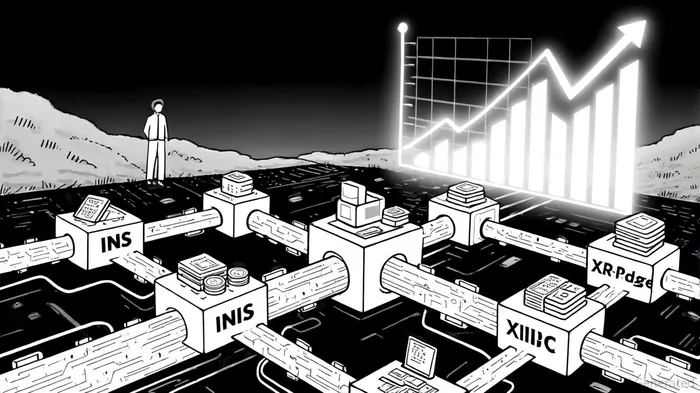
According to a Grand View Research report, the Brazil tokenization market generated $98.5 million in revenue in 2024 and is projected to surge to $392.4 million by 2030, growing at a compound annual growth rate (CAGR) of 21.7%. This trajectory is fueled by the securitization of low-risk assets such as pension receivables, which are now being digitized into tokenized investment vehicles. A landmark example is VERT Capital's recent $40 million tokenization of pension-backed credit on the XRP Ledger, a deal approved by Brazilian regulators and structured as a Fundo de Investimento em Direitos Credenciais (FIDC), according to a U.Today report. FIDCs, which securitize receivables tied to Brazil's federal pension system (INSS), are considered among the lowest-risk asset classes due to their government-backed nature.
Regulatory Sandboxes and Institutional Confidence
Brazil's securities commission (CVM) has played a pivotal role in fostering this innovation through its LEAP program, a regulatory sandbox designed to test blockchain infrastructure in supervised markets. Ripple and VERT Capital's participation in LEAP underscores the alignment between technological experimentation and regulatory oversight. As stated by the companies, the tokenization of pension receivables on the XRP Ledger EVM Sidechain not only ensures compliance but also introduces automation via tools like VERT Sign, a blockchain-based platform that streamlines on-chain documentation and settlement, the U.Today report notes. This innovation reduces transaction times from days to near-instantaneous settlements, a critical advantage for institutional investors seeking liquidity in traditionally rigid markets.
Scalability and the Path to a $190 Million Market
The current $40 million tokenization project by VERT and BYX is just the beginning. With institutional demand showing strong potential, the deal could scale by 500%, reaching up to $190 million in value, the U.Today report suggests. This scalability is underpinned by the XRP Ledger's capacity to handle high-volume transactions at low costs, a feature that traditional financial systems struggle to match. For investors, this represents a dual opportunity: exposure to a high-growth market and the ability to leverage blockchain's inherent transparency and efficiency.
Strategic Implications for Investors
The tokenization of pension receivables in Brazil is not merely a technological experiment-it is a strategic reimagining of capital markets. By converting long-dormant assets into programmable digital tokens, blockchain infrastructure enables new forms of fractional ownership, automated compliance, and cross-border liquidity. For institutional investors, this opens avenues to diversify portfolios with assets that combine low risk (via INSS guarantees) and high innovation potential (via blockchain).
However, challenges remain. While the CVM's LEAP program provides a framework for experimentation, broader adoption will depend on harmonizing regulatory standards across asset classes and jurisdictions. Additionally, market participants must address concerns around cybersecurity and the interoperability of blockchain systems with legacy financial infrastructure.
Conclusion
Brazil's tokenized pension receivables market is a microcosm of the broader shift toward blockchain-driven financial infrastructure. With regulatory support, institutional demand, and technological scalability aligning, the sector is poised to redefine how capital is allocated and managed. For investors, the key takeaway is clear: early engagement with this market offers not just financial returns but a front-row seat to the evolution of a new financial paradigm.






Comentarios
Aún no hay comentarios