
Blockchain-Driven Financial Innovation in Sustainability: The Water150 Paradigm and the Critical Moment for Institutional Investors
The blockchain revolution is no longer confined to speculative hype or niche use cases. In 2025, it has emerged as a cornerstone of institutional-grade ESG (Environmental, Social, and Governance) strategies, with projects like Water150 redefining how capital aligns with planetary imperatives. The recognition of Water150 at JFEX 2025-where it won the Most Innovative Sustainability Initiative award-signals a tectonic shift in how institutions are adopting blockchain to address global challenges. For investors, this moment is not just a milestone; it is a call to action.
Water150: A Case Study in Blockchain-Enabled ESG
Water150, a blockchain-powered initiative by the Longhouse Foundation, has become a flagship example of how decentralized technology can operationalize sustainability. By tokenizing access to a network of 1,000 sustainably managed water wells-starting with its first well in Sätra Brunn, Sweden-the project combines environmental stewardship with financial innovation. Its native W150 token and DROP vouchers (MiCAR-compliant) allow stakeholders to secure long-term water rights, creating a transparent, asset-backed model for hydration security.
At JFEX 2025, Water150's physical and digital presence resonated with institutional audiences. As a sponsoring hydration partner, it distributed premium spring water while demonstrating how blockchain can track water usage, verify sustainability claims, and tokenize resource rights. The award it received at the GFI Awards underscored its role as a bridge between Web3 innovation and traditional finance-a critical step in scaling ESG impact.
Institutional Adoption: From Hype to Infrastructure
The institutional crypto adoption wave of 2025 is no longer speculative. A January 2025 survey by Coinbase and EY-Parthenon revealed that 86% of institutional investors either have existing exposure to digital assets or plan to allocate in 2025, with 59% targeting over 5% of AUM in cryptocurrencies. Regulatory clarity-exemplified by the U.S. GENIUS Act (for stablecoins) and the CLARITY Act (jurisdictional frameworks for crypto)-has been a key catalyst.
Water150's success aligns with this trend. Its partnerships with CEDRA (a blockchain infrastructure provider) and its sponsorship at high-profile events like ETHSofia and JFEX highlight how blockchain is becoming the infrastructure for ESG. By tokenizing water-a critical but often overlooked ESG asset-Water150 demonstrates how institutions can monetize sustainability while ensuring transparency.
Why Now? The Convergence of Market Forces
Three factors make 2025 a critical inflection point for blockchain-driven ESG:
1. Regulatory Legitimacy: Governments are legitimizing digital assets. The U.S. government's exploration of a national digital asset reserve and the EU's MiCAR framework have created a "safe harbor" for institutional participation, as a Q3 2025 recap notes.
2. Market Growth: The Blockchain ESG Solution market is projected to grow from $130 million in 2024 to $323 million by 2031 (CAGR: 12.5%), driven by demand for tamper-proof ESG reporting and carbon credit tokenization.
3. Scalable Use Cases: Projects like Water150 prove blockchain's utility in solving real-world problems. By addressing water scarcity-a $500 billion market by 2030-Water150 taps into a sector where ESG and financial returns are inextricable, consistent with current corporate sustainability priorities.
Investment Implications: Positioning for the Next Decade
For institutional investors, the Water150 model offers a blueprint for future-proofing portfolios. Its tokenized water rights represent a new asset class: planetary infrastructure. Unlike traditional ESG investments, which often rely on opaque reporting, Water150's blockchain-based ecosystem ensures verifiable impact. This aligns with the growing demand for impact-linked tokens, where ownership directly correlates with measurable sustainability outcomes, a trend highlighted by ESG assurance analysis.
Moreover, Water150's post-JFEX 2025 momentum-bolstered by partnerships with financial and innovation hubs-signals institutional validation. As noted by Kim Schneider of Deloitte, blockchain's role in combating greenwashing and ensuring traceability is no longer theoretical but operational.
Conclusion: The New Gold Standard
Water150's JFEX 2025 award is not an isolated event-it is a harbinger of a broader shift. As institutions increasingly prioritize ESG metrics and blockchain provides the infrastructure to verify them, projects that combine environmental impact with financial innovation will dominate. For investors, the question is no longer if to act, but how quickly.
The window is closing on the old ESG paradigm. The new one-powered by blockchain-is already here. 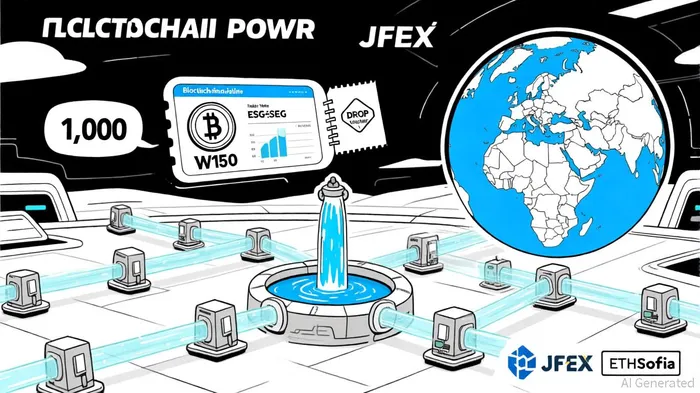







Comentarios
Aún no hay comentarios