
Blockchain-Driven Financial Infrastructure Innovation: How Broadridge's DLT Repo Platform is Reshaping Capital Markets Efficiency
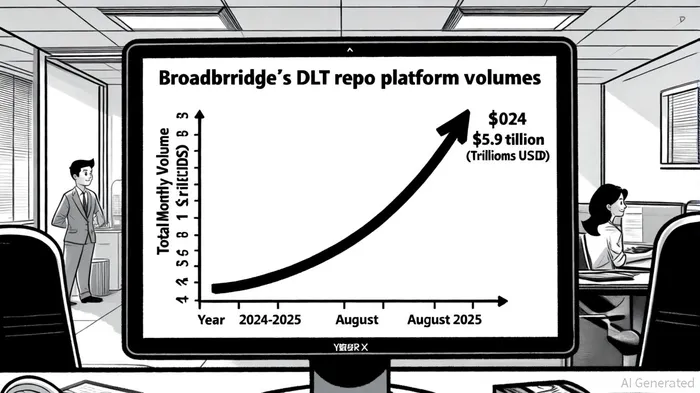
The financial sector is undergoing a seismic shift as blockchain technology redefines the architecture of capital markets. At the forefront of this transformation is Broadridge's Distributed Ledger Repo (DLR) platform, a blockchain-driven solution that has emerged as a linchpin for institutional efficiency. By August 2025, the DLR platform processed an average of $280 billion in daily repo transactions, translating to a staggering $5.9 trillion in monthly volume-a 490% surge from $1 trillion in August 2024, according to The DESK. This exponential growth underscores the platform's role in validating distributed ledger technology (DLT) as a scalable infrastructure for high-stakes financial operations.
Operational Innovations: Atomic Settlement and Smart Contracts
The DLR platform's success lies in its ability to streamline repo transactions through atomic settlement, a process where cash and securities are exchanged simultaneously on a shared, immutable ledger, as reported by Incrypthos. This eliminates the settlement risk inherent in traditional workflows, where delays between asset and cash transfers expose institutions to counterparty risk. By leveraging smart contracts, the platform automates collateral management, reducing processing costs by up to 40% and accelerating liquidity turnover, The DESK found. For instance, tokenized real assets-such as government bonds or commercial real estate-can now be traded with near-instant finality, a feat previously unattainable in legacy systems, as highlighted in Beyond Borders.
Capital Markets Efficiency: Liquidity, Transparency, and Risk Mitigation
The DLR platform's impact extends beyond operational speed. According to a Broadridge study, the platform's design has enhanced intraday liquidity for participating institutions by enabling real-time collateral rehypothecation. This means banks can reuse collateral more frequently, optimizing capital efficiency in a sector where liquidity is paramount. Furthermore, the integration of aggregated platform data through market data providers like Kaiko has democratized access to on-chain metrics, offering investors granular insights into collateral utilization and trade patterns-insights the Broadridge study also highlights. Such transparency notNOT-- only reduces information asymmetry but also fosters trust in digital asset ecosystems.
Industry Adoption and Future Implications
The DLR platform's rapid adoption by major institutions-including UBS, HSBC, and Société Générale-signals a broader industry pivot toward DLT-based infrastructure, as reported by LedgerInsights. These institutions have recognized the platform's interoperability, which allows seamless integration with both traditional and blockchain-native systems. As noted in a 2025 analysis by Incrypthos, this hybrid approach addresses the "chicken-and-egg" problem of DLT adoption: by maintaining compatibility with existing frameworks, the DLR platform lowers the barrier to entry for risk-averse institutions.
Looking ahead, the platform's success hints at a future where DLT becomes the backbone of global capital markets. Broadridge's recent investments in AI and machine learning to further automate trade execution and risk modeling-discussed in Beyond Borders-suggest the company is positioning itself as a leader in the next phase of financial innovation. For investors, this represents a dual opportunity: not only to capitalize on the immediate efficiency gains of the DLR platform but also to position portfolios for the long-term transition to tokenized asset markets.
Conclusion: A Paradigm Shift in Financial Infrastructure
Broadridge's DLT repo platform exemplifies how blockchain technology can transcend its early-stage hype to deliver tangible, enterprise-grade solutions. With daily volumes surging past $280 billion and institutional participation expanding, the DLR platform has proven that DLT can handle the scale and complexity of capital markets. For investors, the implications are clear: blockchain-driven infrastructure is no longer a speculative experiment but a foundational shift in how value is transferred, secured, and optimized. As the financial sector continues to digitize, platforms like Broadridge's DLR will define the benchmarks for efficiency, liquidity, and trust.







Comentarios
Aún no hay comentarios