
Blockchain-Driven Crypto Treasuries and Their Role in Decentralized Scientific Innovation
The Rise of Crypto Treasuries in Biomedical R&D
Traditional biomedical research is plagued by centralized funding models, opaque governance, and high costs. Blockchain-based crypto treasuries offer a radical alternative: tokenized ecosystems where stakeholders can directly fund, validate, and profit from scientific advancements. According to a report by , blockchain staking and tokenization are enabling "community-driven innovation" by aligning incentives across researchers, investors, and the public.
Portage Biotech's Strategic Pivot to AlphaTON Capital
Portage Biotech, a clinical-stage immuno-oncology firm, has rebranded as AlphaTON Capital Corp (ticker: ATON) to focus on digital asset management. In 2025, the company announced a $100 million initiative to acquire TON tokens, leveraging blockchain staking and validation to generate yield while supporting the Telegram Open Network (TON) ecosystem. This pivot was funded through a $38.2 million private placement and a $35 million loan from BitGo Prime as reported in the company's IR filing.
The financial rationale is compelling: AlphaTON's net losses narrowed significantly in Fiscal 2025 (from $75.4 million in 2024 to $6.8 million in 2025), driven by a 75% reduction in R&D expenses after pausing clinical trials. By redirecting resources to TON staking and ecosystem development, the company is positioning itself as a bridge between biotech and blockchain, with strategic partnerships with Kraken and Animoca Brands.
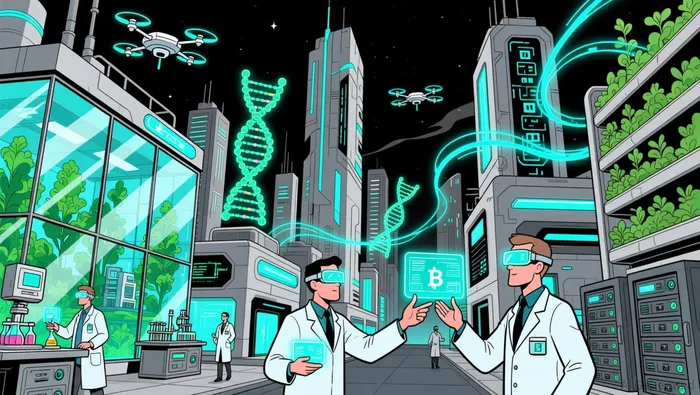
VitaDAO: Tokenizing Longevity Research
VitaDAO, a decentralized autonomous organization (DAO), is pioneering community-driven funding for longevity science. Its governance token, VITA, allows stakeholders to vote on research proposals and allocate capital to projects addressing age-related diseases. By 2025, VitaDAO had funded initiatives like the AI agent Aubrai, which automates experimental workflows and reduces manual review time by 40%.
The model's strength lies in its inclusivity: anyone with VITA tokens can propose or fund research, bypassing traditional gatekeepers. This democratization not only accelerates innovation but also ensures alignment between investors and scientific outcomes.
Bio Protocol: Dual-Flywheel Ecosystems and AI-Driven R&D
Bio Protocol has emerged as a leader in DeSci by tokenizing intellectual property and integrating AI into its research processes. Its BIOBIO-- token enables staking, governance, and access to a decentralized platform where scientists collaborate on drug discovery. The V2 upgrade in 2025 introduced a dual-flywheel mechanism: small-scale, high-frequency fundraising is paired with AI agents and IP tokenization, creating a self-reinforcing cycle of innovation.
A key innovation is the research fund pool, where staking and transaction fees are reinvested into R&D. This closed-loop system ensures that user activity directly supports scientific progress. In 2025, Bio Protocol raised $6.9 million to launch an AI-native platform, further cementing its role as a DeSci pioneer.
Investment Potential and Strategic Windows
The DeSci sector is attracting institutional and retail investors alike. AlphaTON's TON treasury strategy, VitaDAO's community governance, and Bio Protocol's AI-native platform each represent distinct but complementary approaches to decentralizing R&D. For investors, the key metrics to watch include:
- Token utility: Projects with clear, deflationary tokenomics (e.g., Bio Protocol's research fund pool) are more likely to sustain long-term value.
- Ecosystem growth: Partnerships with entities like BitGo and Kraken signal institutional validation.
- ROI potential: AlphaTON's reduced losses and VitaDAO's AI-driven efficiency improvements suggest strong upside.
Conclusion: Leading the Future of Decentralized Science
Blockchain-driven crypto treasuries are not just a technological innovation-they are a paradigm shift in how scientific progress is funded and executed. For investors, the current landscape offers a rare window to back projects that are accelerating R&D timelines, democratizing access, and creating tokenized incentive ecosystems. As DeSci gains traction, early-stage positions in AlphaTON, VitaDAO, and Bio Protocol could yield outsized returns while contributing to a more open and collaborative scientific future.





Comentarios
Aún no hay comentarios