
Blockchain and Cybersecurity: Navigating 2025's Regulatory Evolution and Enforcement Innovations
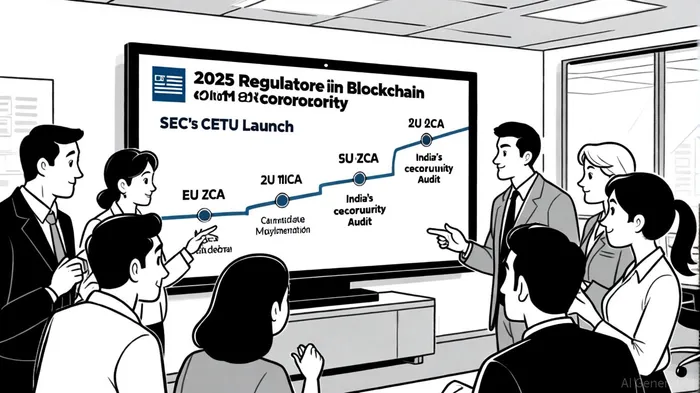
In 2025, the intersection of blockchain technology and cybersecurity has become a focal point for regulators and investors alike. Governments and enforcement agencies are increasingly adopting proactive frameworks to balance innovation with investor protection, reshaping the landscape for digital assets. This analysis explores the regulatory and enforcement innovations of 2025, their implications for the blockchain industry, and the investment opportunities they create.
U.S. Regulatory Developments: A Dual Approach to Innovation and Compliance
The U.S. Securities and Exchange Commission (SEC) has taken center stage in defining the regulatory trajectory for blockchain and digital assets. The Spring 2025 Regulatory Agenda introduced rule proposals to clarify the offer and sale of crypto assets, including amendments to Exchange Act Rules to accommodate trading on Alternative Trading Systems[1]. These changes aim to reduce ambiguity for market participants while fostering onshoring of innovative products.
A pivotal development was the establishment of the Cyber and Emerging Technologies Unit (CETU) in February 2025[1]. Staffed by 30 specialists, CETU focuses on enforcing compliance with cybersecurity rules and addressing fraud involving blockchain, social media, and the dark web[1]. This unit complements the SEC's Crypto Task Force, reflecting a coordinated strategy under Chairman Paul Atkins, who has emphasized deregulation in areas like ESG while maintaining strict oversight of technological risks[2].
Legislatively, the GENIUS Act and CLARITY Act have reshaped the U.S. landscape. The GENIUS Act mandates 1:1 reserve backing for payment stablecoins and independent audits under AML/KYC rules[4], while the CLARITY Act seeks to classify digital assets under existing securities and commodities frameworks[4]. The Trump administration's pro-crypto stance—evidenced by the appointment of a Cryptocurrency Czar and the FDIC's exclusion from a crypto working group—further signals a regulatory environment conducive to innovation[1].
EU's MiCA Framework: Harmonization at a Cost
The European Union's Markets in Crypto-Assets (MiCA) framework, fully effective in 2025, represents a harmonized regulatory structure for crypto service providers across the Eurozone[1]. Starting January 2026, stricter measures will require transaction sender/receiver name recording and ownership verification for self-hosted wallets exceeding €1,000[1]. While proponents argue MiCA enhances investor protection, critics warn of compliance costs that could stifle innovation[1].
India's Cybersecurity Mandates and Tax Policies
India has adopted a dual approach to blockchain regulation. Cybersecurity audits are now mandatory for crypto exchanges, with platforms required to register auditors with CERT-IN and undergo penetration testing[4]. Simultaneously, a 30% capital gains tax and 1% Tax Deducted at Source (TDS) on crypto transactions have driven users toward offshore platforms and P2P trading[4]. This regulatory duality highlights the tension between security and user behavior in emerging markets.
Global Trends: From Reactive to Proactive Regulation
2025 marks a global shift from reactive oversight to proactive frameworks. Governments are prioritizing clarity for market participants while addressing cross-border compliance challenges[4]. For instance, the SEC and CFTC's coordinated approach to digital asset regulation aims to harmonize definitions and streamline reporting standards[1]. Such efforts underscore a growing consensus on the need for international collaboration to mitigate risks like fraud and market manipulation.
Enforcement Innovations: CETU's Strategic Focus
The CETU's enforcement priorities—fraud involving blockchain, unauthorized access to nonpublic information, and social media/dark web misuse—align with broader SEC goals[1]. By ensuring compliance with cybersecurity rules, CETU addresses vulnerabilities in a rapidly evolving ecosystem. This focus on enforcement innovation is critical for maintaining trust in digital assets, particularly as AI and decentralized finance (DeFi) expand[3].
Investment Implications: Opportunities and Risks
For investors, 2025's regulatory evolution presents both opportunities and risks. On one hand, clearer frameworks in the U.S. and EU reduce compliance uncertainty, potentially attracting institutional capital to blockchain projects. On the other, stringent measures like MiCA's transaction recording requirements could increase operational costs for smaller firms. Additionally, enforcement innovations like CETU's focus on dark web fraud may drive demand for cybersecurity solutions tailored to blockchain ecosystems.
Conclusion
The regulatory and enforcement innovations of 2025 signal a maturing blockchain industry. While challenges remain—such as balancing innovation with compliance—the proactive frameworks being implemented globally are laying the groundwork for sustainable growth. Investors who align with these trends, particularly in cybersecurity and cross-border compliance, are well-positioned to capitalize on the next phase of the digital asset revolution.







Comentarios
Aún no hay comentarios