
Blockchain Adoption in the Middle East: A New Era for Tech and Finance
A Market on the Verge of Exponential Growth
The Middle East and Africa (MEA) blockchain technology market is set to explode in 2025. According to a report by Grand View Research, the MEA market size was valued at USD 2,759.1 million in 2024 and is projected to surge to USD 131,415.0 million by 2030, with a compound annual growth rate (CAGR) of 91.3%. This meteoric rise is fueled by the UAE and Saudi Arabia, which together account for over 70% of the region's blockchain investments. The UAE's Emirates Blockchain Strategy 2021 and Saudi Arabia's Vision 2030 have catalyzed a regulatory environment that attracts global crypto platforms like Binance and Crypto.com.
Meanwhile, the region's crypto market alone is valued at $110.3 billion in 2024, with expectations to reach $234.3 billion by 2033. This growth is underpinned by blockchain's integration into anti-money laundering (AML) and know-your-customer (KYC) compliance, which has already increased from 62% adoption in 2023 to 90% in 2025.
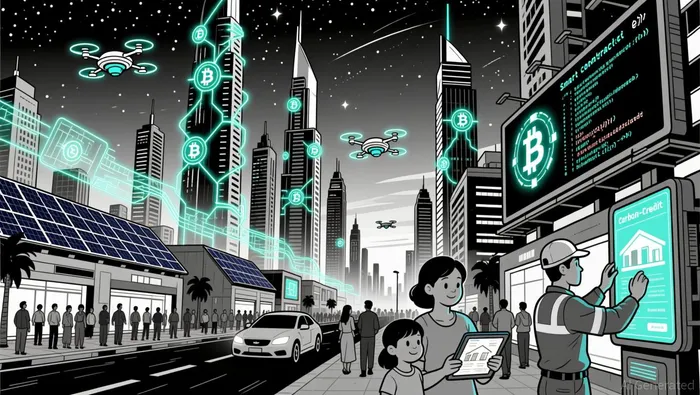
Government-Driven Infrastructure and Sovereign Investments
Middle Eastern governments are not merely observers in this blockchain revolution-they are active architects. The UAE has established a multi-layered regulatory framework involving the Dubai Virtual Assets Regulatory Authority (VARA), the Central Bank of the UAE (CBUAE), and the Securities and Commodities Authority (SCA) according to analysis. This structure ensures that blockchain is not just a speculative tool but a foundational element of governance.
Abu Dhabi's sovereign wealth fund, ADQ, is collaborating with Agile Dynamics to build a quantum-resistant blockchain infrastructure, including an AED-stablecoin issued by First Abu Dhabi Bank according to industry reports. Similarly, Saudi Arabia's Central Bank (SAMA) has invested in MicroStrategy Inc., a company with a $6.5 billion BitcoinBTC-- portfolio, signaling a strategic pivot toward digital assets as reserves.
Sovereign wealth funds are also diversifying into blockchain. Mubadala, Abu Dhabi's investment arm, has increased its Bitcoin holdings via the IShares Bitcoin Trust, while Qatar's Digital Assets Lab explores tokenization strategies according to market analysis. These moves reflect a broader trend: blockchain is no longer a niche technology but a core component of national economic strategy.
Sector-Specific Breakthroughs: Energy, Finance, and Digital Identity
The energy sector is one of the most dynamic areas of blockchain adoption. The UAE's Dubai Electricity and Water Authority (DEWA) launched a blockchain-powered solar energy trade platform in 2023, enabling peer-to-peer (P2P) energy transactions. Meanwhile, the UAE government's blockchain carbon trading platform links carbon tokens to reforestation projects, aligning with net-zero goals. Globally, the blockchain in energy market is projected to grow at a 41.6% CAGR, with the Middle East and Africa leading at 42.6% according to market projections.
In finance, real estate tokenization is reshaping property markets. Dubai's Land Department (DLD) has initiated a pilot program allowing property transactions to be tokenized via smart contracts, with biometric KYC checks. The DLD anticipates a $16 billion tokenized real estate market in Dubai by 2033 according to market forecasts. Additionally, the UAE's AE Coin-a stablecoin pegged 1:1 to the dirham-is facilitating digital payments and cross-border transactions.
Digital identity systems are also being reimagined. Bahrain's Crypto-Assets (CRA) regulatory module and the UAE's blockchain-based licensing systems are streamlining identity verification and reducing bureaucratic friction according to regulatory analysis.
Private Sector Momentum and Institutional Confidence
The private sector is equally pivotal. The UAE's business-friendly environment-0% personal income tax, 9% corporate tax-has attracted $2 billion in crypto investments from entities like Abu Dhabi's MGX into Binance. Blockchain investment firms such as NewTribe Capital and Cypher Capital are backing early-stage startups, with 58 blockchain-focused firms operating in the region.
Real-world asset (RWA) tokenization is another growth area. Powerledger's TraceX platform, a blockchain-based renewable energy credit (REC) marketplace, traded over 1.2 million RECs in January 2025, reducing administrative costs by 72%. This efficiency underscores blockchain's potential to optimize hybrid energy grids and decentralized systems.
The Road Ahead: Strategic Investment Opportunities
For investors, the Middle East's blockchain ecosystem offers a unique confluence of regulatory clarity, sovereign backing, and sector-specific innovation. Key opportunities include:
1. Energy Blockchain Platforms: Projects like DEWA's solar energy trade system and Powerledger's REC marketplace.
2. Real Estate Tokenization: Dubai's DLD pilot and AE Coin integration.
3. Digital Asset Reserves: Sovereign investments in Bitcoin and stablecoins by Mubadala and SAMA.
4. Regulatory Arbitrage: The UAE's layered regulatory framework, which allows businesses to choose jurisdictions aligned with their operational models.
As the region's blockchain market accelerates, early adopters and institutional investors stand to benefit from a compounding growth trajectory. The Middle East is not just embracing blockchain-it is redefining its economic future through it.






Comentarios
Aún no hay comentarios