
Blockchain Adoption and Market Performance: Cardano's ETF Surge, Polygon's Volatility, and BlockDAG's Disruptive Potential
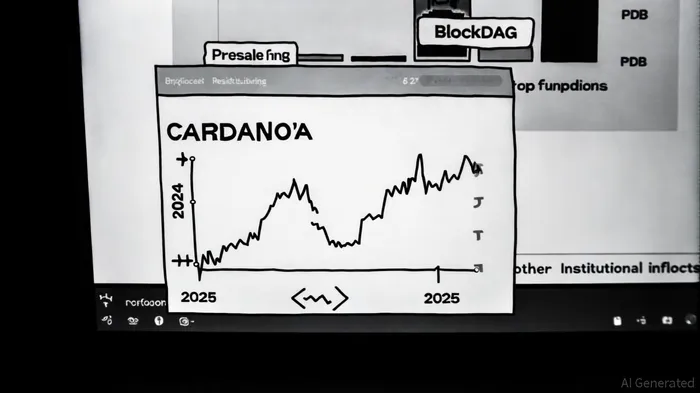
The blockchain landscape in 2025 is marked by divergent narratives: Cardano's ETF-driven optimismOP--, Polygon's technological reinvention, and BlockDAG's explosive presale growth. These projects exemplify the interplay of institutional adoption, regulatory shifts, and technological innovation shaping the next phase of crypto markets.
Cardano's ETF-Driven Surge: Institutional Confidence and Regulatory Hurdles
Cardano (ADA) has emerged as a focal point for institutional investors, buoyed by the pending approval of the Grayscale CardanoADA-- ETF (GADA). With $73 million in institutional inflows this year alone[1], the project's total custody holdings now exceed $900 million[2]. Grayscale's plan to stake all ADAADA-- in its ETF—pending SEC approval—could amplify returns for shareholders through staking rewards[3], a move that underscores ADA's utility beyond speculative trading.
Price action reinforces this optimism: ADA has surged 155.7% year-to-date, trading near $0.88–$0.89[1]. Whale accumulation of over 200 million tokens[3] and a bullish technical pattern suggest a potential breakout to $3 if the $1.34 resistance level is breached[3]. Historical data on ADA's price behavior reveals that breaking a 20-day resistance level has historically generated a modest but consistent edge: a 2.4% average return over 10 days post-break, compared to a 0.74% benchmark[1]. However, the win rate for such events hovers around 45–55%, indicating a moderate but not overwhelming probability of success[1].
Regulatory uncertainty looms. While the SEC's anticipated altcoin ETF approvals could catalyze broader adoption[2], delays in approvals for projects like PolkadotDOT-- highlight the risks[3].
Polygon's Volatility: Technological Reinvention and Market Realities
Polygon (MATIC/POL) has navigated a more volatile path, driven by its pivot from a Layer-2 scaling solution to a modular blockchain ecosystem. The launch of AggLayer V1—a hybrid architecture combining monolithic and modular designs—aims to enhance scalability and interoperability[3]. This innovation, coupled with the transition to zkEVM Validium L2, positions Polygon to compete with Arbitrum and Optimism in the Layer-2 space[3].
Institutional partnerships, such as the Fox Corporation's “Verify” protocol for AI content authentication[3], signal growing real-world utility. Yet, Polygon's Total Value Locked (TVL) dipped to $926.58 million in May 2025[3], reflecting broader market jitters. Analysts project a short-term price target of $0.772578 by mid-2025[3], but sustained growth will depend on maintaining daily active users (523,000 as of May 2025[3]) and expanding DeFi integrations.
BlockDAG's Disruptive Potential: Presale Momentum and Technological Innovation
BlockDAG has captured attention with its $395 million presale and a holder base of 2.5 million miners[2]. Its hybrid Directed Acyclic Graph (DAG) and Proof-of-Work (PoW) architecture promises real-time scalability, a critical differentiator in an era of blockchain congestion[2]. The X1 mining app's 3 million users[2] and a $1.1 million BitcoinBTC-- auction[1] further underscore its grassroots adoption.
Technologically, BlockDAG's disruptive potential lies in its tokenization model, which enables transparent capital raising. Early investors, who purchased tokens at $0.0013, face a projected 3,025% return if the price reaches $0.05[2]. Institutional interest is also evident, with whale investments totaling $8 million[3]. Upcoming global events, such as its Singapore Deployment Event, could amplify visibility[2], positioning BlockDAG as a top bullish asset for 2025.
Comparative Analysis: Institutional Flows and Technological Momentum
While Cardano and Polygon both attract institutional capital, their strategies differ. Cardano's focus on ETF-driven liquidity contrasts with Polygon's emphasis on modular infrastructure. Cardano's $73 million in inflows[1] outpace Polygon's recent funding, but Polygon's TVL and user base suggest stronger ecosystem stickiness[3].
BlockDAG's presale success, however, highlights a new paradigm: tokenization as a fundraising tool. Its $395 million presale[2] dwarfs traditional crypto capital-raising methods, offering a blueprint for future projects. Yet, its disruptive potential hinges on execution—scaling the DAG-PoW model without compromising decentralization will be critical.
Strategic Entry Points for Next-Gen Blockchain Assets
Investors navigating this landscape should prioritize projects with clear regulatory alignment, robust technological differentiation, and scalable use cases. Cardano's ETF potential and institutional inflows make it a high-conviction play, albeit with regulatory risks. Polygon's modular upgrades and partnerships offer a balanced bet on long-term infrastructure growth. BlockDAG, while speculative, represents a high-risk/high-reward opportunity in tokenization-driven innovation.
As the SEC's altcoin ETF timeline clarifies and Bitcoin's dominance wanes[3], diversifying exposure across these narratives could position portfolios to capitalize on the next wave of blockchain adoption.






Comentarios
Aún no hay comentarios