
Blackstone's Valuation: A Cautionary Tale of Overextension in a Shifting Private Equity Landscape
The private equity sector in 2025 is navigating a complex landscape of macroeconomic volatility, shifting valuation norms, and liquidity constraints. Against this backdrop, BlackstoneBX-- Group Inc. (BX) stands out as a case study in valuation overextension. While the firm's Q2 2025 financial results-$3.71 billion in revenue and $1.6 billion in distributable earnings-have impressed analysts, according to the Blackstone Q2 financials, its current valuation metrics raise critical questions about sustainability.
Valuation Metrics: A Disconnect from Industry Realities
Blackstone's trailing price-to-earnings (P/E) ratio of 46.12 and forward P/E of 29.56, per the StockAnalysis statistics, place it in stark contrast to sector-wide trends. The global private equity EV/EBITDA multiple, which peaked at 13.3X in 2021, has since contracted to 10.5X in 2024 amid higher interest rates and valuation adjustments, according to an LPL Financial report. Yet Blackstone's EV/EBITDA ratio of 31.85, noted on ValueInvesting's EV/EBITDA page,-calculated using an enterprise value of $225.4 billion and TTM EBITDA of $7.08 billion-far exceeds these benchmarks. Even within the U.S. M&A landscape, where private equity buyers paid a median EV/EBITDA of 12.8X in Q2 2025 according to CLFI M&A data, Blackstone's multiple appears disconnected from market realities.
The firm's price-to-book (P/B) ratio of 6.53, shown on Macrotrends P/B data, further underscores this divergence. While peers like Blackstone Mortgage Trust (BXMT) trade at a discount to book value (P/B of 0.89), the parent company's premium valuation suggests an overreliance on growth expectations rather than tangible asset backing.
Financial Performance vs. Market Dynamics
Blackstone's Q2 2025 results-25% year-over-year growth in distributable earnings and a record $1.2 trillion in assets under management (AUM), according to the earnings call transcript-are undeniably strong. However, these figures must be contextualized within the broader private equity ecosystem. The sector is grappling with a $1 trillion liquidity crunch, as older vintages remain trapped in long-held assets, according to the EY Private Equity Pulse. Blackstone's $181 billion in dry powder, while impressive, faces the same deployment challenges as its peers.
Moreover, the firm's PEG ratio of 1.24 (StockAnalysis) indicates that its valuation is not justified by growth prospects. In a market where investors are increasingly prioritizing distributable profits (DPI) over internal rate of return (IRR), as noted by WithIntelligence, Blackstone's high multiples may struggle to attract capital unless earnings growth accelerates meaningfully.
Historical data on BX's earnings performance further complicates the picture. A backtest of BX's stock behavior following earnings beats since 2022 reveals mixed outcomes. For instance, on December 2, 2022, BXBX-- closed at $85.16, a 0.14% increase from the prior session (Yahoo historical data), outperforming the S&P 500's 0.12% decline. However, this momentum reversed sharply by December 22, 2022, when BX closed at $74.34, a 1.98% drop (StockAnalysis earnings data), underperforming the S&P 500's 1.45% decline. Over the month preceding the 2022 earnings release, BX lost 3.4% while the Finance sector gained 5.77% (Yahoo historical data), underscoring inconsistent alignment with broader market trends. Analysts have also revised expectations downward, with the next quarter's EPS forecast at $1.02-a 40.35% year-over-year decline (StockAnalysis). These patterns suggest that even when BX beats earnings expectations, its stock struggles to sustain gains amid sector-specific headwinds and macroeconomic volatility.
Market Cycles and Strategic Risks
The private equity sector's Q2 2025 rebound-marked by 215 major exits totaling $308 billion, as reported in the EY Private Equity Pulse-has created a false sense of stability. However, this activity masks underlying fragility. Trade policy shifts, such as the "Liberation Day" tariffs, have forced 30% of firms to renegotiate deals, according to an Apex Leaders analysis, and secondary market premiums (21% of transactions priced above last funding rounds) reflect speculative excess rather than fundamental value, per an EquityZen analysis.
Blackstone's exposure to AI-driven sectors and infrastructure-while strategically sound-also introduces volatility. The firm's 31% year-over-year growth in fee-related earnings, documented in The Motley Fool transcript, is partly attributable to these high-growth areas, but AI's rapid technological obsolescence and infrastructure's long capital cycles pose risks that current valuations may not fully account for.
Conclusion: A Ticking Clock for Value Preservation
Blackstone's financial performance in Q2 2025 is commendable, but its valuation metrics-particularly EV/EBITDA and P/E-suggest a significant overreach relative to industry norms. While the firm's scale and diversification offer some insulation from macroeconomic shocks, the private equity sector's liquidity constraints and valuation corrections loom as critical headwinds. Investors must weigh the firm's near-term momentum against the structural challenges of a market where 71% of venture capital exits in 2024 came from secondary transactions (EquityZen), signaling a shift toward liquidity-seeking strategies rather than long-term value creation.
In a landscape where 56% of investors increased allocations to AI and crypto in Q2 2025 (EquityZen), Blackstone's ability to maintain its premium valuation will depend on its capacity to navigate these dynamics without sacrificing returns. For now, the data suggests caution.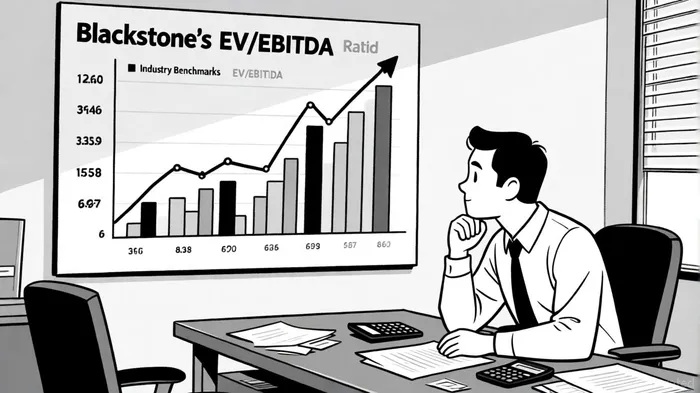







Comentarios
Aún no hay comentarios