
Blackstone's $1.2 Billion Senior Notes Offering: A Strategic Move or a Warning Signal?
Capital Structure Optimization: Extending Maturity and Leveraging Growth
Blackstone's decision to issue long-dated senior notes aligns with a strategic effort to extend its debt maturity profile. The 2030 and 2036 maturities provide a buffer against near-term refinancing risks, a prudent move given the firm's recent Q3 2025 results, which showed a 6.2% revenue miss against Wall Street expectations and a decline in operating margins to 44.6% from 57.4% in the prior-year period. By locking in interest rates at 4.300% and 4.950%, BlackstoneBX-- secures favorable terms amid a rising-rate environment, potentially reducing future refinancing costs.
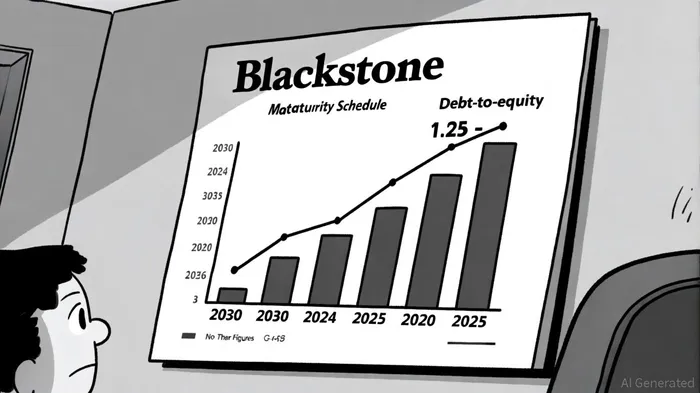
The offering also reflects the firm's historical reliance on leverage. As of June 2025, Blackstone's debt-to-equity ratio stood at 1.32, with long-term debt of $25.78 billion against shareholders' equity of $19.59 billion. While this ratio has fluctuated-peaking at 1.45 in March 2025-it remains within a range consistent with its asset-heavy business model. The $1.2 billion issuance, though significant, appears calibrated to support high-conviction investments such as the $3 billion Saudi data center partnership with AirTrunk and HUMAIN, which underscores Blackstone's focus on AI-ready infrastructure.
Risk Assessment: Profitability Pressures and Sector-Specific Challenges
Despite these strategic benefits, the offering coincides with operational headwinds. Blackstone's Q3 2025 earnings revealed a GAAP profit of $0.80 per share, 34.8% below analyst forecasts, attributed to higher-than-anticipated expenses and seasonal costs, as reported in the IndexBox write-up. While the firm's infrastructure and private credit segments grew by 29% year-over-year, its overall profitability remains vulnerable to cost overruns and margin compression.
The data center initiative in Saudi Arabia, though ambitious, introduces sector-specific risks. As CEO Stephen Schwarzman noted, energy supply constraints could limit the scalability of such projects. For a firm that relies on long-term, capital-intensive investments, these challenges could amplify exposure to cost inflation or regulatory shifts.
Strategic Context: Balancing Growth and Prudence
Blackstone's capital allocation strategy has long emphasized diversification across alternative assets, from infrastructure to private equity. The recent acquisition of a 22% stake in British AGS Airports and exploratory talks to acquire a TikTok US stake highlight its appetite for high-impact, non-traditional investments. The $1.2 billion senior notes offering, therefore, should be viewed as a funding mechanism to capitalize on these opportunities rather than a sign of distress.
However, the firm's leverage metrics warrant closer scrutiny. While its debt-to-equity ratio remains stable, the absence of explicit debt-to-EBITDA data complicates a full risk assessment (per the HUMAIN and AirTrunk partnership announcement). If EBITDA growth lags behind debt accumulation, the firm could face margin pressures similar to those observed in Q3 2025.
Conclusion: A Calculated Gamble?
Blackstone's $1.2 billion senior notes offering is a double-edged sword. On one hand, it extends the firm's debt maturity, secures favorable interest rates, and funds high-conviction investments in AI and infrastructure. On the other, it amplifies exposure to operational inefficiencies and sector-specific risks. For investors, the key question is whether the returns from these ventures will offset the costs of increased leverage.
As the alternative asset management landscape evolves, Blackstone's ability to balance aggressive growth with prudent risk management will determine whether this offering is a strategic masterstroke or a harbinger of financial strain.





Comentarios
Aún no hay comentarios