
BlackRock's Institutional Crypto Movements and Their Market Implications
The cryptocurrency market in Q3 2025 has been marked by a complex interplay of bearish pressures and long-term institutional adoption trends. BlackRockBLK--, as a key player in the space, has navigated this duality through strategic rebalancing of its crypto portfolio, on-chain activity, and ETF dynamics. This analysis evaluates whether these moves signal short-term bearish sentiment or reflect a maturing market's structural evolution.
On-Chain Activity and ETF Dynamics: A Tale of Two Trends
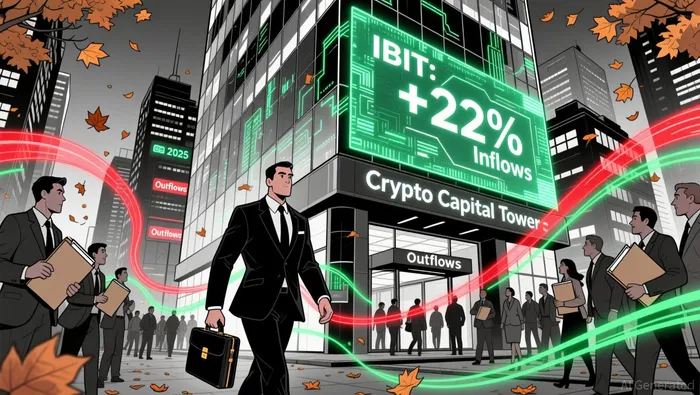
BlackRock's institutional crypto movements in Q3 2025 reveal a nuanced picture. While broader crypto ETF outflows have raised concerns about institutional disengagement, BlackRock's iShares Bitcoin TrustIBIT-- (IBIT) has defied the trend. Data from Glassnode indicates that the 30-day simple moving average of capital flows into U.S. spot BitcoinBTC-- and EthereumETH-- ETFs turned negative in early November 2025, coinciding with a 30% drop in Bitcoin's price since mid-October. However, IBITIBIT-- recorded $6.1 million in inflows on December 23, 2025, even as competitors like Bitwise's BITB and Grayscale's GBTC faced redemptions.
This divergence underscores a critical shift: institutional investors are increasingly favoring quality ETF structures over speculative exposure. IBIT, with $62.5 billion in total inflows since its launch, has become a strategic allocation tool rather than a speculative play. The ETF's resilience suggests that institutional confidence is tied to regulatory clarity and infrastructure, not short-term volatility.
Institutional Sentiment: A Strong Foundation Amid Corrections
Despite the recent outflows, institutional sentiment toward crypto assets in Q3 2025 remained robust. CoinShares' analysis of 13F filings revealed a 13% quarter-over-quarter increase in ETF AUM and a 12% rise in 13F bitcoin holdings. Advisors accounted for 57% of these holdings, driven by client demand for diversified portfolios. Notably, institutions like Harvard and Emory University increased their Bitcoin allocations, while traditional banks such as Wells Fargo and JP Morgan expanded exposure.
Regulatory milestones, including the approval of U.S. spot ETFs, have further solidified this confidence. As stated by BlackRock in its Fall 2025 investment directions, Bitcoin is increasingly viewed as a "debasement hedge" and a means to enhance risk-adjusted returns. This shift from speculative to strategic allocation reflects a maturing market where crypto is integrated into mainstream portfolio strategies.
Short-Term Risks: Leverage Unwinding and Whale Selling
Short-term volatility in Q3 2025 was exacerbated by factors such as leverage unwinding and whale-driven selling. A flash crash on October 10, triggered by automated liquidations of long positions, led to a 30% drop in futures open interest. Additionally, large Bitcoin holders began rebalancing portfolios after hitting psychological price thresholds, adding to downward pressure. These dynamics highlight the risks of excessive leverage and speculative positioning in a still-evolving market.
However, BlackRock's analysis suggests that such corrections may present long-term opportunities. The firm noted that while short-term direction remains unpredictable, the unwinding of optimism around digital asset treasuries and the normalization of stablecoin regulations (e.g., the GENIUS Act) have created a more resilient ecosystem.
Strategic Rebalancing: Infrastructure and Institutional Confidence
BlackRock's strategic rebalancing in Q3 2025 was underpinned by infrastructure upgrades and institutional-grade offerings. The integration of Talos' platforms with BlackRock's Aladdin® and the acquisition of Coin Metrics created the first integrated investment and data platform for digital assets. This move enhanced institutional access to real-time on-chain analytics, reinforcing trust in crypto as a legitimate asset class.
A landmark example is Harvard University's $443 million investment in IBIT, which the university framed as a strategic diversification tool. By October 30, 2025, the U.S. Bitcoin ETF market had reached $103 billion in AUM, with institutional participation at 24.5%. These figures underscore a broader trend: institutions are treating crypto as a core component of risk-adjusted portfolios rather than a speculative fad.
Conclusion: Bearish Signals or Strategic Evolution?
The Q3 2025 data paints a dual narrative. On one hand, ETF outflows and leverage unwinding signal short-term bearish pressures. On the other, BlackRock's strategic rebalancing, regulatory clarity, and institutional adoption trends point to a maturing market. The key distinction lies in the nature of institutional participation: while speculative flows have waned, strategic allocations are growing.
As the crypto market evolves, BlackRock's actions-such as enhancing infrastructure, securing major institutional clients, and emphasizing risk-adjusted returns-suggest a long-term commitment to digital assets. For investors, the challenge lies in distinguishing between transient volatility and structural progress. In this context, BlackRock's movements appear less like a bearish retreat and more like a recalibration for sustained growth.







Comentarios
Aún no hay comentarios