
Why BlackRock's Dip Presents a Strategic Buying Opportunity
Investors have been quick to punish BlackRockBLK-- (BLK) shares in recent sessions, with the stock down roughly 8% year-to-date amid concerns over a single institutional client's withdrawal and macroeconomic volatility. But this pullback masks a deeper truth: BlackRock's fundamentals remain rock solid, and the company is positioned to capitalize on long-term structural trends in asset management. For disciplined investors, the dip offers a rare chance to buy one of the world's most resilient financial institutionsFISI-- at an undervalued entry point.
Let's break down why the short-term noise is obscuring a compelling long-term story.
Record AUM and Resilient Inflows Defy the Bearish Narrative
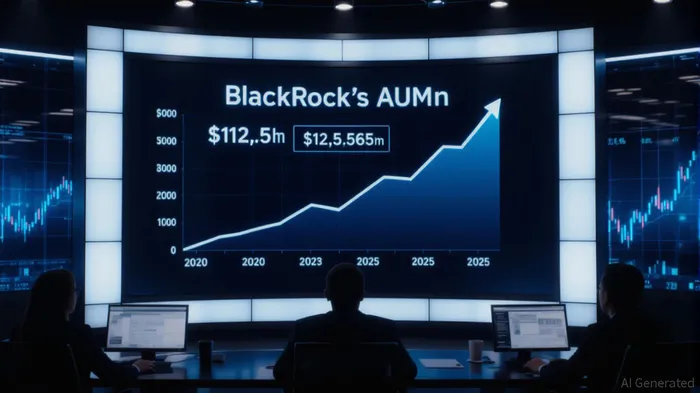
BlackRock's assets under management (AUM) hit a record $12.5 trillion as of June 30, 2025, driven by net inflows of $68 billion in Q2. While headlines fixated on a $52 billion fixed-income outflow from a single institutional client—a drag that will not repeat—investors overlooked the broader picture: excluding that one-off withdrawal, inflows hit $116 billion, with ETFs, private markets, and cash products all thriving.
The iShares ETF franchise, for instance, posted record first-half net inflows of $85 billion, with fixed-income ETFs leading at $44 billion and the BitcoinBTC-- Trust (IBIT) surpassing $80 billion in AUM. This underscores the demand for BlackRock's diversified product suite, which caters to both retail and institutional investors. Even as markets wobble, BlackRock's ETFs continue to attract capital, a testament to its brand strength and distribution power.
Organic Fee Growth and Margin Resilience: A Foundation for Stability
BlackRock's organic base fee growth of 6% for the fourth consecutive quarter is a critical indicator of its underlying health. This growth is not just about scale—it's about the stickiness of its fee-generating assets. The company's ability to grow fees steadily, even in a challenging rate environment, reflects its shift toward higher-margin businesses like private equity, real assets, and technology-driven solutions.
The operating income rose 12% to $2.1 billion in Q2, while earnings per share (EPS) jumped 16% to $12.05. Even with a higher tax rate and share count headwinds, BlackRock's margins held up. This resilience suggests the company can weather near-term macro pressures, particularly as its private markets and ETF businesses—less sensitive to market volatility—are accelerating.
Acquisitions Are Adding Immediate Value, Not Just Long-Term Potential
The $16 billion acquisition of HPSHPS-- Investment Partners and the $4.3 billion purchase of Preqin are already delivering. HPS added $165 billion in AUM and is expected to contribute $450 million in Q3 revenue, while Preqin's data and analytics platform boosted Q2 tech revenue by 26% year-over-year. These moves are not just about size—they're about fee rate accretion, with HPS alone expected to lift BlackRock's effective fee rate by 0.6 basis points.
Meanwhile, the Global Infrastructure Partners (GIP) acquisition is fueling BlackRock's push into private markets, a sector where it aims to generate 30% of its revenue by 2030. The GIP V fund closed at $25.2 billion, exceeding its target, and the SLS II secondary fund surpassed $2.5 billion. With $400 billion in private markets fundraising planned through 2030, this segment is a growth engine.
The Dip Reflects Profit-Taking, Not Fundamentals
BlackRock's stock decline has been driven by short-term factors: the one-off institutional outflow, profit-taking after a strong 2024, and broader market skepticism about financials. Yet the company's cash AUM grew 25% year-over-year to nearly $1 trillion, and its technology segment—Aladdin and data services—showed 16% organic growth.
The Tokenized Liquidity Fund, managing $50 billion in Circle's stablecoin reserves, exemplifies BlackRock's innovation edge. Even in crypto, which remains volatile, BlackRock's institutional-grade infrastructure is attracting capital.
Why This Is a Buying Opportunity
The stock's dip creates a rare entry point for investors willing to look beyond quarterly noise. Key catalysts ahead include:
1. HPS and Preqin synergies: Their contributions to revenue and margins will become clearer in coming quarters.
2. Private markets growth: The $400 billion fundraising target is achievable given BlackRock's scale and relationships.
3. ETF dominance: The iShares Bitcoin Trust and fixed-income ETFs are likely to remain top performers.
4. Capital returns: With $375 million in Q2 buybacks and a 40-50% dividend payout target, shareholders are prioritized.
Investment Thesis: Buy the Dip, Hold for the Long Game
BlackRock's valuation is now attractive. At 13.5x trailing EPS (vs. a five-year average of 15x), the stock trades at a discount to its growth trajectory. The recent pullback is a function of profit-taking and a single client's withdrawal—not a sign of weakening demand or margin pressure.
For investors focused on resilience, diversification, and compounding growth, BlackRock is a buy here. Its balance sheet is strong, its strategic moves are accretive, and its ETF and private markets franchises are secular winners. The dip is a chance to position for the next leg of its journey to $15 trillion+ in AUM.
Final Take: BlackRock's fundamentals are too robust to be derailed by short-term headwinds. Investors who buy now are likely to be rewarded as the company continues to dominate asset management's evolving landscape.





Comentarios
Aún no hay comentarios