
Blackline Safety: Capitalizing on the Infrastructure Boom in Utility Safety Technology
The U.S. infrastructure landscape is undergoing a seismic shift, driven by historic federal investments and a reorientation of state and local spending priorities. For companies like Blackline Safety, which specializes in connected safety technology for high-risk industries, this transformation represents a golden opportunity. As public infrastructure spending surges and utilities modernize aging systems, demand for advanced worker safety solutions is accelerating. Let's dissect how BlacklineBL-- Safety is strategically positioned to benefit from these trends—and what investors should watch.
The Infrastructure Tailwind: From Federal Legislation to State-Level Execution
The Infrastructure Investment and Jobs Act (IIJA) and Inflation Reduction Act (IRA) have injected over $1 trillion into U.S. infrastructure, with a significant portion allocated to utility systems. For example, the EPA's $50 billion investment in water infrastructure and the Department of Energy's $97 billion for energy modernization[1] are reshaping the utility sector's capital priorities. However, the execution of these programs is increasingly decentralized.
According to a Brookings Institution report, 79% of public infrastructure spending in 2023 came from state and local governments, with 71.6% of local transportation and water projects funded by subnational revenues[2]. This shift is critical for companies like Blackline Safety, whose clients—utilities, construction firms, and emergency responders—are often state or locally managed. As these entities prioritize operations and maintenance (56.7% of infrastructure spending in 2023[2]), the demand for safety technologies that reduce downtime and prevent accidents is rising.
Moreover, federal programs like the Safe Streets and Roads for All initiative are directly funding safety technology. For instance, Austin, Texas, received $22.9 million to enhance pedestrian safety through lighting and signalization[5], while Alameda County plans similar investments. Though these projects focus on transportation, they signal a broader appetite for technology-driven safety solutions—a trend that extends to utility infrastructure.
Utility Sector Modernization: A $790 Billion Opportunity
The utility sector itself is a major beneficiary of infrastructure spending. According to Deloitte, electric, gas, and water utilities are projected to invest over $790 billion in capital expenditures from 2025 through 2028, with a focus on modernizing transmission systems, expanding renewables, and adopting smart technologies[3]. This includes $30+ billion annually in renewable energy spending[3], supported by IRA tax incentives.
However, modernization comes with risks. Aging infrastructure, extreme weather events, and the integration of intermittent renewable sources create hazardous conditions for workers. This is where Blackline Safety's offerings—wearable gas detectors, area monitors, and connected safety platforms—shine. For example, the EXO 8 area monitor, which detects up to eight gases and gamma radiation, is gaining traction in fire and hazmat response[1].
Blackline's Strategic Moves: Contracts, Financials861076--, and Market Expansion
Blackline Safety's recent performance underscores its alignment with these trends. In September 2025, the company reported record Q3 2025 revenue of $37.6 million, a 12% year-over-year increase, driven by a 27% surge in service revenue to $23.2 million[1]. Its Annual Recurring Revenue (ARR) hit $80.2 million, up 29% YoY, while Adjusted EBITDA reached $1.3 million—a 64% improvement from the prior year[1].
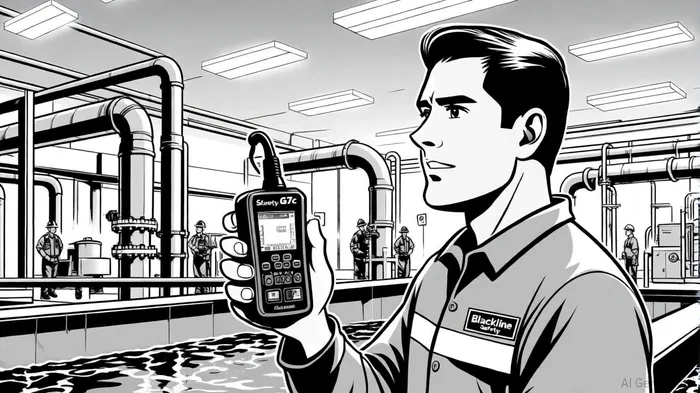
A standout win was a $1.8 million contract with a major Californian water and wastewater utility, marking Blackline's largest U.S. water deal to date[2]. The agreement includes 560 G7c wearable gas detectors, Blackline Docks for calibration, and four years of self-monitoring services. This contract highlights two key points:
1. Growing demand for connected safety solutions in essential infrastructure.
2. Blackline's ability to scale in the utilities sector, which now spans the U.S., UK/Europe, and Australia[4].
The G7c devices, equipped with SOS latch, fall detection, and real-time connectivity, address critical risks in water utilities—such as gas exposure in confined spaces and adverse weather conditions[2]. As utilities prioritize worker safety to avoid costly accidents and regulatory penalties, Blackline's technology becomes indispensable.
Risks and Challenges: Funding Uncertainty and Market Saturation
Despite the tailwinds, challenges persist. The Trump administration's Department of Government Efficiency (DOGE) has introduced uncertainty by freezing some infrastructure projects and reducing staffing at agencies like the EPA[2]. While state and local spending remains robust, delays in federal funding could slow adoption of safety technologies in the short term.
Additionally, the utility safety tech market is competitive, with players like HoneywellHON-- and 3MMMM-- offering similar solutions. However, Blackline's 128% Net Dollar Retention (NDR)—a metric indicating strong customer loyalty and expansion—suggests it is outpacing rivals[1]. Its focus on cloud-based, real-time monitoring also differentiates it in an industry still reliant on legacy systems.
The Road Ahead: A Sector in Growth Mode
For Blackline Safety, the next 12–24 months will hinge on three factors:
1. Execution of state/local contracts: As utilities allocate funds from IIJA/IRA, Blackline must maintain its winning streak.
2. Product innovation: The EXO 8 and future devices must keep pace with evolving hazards, such as those posed by hydrogen infrastructure or AI-driven grid systems.
3. Global expansion: With utilities in Europe and Australia investing heavily in modernization, Blackline's international presence could become a key growth driver.
Conclusion
Blackline Safety is not just riding the infrastructure wave—it's building moats around itself in a sector poised for decades of growth. With utilities spending billions to modernize and protect workers, and Blackline's financials and product pipeline showing strength, the company is well-positioned to capitalize on the intersection of public policy and private innovation. For investors, the key question is not if the infrastructure boom will continue, but how much Blackline can scale within it.





Comentarios
Aún no hay comentarios