
BlackBerry's Q2 Earnings: A Glimpse into Its Cybersecurity and IoT Future
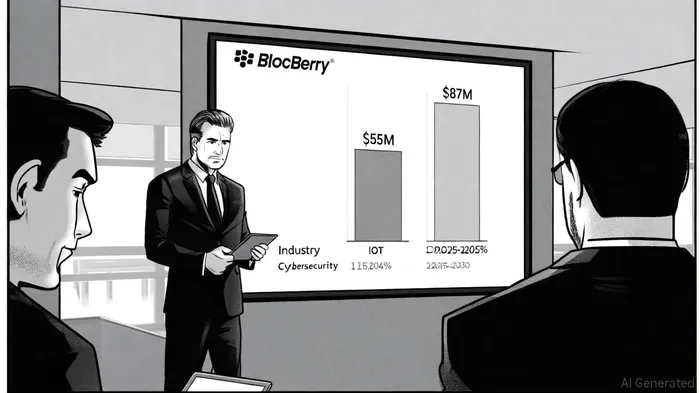
BlackBerry Limited (BB) delivered a mixed but telling performance in its Q2 2025 earnings report, offering a snapshot of its evolving role in the cybersecurity and IoT sectors. While the company posted a GAAP net loss of $19 million, it exceeded revenue guidance and achieved breakeven adjusted EBITDA, signaling progress in cost management and operational efficiency[2]. For investors, the key question is whether these short-term gains align with long-term growth in markets poised for explosive expansion.
Historically, BB's earnings-beat events since 2022 have shown limited persistence. While the 5-day average return after a beat has been +1.95%, returns typically fade by day 8 and turn negative. With only five such events in the period, the results lack statistical significance, but they suggest a pattern: short-term pops followed by profit-taking. This implies that while exceeding guidance is positive, investors may need to act quickly to capture upside before momentum dissipates.
Segment Strength: IoT and Cybersecurity Lead the Charge
BlackBerry's IoT segment revenue hit $55 million in Q2 2025, a 12% year-over-year increase driven by QNX royalty income[2]. This outperformed even the company's own guidance and reflects the enduring relevance of its QNX operating system in automotive and industrial applications. Meanwhile, the Cybersecurity division reported $87 million in revenue, up 10% year-over-year, with particular strength in secure communications products[2]. These results are encouraging given the global IoT market's projected CAGR of 15.04% (reaching $2.72 trillion by 2030) and the cybersecurity market's anticipated 12.45% CAGR (reaching $423.43 billion by 2030)[3].
BlackBerry's strategic focus on these segments appears well-timed. The company's AI-powered threat detection and IoT security platforms are increasingly attractive as enterprises grapple with rising cyber threats and the complexities of managing connected devices[5]. For instance, the QNX Hypervisor 8.0 launch underscores its ability to innovate in embedded systems, a critical area for autonomous vehicles and smart infrastructure[3].
Cost Discipline and Capital Allocation: A Path to Profitability?
Operating expenses fell 24% year-over-year to $99 million, a testament to aggressive cost-cutting measures[2]. This reduction, coupled with a 70% adjusted gross margin in the Secure Communications division[3], suggests BlackBerryBB-- is making strides toward profitability. The company also returned $10 million to shareholders via share buybacks, a move that signals confidence in its financial stability[3].
However, GAAP net income of $1.9 million in another report[3] contrasts sharply with the $19 million loss cited elsewhere[2]. This discrepancy highlights the importance of non-GAAP metrics in assessing the company's core operations. As noted in Harvard Business Review, non-GAAP adjustments—such as excluding stock-based compensation or restructuring charges—can obscure or clarify a company's true performance, depending on the lens[4]. For BlackBerry, this duality underscores the need for investors to scrutinize both GAAP and non-GAAP figures when evaluating progress.
Industry Tailwinds and Competitive Challenges
The cybersecurity and IoT markets are expanding rapidly, driven by AI-powered threats, 5G adoption, and the proliferation of edge computing[5]. BlackBerry's revised 2026 revenue forecast ($508–$538 million) hinges on its ability to capitalize on these trends[5]. Yet, the company faces headwinds. Post-Cylance acquisition integration has been rocky, and revenue growth excluding one-time patent sales has lagged[4]. Competitors like Cisco, Palo Alto Networks, and Siemens are also deepening their IoT and cybersecurity offerings, intensifying competition in a market where differentiation is key[5].
The Verdict: Caution Amid Optimism
BlackBerry's Q2 results suggest a company in transition. Its IoT and Cybersecurity segments are growing at a pace that mirrors industry projections, and cost discipline is improving margins. However, the GAAP net loss and integration challenges highlight unresolved risks. For long-term investors, the critical question is whether BlackBerry can sustain its current trajectory while scaling its offerings to compete in a crowded, high-stakes market.
If the company can maintain its focus on innovation—such as expanding its AI-driven security tools and leveraging QNX's dominance in automotive OS—it may yet carve out a niche in the trillion-dollar IoT and cybersecurity ecosystems. But for now, the path remains a tightrope walk between promise and peril.





Comentarios
Aún no hay comentarios