
'Black Monday' Just Striked Japan, Is The U.S. Stock Market Next In Line?
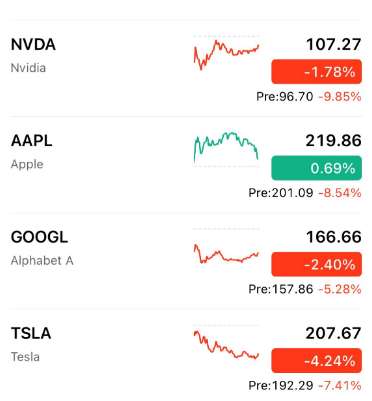
The panic sentiment in the market is still spreading: Before the market opened on Monday, U.S. technology stocks plummeted in pre-market trading. As of press time, NVIDIA fell over 9%, TSMC fell over 7%, Apple fell over 8%, Tesla fell over 7%, Microsoft fell over 4%, and Intel fell nearly 5%. At the same time, financial stocks also suffered a significant drop in pre-market trading - Bank of America fell nearly 5%, Citigroup fell over 5%, and Wells Fargo fell over 3%.
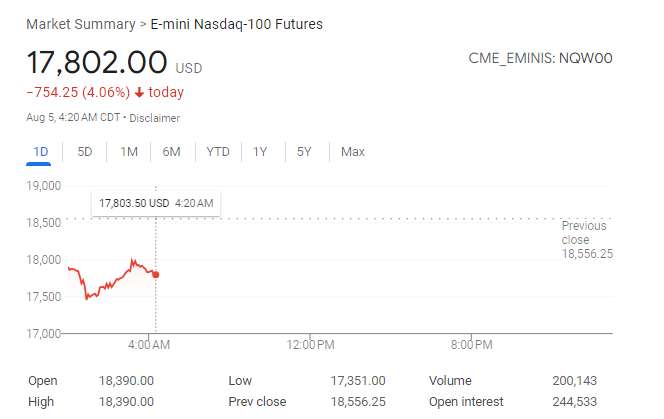
The Nasdaq 100 index futures once fell 6.5%, and then the decline quickly narrowed to around 4%. S&P 500 index futures fell 2.5%, and Dow Jones Industrial Average futures fell 1.6%.
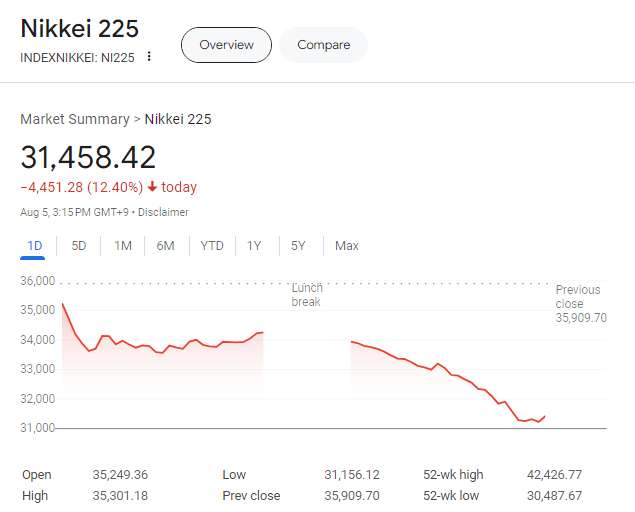
It is worth noting that on the other side of the ocean in Japan, Black Monday has already taken place: After the market opened on Monday, the Nikkei 225 index plummeted by 7% in the morning! It set a new low on January 11th. The Tokyo Stock Exchange index circuit breaker was triggered, falling 20% from the July high, entering a technical bear market. Among them, the Japanese Tokyo Stock Exchange bank stock index fell as much as 12%.
For the U.S. stocks that have already experienced a brutal week, Black Monday is definitely a situation that no one wants to see. However, some analysts point out that the pre-market decline indicates that the air is coming out of equity markets, and due to the previous high concentration of U.S. stocks, the future outlook is not optimistic.
More losses are possible if confidence in the AI trade is dented further due to weak earnings, and if the US economy does indeed hit a bump. , some analysts say.
Meanwhile, Russell Napier, co-founder of the investment research portal ERIC, also stated in the latest macro strategy report that investors have caught a glimpse of the impact that changes in Japanese monetary policy may have on the U.S. financial market.
That there is such a strong relationship between the structure of monetary policy in China and Japan and US assets prices will come as a huge shock for most US investors, Napier said in the report released on Tuesday.
However, some people believe that although the decline looks frightening, these are all normal phenomena: Cedric Chehab, head of global country risk at research firm BMI, said that over the past ten days or so, a variety of factors have been at play. However, he insists that corrections like this are absolutely normal at this time of year. At the same time, he also pointed out that some investors seem to have forgotten one factor, that is, during the period from July to October, stock market volatility usually rises seasonally.
Christian Mueller-Glissmann, an economist at Goldman Sachs, also believes that the current market situation in U.S. stocks is a relatively healthy correction. He also said that although the weakness of U.S. data was a surprise, the economists at Goldman Sachs are not that worried.





Comentarios
Aún no hay comentarios