
Bitwise's Spot Hyperliquid ETF and the Evolving Decentralized Exchange Landscape
The filing of Bitwise's Spot Hyperliquid ETF represents a pivotal moment in the convergence of traditional finance and decentralized finance (DeFi). By proposing the first U.S.-regulated investment vehicle directly tied to a DeFi protocol token—Hyperliquid's HYPE—the asset manager is challenging conventional market structures while navigating a regulatory landscape in fluxFLUX--. This development underscores both the disruptive potential of decentralized exchanges (DEXs) and the evolving alignment of crypto innovation with institutional-grade investment frameworks.
Market Structure Disruption: In-Kind Mechanisms and DEX Integration
Bitwise's ETF leverages an in-kind creation and redemption model, a structure recently endorsed by the SEC for its efficiency and cost-effectiveness in crypto funds[1]. Unlike cash-based ETFs, this mechanism allows investors to exchange shares directly for HYPE tokens, mirroring the operational simplicity of BitcoinBTC-- and EthereumETH-- ETFs. This design reduces counterparty risk and aligns with the ethos of DeFi, where transparency and direct asset ownership are paramount[3].
Hyperliquid's DEX underpins this innovation. The platform's fully on-chain order book, zero gas fees, and sub-second finality create a hybrid model that rivals centralized exchanges while preserving decentralization[4]. Its integration of protocol-owned market makers, such as the Hyperliquidity Provider (HLP) vault, further enhances liquidity for large trades—a critical feature for institutional investors seeking reliable execution[3]. These attributes position the Bitwise ETF as more than a token wrapper; it is a bridge between DeFi's technical capabilities and traditional market infrastructure.
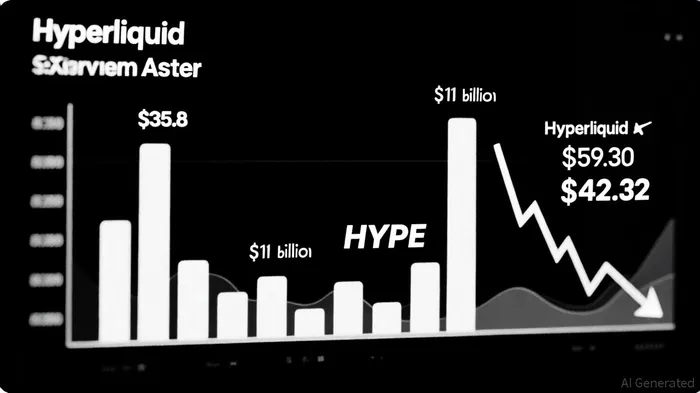
However, Hyperliquid faces stiff competition. Rival DEX Aster has surged ahead, reporting $35.8 billion in 24-hour trading volume—tripling Hyperliquid's $10 billion—and $1.15 billion in open interest for its token[1]. This competitive pressure highlights the fragility of market share in the decentralized futures space, where user experience and liquidity are decisive factors.
Regulatory Alignment: SEC Policies and the CFTC Conundrum
The SEC's recent introduction of generic listing standards for crypto ETFs signals a shift toward accommodating digital assets[1]. Bitwise's filing under Form S-1 aligns with these standards, yet the absence of registered Hyperliquid futures with the Commodity Futures Trading Commission (CFTC) complicates the approval process[4]. Without CFTC-registered futures, the ETF cannot qualify for the SEC's expedited review, potentially extending the approval timeline to 240 days[1].
This regulatory bottleneck reflects broader uncertainties in the crypto sector. While the SEC has shown openness to in-kind models, the lack of a clear framework for altcoin ETFs—unlike the well-trodden path for Bitcoin and Ethereum—creates ambiguity for firms like Bitwise[2]. The outcome of this filing could set a precedent for future altcoin ETFs, particularly if the SEC prioritizes innovation alongside investor protection.
Competitive Landscape and Token Price Pressures
Despite the ETF's potential to bolster Hyperliquid's institutional credibility, the HYPE token has struggled. Its price has fallen over 25% from a peak of $59.30 to $42.32 in a week[5], reflecting broader market skepticism and competitive headwinds. Aster's dominance in trading volume and open interest exacerbates these challenges, raising questions about Hyperliquid's ability to retain market share[1].
The ETF's approval could stabilize HYPE's trajectory by injecting institutional demand. However, the token's performance will ultimately depend on Hyperliquid's ability to differentiate itself through technological innovation and user adoption.
Implications for DeFi and Traditional Finance
Bitwise's initiative marks a critical step in mainstream finance's integration with DeFi. By offering regulated exposure to a DeFi protocol token, the ETF could catalyze broader acceptance of decentralized infrastructure in traditional investment vehicles[3]. This alignment is not without risks, however. The SEC's cautious approach and the volatility of DeFi tokens underscore the need for robust governance and risk management frameworks.
For investors, the Bitwise Hyperliquid ETF represents both opportunity and uncertainty. It opens a new asset class to those wary of the complexities of direct DeFi participation while testing the regulatory boundaries of crypto innovation.
Conclusion
Bitwise's Spot Hyperliquid ETF is a bold experiment at the intersection of DeFi and traditional finance. Its success hinges on regulatory alignment, competitive differentiation, and the broader market's appetite for decentralized assets. As the SEC deliberates, the filing serves as a litmus test for the sector's readiness to embrace a new era of market structure—one where decentralized protocols and institutional-grade investment vehicles coexist.







Comentarios
Aún no hay comentarios