
Bitwise's HYPE ETF: A New Frontier for Regulated Crypto Derivatives Exposure
The crypto derivatives market is undergoing a seismic shift as institutional demand for regulated exposure to digital assets intensifies. At the forefront of this evolution is Bitwise's proposed Hyperliquid HYPE ETF, a physically backed exchange-traded fund that could redefine how investors access decentralized derivatives platforms. By directly holding HYPE tokens—Hyperliquid's native utility and governance token—the ETF aims to bridge the gap between traditional finance and the rapidly expanding DeFi ecosystem.
The Strategic Value of Token-Backed ETFs
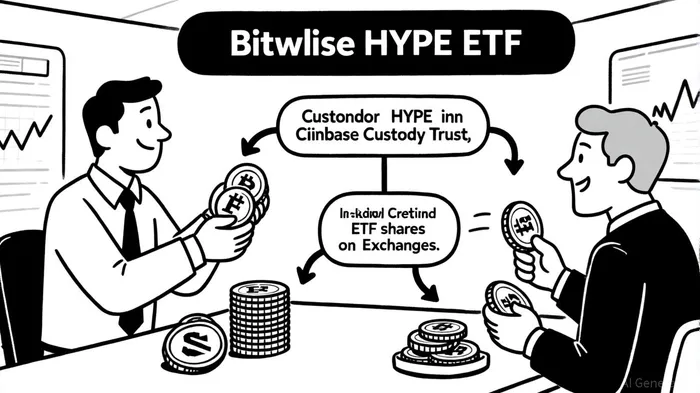
Token-backed ETFs like Bitwise's HYPE offering represent a critical innovation in crypto asset accessibility. Unlike synthetic or futures-based products, these funds hold the underlying asset, reducing counterparty risk and aligning with investor demand for transparency[1]. The HYPE ETF's in-kind creation and redemption mechanism further enhances efficiency, allowing authorized participants to exchange ETF shares for HYPE tokens directly[2]. This structure minimizes tracking errors and operational costs, addressing key criticisms of earlier crypto ETF proposals[3].
For Hyperliquid, a Layer 1 blockchain focused on perpetual futures trading, the ETF could catalyze broader adoption of its platform. HYPE tokens already serve as the backbone of Hyperliquid's ecosystem, funding fee discounts, staking rewards, and governance. With 97% of trading fees allocated to token buybacks and staking[4], the token's utility is deeply intertwined with the platform's growth. The ETF introduces a new liquidity channel for retail and institutional investors, potentially amplifying demand for HYPE and reinforcing its role in the DeFi stack.
Regulatory Hurdles and Market Implications
Despite its promise, the HYPE ETF faces a protracted SEC approval process. The absence of CFTC-regulated HYPE futures means the fund cannot leverage the SEC's expedited review pathway, potentially delaying launch by up to 240 days[5]. This regulatory uncertainty contrasts with the recent approval of spot BitcoinBTC-- ETFs, highlighting the SEC's cautious approach to newer crypto assets. However, Bitwise's alignment with the SEC's July 2025 guidance on in-kind creation/redemption mechanisms[6] suggests the firm is navigating these challenges strategically.
Market dynamics also present both opportunities and risks. Hyperliquid's dominance in on-chain perpetual trading volume—surpassing platforms like dYdXDYDX-- and Aster[7]—positions HYPE as a compelling candidate for institutional investment. Yet, competition from emerging DEXs like Aster, which recently outpaced Hyperliquid in trading volume[8], underscores the need for continuous innovation. Analysts project HYPE's price could rise to $55 if key support levels hold, with a Sum-of-the-Parts (SOTP) valuation model estimating a fair value range of $38–$59[9]. These projections hinge on the ETF's approval and broader adoption of Hyperliquid's revenue-sharing model.
The Bigger Picture: Crypto Derivatives and Institutional Adoption
The HYPE ETF is emblematic of a larger trend: the convergence of crypto derivatives and traditional finance. As decentralized exchanges capture a growing share of derivatives trading—Hyperliquid's revenue exceeded $1.2 billion in 2025[10]—investors are demanding regulated vehicles to participate in this market. Bitwise's partnership with Coinbase Custody Trust Company[11] and backing from firms like Galaxy DigitalGLXY-- and Pantera Capital[12] signal confidence in the token's long-term value.
However, the success of the HYPE ETF will depend on its ability to attract liquidity and maintain price alignment with the underlying asset. If approved, it could set a precedent for future token-backed ETFs, particularly for projects in the DeFi and blockchain infrastructure spaces. For now, the 240-day SEC review period offers a critical window for Hyperliquid to solidify its market position and demonstrate the strategic value of token-backed exposure in a derivatives-driven crypto economy.





Comentarios
Aún no hay comentarios