
Bittensor (TAO) Price Potential: A Technical and Sentiment-Driven Deep Dive
The Decentralized AI Gold Rush: Is BittensorTAO-- (TAO) the Next Big Thing?
Bittensor (TAO) has emerged as a pivotal player in the decentralized AI revolution, leveraging blockchain to democratize AI model development. By incentivizing miners and validators to contribute computational power and refine AI models, TAOTAO-- aims to create a self-sustaining ecosystem where value is distributed fairly. As of September 2025, TAO trades at $323, with a market cap of $3.16 billion, but its price trajectory remains a tug-of-war between technical indicators and market sentiment.
Technical Analysis: A Crossroads of Opportunity and Risk
Price Action and Key Levels
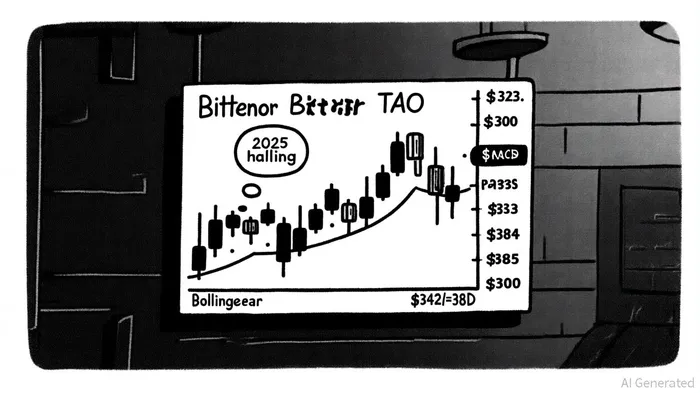
TAO's current price of $323 sits below the Bollinger mid-band at $342, with critical support at $300 and resistance clustered between $342–$384. A breakout above $342 could trigger a rally toward $384, while a drop below $300 may test the $240 psychological level[1]. The Relative Strength Index (RSI) at 42.8 suggests neutral to slightly bearish momentum, and the negative MACD indicates waning short-term bullish energy[1].
Supply Dynamics and Catalysts
The first Bittensor halving, expected in Q4 2025, will reduce TAO's supply by 50%, potentially creating scarcity-driven demand[1]. Historically, halving events in BitcoinBTC-- and other blockchains have led to price surges, and TAO's staking activity—currently at 72% of the total supply—further reduces circulating liquidity, enhancing price stability.
Parabolic Potential
If TAO sustains a breakout above $342 and Bitcoin's bull cycle aligns with AI adoption trends, a parabolic move to $620–$700 is plausible by year-end 2025[1]. However, this hinges on enterprise integrations and subnet adoption, which remain unproven at scale.
Market Sentiment: Fear, Greed, and the AI Hype Cycle
Bearish Pressures
The Fear & Greed Index for TAO stands at 44 (out of 100), reflecting widespread fear among investors[2]. Over the past month, TAO has dropped 6.63%, and its annual decline of 44.18% mirrors broader crypto market weakness[2]. Analysts caution that token unlocks and macroeconomic headwinds could exacerbate volatility.
Bullish Drivers
Conversely, TAO's unique value proposition—decentralized AI model training and a tokenized incentive structure—positions it to capitalize on the $1.8 trillion AI market[3]. Enterprise partnerships and subnet specialization (e.g., text prompting, data prediction) could drive demand for TAO as a utility token[1]. Long-term forecasts suggest an average price of $5,346.52 by 2030, assuming regulatory tailwinds and sustained adoption[1].
Social and On-Chain Metrics
Staking activity remains robust, with 72% of TAO tokens locked, reducing sell pressure. However, social media sentiment is mixed, with 76% of indicators favoring a bearish outlook[2]. This divergence between on-chain strength and social fear underscores the market's uncertainty.
The Road Ahead: Balancing Risks and Rewards
Short-Term Outlook (2025–2026)
TAO faces a critical inflection point. A successful halving event and subnet expansion could propel it to $392.18 by year-end 2025[3], but a breakdown below $300 would likely trigger a bearish scenario of $145.9[1]. Investors should monitor on-chain metrics like staking ratios and subnet participation rates.
Long-Term Potential (2026–2030)
If Bittensor secures enterprise AI contracts and regulatory clarity, TAO could mirror Bitcoin's 2017–2018 trajectory, with a 2029 price target of $632.29[3]. However, this requires overcoming challenges like token dilution and competition from centralized AI platforms.
Conclusion: A High-Volatility Bet with AI-Driven Upside
Bittensor (TAO) embodies the disruptive potential of decentralized AI, but its price action reflects the inherent risks of a nascent ecosystem. While technical indicators and market sentiment remain conflicted, the project's innovative architecture and supply-side catalysts (halving, staking) offer compelling upside for risk-tolerant investors. As with any speculative asset, due diligence is paramount—monitoring subnet adoption, enterprise integrations, and macroeconomic trends will be key to navigating TAO's volatile journey.






Comentarios
Aún no hay comentarios