
Bittensor (TAO) and the Halving-Driven Scarcity Play: A Catalyst for a 2025 Bull Run
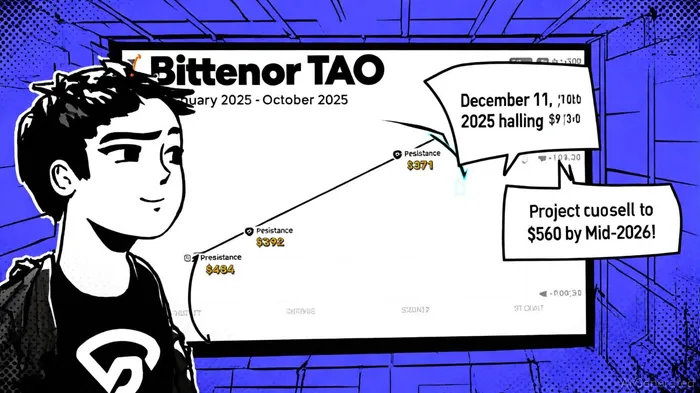
The cryptocurrency market is on the cusp of a pivotal event: Bittensor's (TAO) first halving on December 11, 2025. This economic milestone, modeled after Bitcoin's scarcity-driven framework, is set to reduce daily TAOTAO-- emissions by 50%, from 7,200 to 3,600 tokens per day. For investors, this represents more than just a technical adjustment-it's a structural catalyst for price discovery in a market already primed by speculative momentum and institutional validation.
Historical Parallels and Scarcity Dynamics
Bitcoin's halving history offers a compelling blueprint. Each of its three halvings has been followed by multi-year bull runs, driven by reduced supply and sustained demand. Bittensor's halving mirrors this model, with the added nuance of a 21 million supply cap and a decentralized AI network that ties token utility to real-world value creation [1]. According to a report by Holder.io, the reduction in TAO emissions will directly lower market sell pressure, creating a supply-demand imbalance that historically favors price appreciation [5].
The Dynamic TAO upgrade in February 2025 further amplifies this effect. By introducing subnet-specific AlphaALPHA-- tokens, the network diversified TAO's utility while aligning its halving schedule with subnet emissions. This means liquidity in subnet trading pools will contract by 50%, potentially driving volatility and incentivizing TAO as the primary staking asset [6]. Analysts at Cointeeth note that this dual-layer scarcity mechanism could accelerate TAO's adoption as a "store of value" in the AI sector [6].
On-Chain Activity and Technical Momentum
TAO's on-chain metrics tell a story of bullish consolidation. As of October 2025, the token is trading within a tightening triangle pattern, oscillating between $320 and $328 [4]. A breakout above the $484 resistance level-confirmed by a close above the 20-day EMA-could trigger a rally toward $560, as highlighted by TronWeekly analysts [6]. The Relative Strength Index (RSI) and Moving Average Convergence Divergence (MACD) indicators both suggest increasing buying pressure, with RSI hovering near overbought territory and MACD showing positive divergence [6].
Institutional Validation and Market Sentiment
Institutional adoption is another tailwind. Grayscale's recent filing for a BittensorTAO-- Trust has injected credibility, while Coinbase Institutional and public companies like Oblong and TAO Synergies have added TAO to their treasuries [3]. This institutional validation is critical in a market where retail speculation often drives short-term volatility. Coinpedia reports that TAO's recovery from a major liquidation event in early 2025 has further solidified investor confidence, with Grayscale's interest acting as a liquidity catalyst [5].
Market sentiment remains cautiously optimistic. While prices have yet to break above $400, the token's unique position in the AI sector-hosting 63+ subnets and competing with centralized rivals like OpenAI-positions it as a beneficiary of the AI hype cycle [3]. The Yuma Consensus mechanism, which rewards the most useful AI models, adds a layer of utility that differentiates TAO from pure speculative assets [5].
Risks and Realities
No analysis is complete without addressing risks. Regulatory scrutiny looms over AI-driven networks, and Bittensor's high computational demands could strain adoption. However, these challenges are not insurmountable. The halving itself acts as a buffer, reducing emissions at a time when demand is likely to outpace supply.
Conclusion: A Halving-Driven Bull Case
Bittensor's December 2025 halving is more than a technical event-it's a structural inflection point. By reducing emissions, diversifying utility, and aligning with institutional adoption, TAO is positioning itself as a scarcity-driven asset in the AI revolution. While $1,500 by year-end and $7,000 by 2030 may seem ambitious, the historical precedent of Bitcoin's halvings and the current technical setup suggest that a multi-month bull run is not only possible but probable.
For investors, the key is to monitor the $484 breakout level and institutional flows in the coming weeks. If TAO can clear this threshold, the path to $560-and beyond-becomes increasingly clear.






Comentarios
Aún no hay comentarios