
Bittensor's TAO: A $500 Post-Halving Play Driven by On-Chain Incentives and Network Value Capture
The Halving Event: Scarcity as a Catalyst
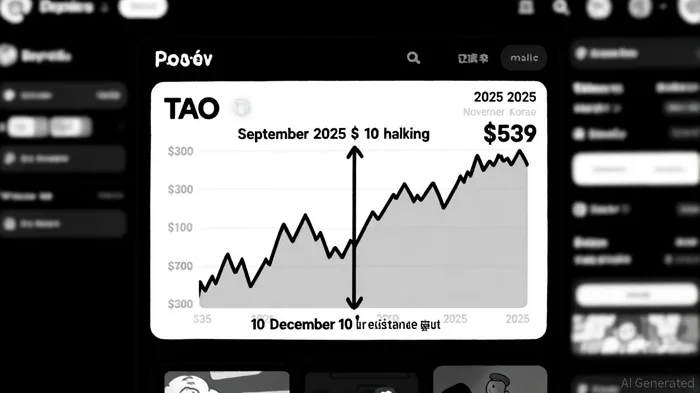
Bittensor's halving mechanism mirrors Bitcoin's deflationary playbook but with a twist tailored to AI infrastructure. Daily TAO emissions will drop from 7,200 to 3,600 tokens post-halving, reducing annual inflation from ~26% to ~13%, according to an ASVA Capital analysis. This drastic reduction in supply is designed to counteract sell pressure from miners and validators, who currently face a liquidity crunch as subnet token pools shrink, as noted in a Panewslab analysis. The halving also introduces a supply-milestone trigger-activated when circulating supply hits 10.5M TAO-ensuring scarcity remains a core feature even as adoption scales.
Historically, halving events in BitcoinBTC-- and other proof-of-work models have led to price surges due to reduced supply elasticity. For TAO, the effect could be amplified by its dual role as both a governance token and a utility token for AI computation. As one analyst notes, "The halving isn't just a supply shock-it's a signal to the market that TAO's scarcity premium is now baked into its value proposition."
On-Chain Incentives: Staking, Yield, and Validator Competition
The launch of Europe's first staked TAO ETP (STAO) by Deutsche Digital Assets and Safello has been a game-changer. This product offers investors a 10% annual yield through staking rewards, according to a Coinotag report, effectively transforming TAO into a "bond-like" asset for institutional portfolios. The ETP's success-sparking a 20% price jump in a week-highlights how on-chain incentives can drive demand.
Post-halving, validator competition will intensify. Weaker subnets, which rely on emissions to sustain activity, may struggle with liquidity and slippage, while stronger subnets (e.g., those focused on high-demand AI applications like Sportstensor) will attract more TAO due to efficiency and performance. This "flight to quality" dynamic creates a self-reinforcing cycle: better subnets earn more TAO, which further improves their computational output, attracting even more stakers.
The staking ratio, already at 71.67%, suggests robust confidence in the network. With halving reducing emissions, validators will need to rely more on transaction fees and subnet-specific rewards to maintain equilibrium. This shift could drive innovation in niche AI applications, further cementing TAO's utility.
Network Value Capture: From ETPs to Institutional Staking
Bittensor's network value capture is now being amplified by institutional-grade products. The STAO ETP, with its 1.49% management fee, is detailed in an ETF Express article, and provides a regulated on-ramp for pension funds and hedge funds, many of which are already staking TAO through entities like Grayscale's Decentralized AI Fund, per an NFTPlazas article. This institutional adoption is critical: it notNOT-- only boosts demand but also stabilizes the network by locking up tokens for extended periods.
Derivatives markets are also signaling bullish sentiment. Open interest in TAO derivatives has surged to $446.28 million, while spot volume spiked by 100% post-ETP launch. These metrics suggest that both retail and institutional players are positioning for a post-halving rally.
The $500 Thesis: Scarcity, Yield, and AI Utility
To reach $500, TAO must break through its $470–$480 near-term resistance. The halving, combined with the ETP-driven yield premium, creates a strong case for this. Here's the math:
- Supply Reduction: A 50% cut in emissions will reduce sell pressure, pushing TAO's price-to-utility ratio higher.
- Yield Arbitrage: At 10% annual staking rewards, TAO's yield outperforms most crypto assets, making it a magnet for capital.
- AI Network Effects: As more subnets optimize for computational efficiency, TAO's role as a governance token will grow, increasing its scarcity premium.
Analysts project TAO could test $560–$570 post-halving, assuming bullish momentum continues. Even conservative estimates suggest $500 is within reach, given the current trajectory.
Risks and Considerations
While the case for TAO is compelling, risks remain. The halving could exacerbate volatility, especially if weaker subnets struggle to adapt. Regulatory shifts in the ETP space could also impact adoption. However, the token's unique position at the intersection of AI and crypto-coupled with its deflationary design-positions it as a long-term winner.






Comentarios
Aún no hay comentarios