
Bittensor's December 2025 Halving and Its Impact on TAO's Scarcity and Subnet Liquidity
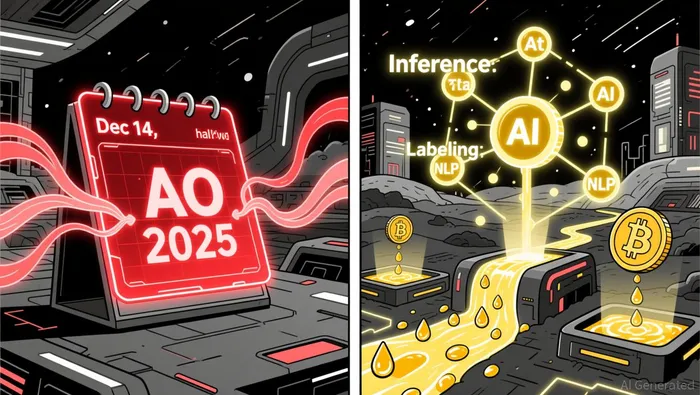
The BittensorTAO-- (TAO) network is on the verge of a pivotal moment: its first halving event, scheduled for December 14, 2025. This event will reduce daily TAOTAO-- emissions from 7,200 to 3,600 tokens, effectively halving the rate at which new TAO enters circulation. For investors and participants in the decentralized AI ecosystem, this structural shift represents more than a technical adjustment-it's a catalyst for redefining TAO's scarcity-driven valuation and the liquidity dynamics of its subnet economy.
Scarcity as a Valuation Engine
Bittensor's halving mirrors Bitcoin's supply model, where reduced issuance creates artificial scarcity. By cutting emissions in half, the network's inflation rate drops from ~26% to ~13%, aligning TAO with a deflationary trajectory. This scarcity is not just symbolic; it directly impacts valuation. As of mid-October 2025, TAO trades at ~$389 with a $3.7 billion market cap, according to data. Analysts argue that the halving could push the token out of its two-year accumulation range, with bullish forecasts suggesting a potential $1,000 price tag by year-end 2025 and $2,000 by early 2026.
The logic is straightforward: if demand for TAO remains stable or grows-driven by institutional adoption or AI subnet utility-reduced supply will drive upward price pressure. This is already evident in the market's anticipation of the event. For instance, Grayscale's Bittensor Trust and TAO listings on major exchanges have attracted institutional capital, further solidifying TAO's appeal as a scarce, AI-native asset.
Subnet Liquidity and the dTAO Upgrade
The halving's impact extends beyond token scarcity to the mechanics of subnet liquidity. Bittensor's Dynamic TAO (dTAO) upgrade has transformed how liquidity is allocated. Instead of a centralized validator-driven model, dTAO enables subnet-specific liquidity pools, where TAO holders stake tokens to receive alphaALPHA-- tokens tied to particular subnets, according to research. This system rewards subnets based on performance metrics like computational output and user engagement, creating a market-driven incentive structure.
Post-halving, the reduced TAO supply will amplify competition for liquidity. Subnets with strong fundamentals-such as those offering high-value AI services like inference or data labeling-will attract more stakers, securing a larger share of the 3,600 daily emissions. Conversely, weaker subnets may struggle to maintain liquidity, leading to faster decomposition. Early subnets, which already control ~50% of daily emissions, are poised to benefit, while newer subnets face a steeper uphill battle.
The dTAO distribution model-41% to miners, 41% to validators, and 18% to subnet owners-further underscores this shift. Performance-based emissions ensure that subnets delivering the most value capture a disproportionate share of rewards, according to market analysis. This aligns with Bittensor's vision of a decentralized AI network where liquidity and utility are inextricably linked.
Validator behavior and staking incentives will play a pivotal role in how the halving unfolds. With ~80.95% of TAO already staked, the halving will likely intensify staking activity. Validators and miners, facing reduced rewards, may double down on efficiency to maintain returns. This could lead to a more secure and performant network, as participants optimize their hardware and strategies to compete for a smaller but more valuable pool of emissions.
The Root Subnet (Subnet 0), once central to reward allocation, has seen its influence wane under dTAO. Its staking weight is now 18%, compared to the 41% allocated to subnet-specific alpha tokens. This shift reflects Bittensor's maturation: the network is no longer a monolithic entity but a collection of specialized subnets, each vying for liquidity and emissions in a decentralized marketplace.
Institutional interest and market implications have taken center stage in the lead-up to the halving. Products like Grayscale's Bittensor Trust and the introduction of dynamic TAO have made TAO more accessible to institutional investors. This influx of capital could offset the reduced supply, creating a self-reinforcing cycle where scarcity and demand drive price appreciation.
However, risks remain. Subnets with weak fundamentals may see alpha token prices collapse under liquidity pressure, particularly if TAO's price stagnates post-halving. Additionally, the transition to a deflationary model could strain smaller participants who lack the resources to compete for liquidity.
Conclusion: A New Era for Bittensor
Bittensor's December 2025 halving is more than a technical event-it's a structural inflection point. By reducing TAO emissions, the network is accelerating its transition to a scarcity-driven model, where value is derived from both token economics and AI utility. For investors, the key question is whether demand for TAO and its subnets will outpace the reduced supply.
If history is any guide-Bitcoin's halvings have historically preceded bull markets-the stage is set for TAO to break out. But unlike BitcoinBTC--, Bittensor's value is tied to the real-world utility of its decentralized AI network. As AI adoption accelerates, TAO's scarcity and subnet liquidity dynamics could position it as a unique asset in the crypto landscape.







Comentarios
Aún no hay comentarios