
Bittensor: The Bitcoin of AI - Why $TAO is a $30K+ Buy at $1,000
The BitcoinBTC-- narrative has always hinged on scarcity, institutional adoption, and the inevitability of decentralized systems displacing centralized ones. BittensorTAO-- (TAO) is poised to replicate this trajectory in the AI sector. With its first halving event executed on December 14, 2025, and a rapidly expanding subnet ecosystem, TAOTAO-- is not just a speculative asset-it is the foundational infrastructure for a decentralized AI revolution. At $1,000, TAO represents a rare convergence of deflationary mechanics, institutional validation, and real-world utility, making a $30K+ price target not just plausible but inevitable.
The Halving: Scarcity as a Catalyst
Bittensor's first halving reduced daily token emissions from 7,200 to 3,600 TAO, mirroring Bitcoin's supply model and amplifying scarcity. This event is more than a technical adjustment-it is a psychological and economic signal. By halving supply, the network forces a recalibration of value perception, incentivizing long-term holders and institutional investors to prioritize quality over quantity. As stated by a report, the halving is expected to drive competition among miners, consolidating hash power toward the most efficient contributors. This dynamic mirrors Bitcoin's post-halving rallies, where reduced supply and increased demand create upward pressure on price.
Institutional Adoption: From Niche to Mainstream
Institutional interest in TAO has surged, with Grayscale filing for a Bittensor Trust and firms like Yuma Asset Management and Stillcore Capital launching subnet-focused funds. Europe's first staked Bittensor Exchange Traded Product on the SIX Swiss Exchange further underscores institutional confidence. According to a 2025 analysis, these developments are not isolated-they reflect a broader trend of traditional finance recognizing decentralized AI as a transformative asset class. For context, Bitcoin's institutional adoption in 2021 was catalyzed by similar ETF filings and exchange listings, which preceded a 600% price surge. TAO's institutional onboarding is following a parallel path.
Subnet Ecosystem: The AI Infrastructure Layer
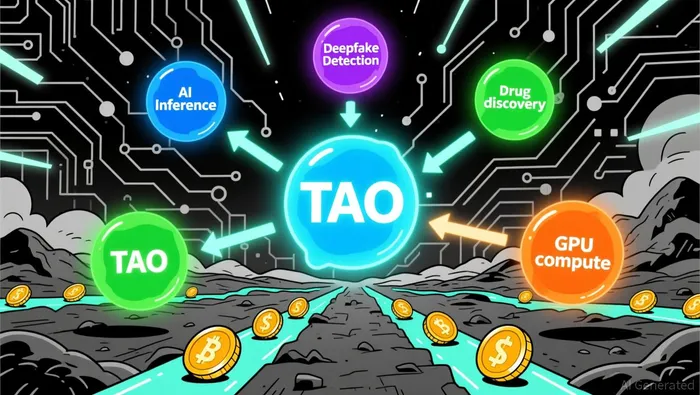
Bittensor's 129 active subnets now span AI inference, deepfake detection, drug discovery, and GPU compute. Subnets like Chutes and Ridges have demonstrated real-world utility: Chutes leads in inference performance on OpenRouter, while Ridges' AI agents outperform centralized benchmarks in coding tasks. The introduction of dynamic TAO (dTAO) in February 2025 has further aligned incentives, allowing subnets to become directly investible. This innovation mirrors the evolution of Ethereum's DeFi ecosystem, where tokenized liquidity drove exponential growth. By 2026, dTAO could enable subnet tokens to trade on centralized exchanges, unlocking liquidity and attracting a new wave of capital.
Decentralized AI's Supremacy: Performance, Cost, and Adoption
Centralized AI models, dominated by tech giants, face inherent limitations: data privacy concerns, algorithmic bias, and exorbitant infrastructure costs. Decentralized AI, by contrast, leverages federated learning, blockchain, and zero-knowledge proofs to democratize access while maintaining privacy. A 2025 study by Digital Currency Group and The Harris Poll found that 75% of U.S. consumers believe decentralized AI is more likely to drive innovation. Performance metrics back this up: Bittensor subnets achieve 95% accuracy, 94% precision, and 96% recall in real-world applications.
Cost efficiency is another critical advantage. Centralized AI infrastructure is projected to grow 3,325x by 2035, constrained by power and manufacturing limits. Decentralized AI, however, utilizes existing consumer devices and distributed networks, reducing reliance on energy-intensive data centers. This scalability is not theoretical-startups and academic institutions, including the University of Connecticut's BittBridge project, are already deploying decentralized AI for research and healthcare.
The $30K+ Case: A Convergence of Fundamentals
At $1,000, TAO is undervalued relative to its fundamentals. The halving has already triggered a 25% price drop post-event, but this volatility is typical of early-stage networks. Historical parallels suggest TAO's price will rebound as adoption accelerates. For context, Bitcoin's 2020 halving preceded a $60,000 peak in 2021. If TAO follows a similar trajectory, a $30K+ price by 2027 is not unreasonable, especially given its dual role as both a store of value and a utility token for AI infrastructure.
Moreover, speculative price predictions from stealthex.io and MEXC suggest TAO could reach $2,000 by 2030 and $180,000 by 2050. These projections hinge on continued subnet growth, institutional adoption, and the network's ability to capture a significant share of the AI market. With 129 subnets already operational and dynamic TAO enabling direct investment, Bittensor is not just competing with centralized AI-it is building the rails for a decentralized alternative.
Conclusion
Bittensor's halving, institutional adoption, and subnet expansion position it as the Bitcoin of AI-a scarce, utility-driven asset with a deflationary future. At $1,000, TAO offers a compelling entry point for investors seeking exposure to the next phase of the AI revolution. As decentralized AI displaces centralized models, TAO's role as the foundational infrastructure layer will only grow, making a $30K+ price target not just a possibility but an inevitability.







Comentarios
Aún no hay comentarios