
BitMine's Premarket Slide: Is Kerrisdale's Critique a Catalyst for Long-Term Value or a Short-Sighted Bearish Play?
The recent premarket slide in BitMine ImmersionBMNR-- (BMNR) has reignited debates about the sustainability of its Ethereum-focused business model. Short-seller Kerrisdale Capital's October 2025 report, which labeled BitMine's strategy as "on its way to extinction," has drawn both skepticism and scrutiny. To assess whether this critique is a catalyst for long-term value or a short-sighted bearish play, one must dissect the firm's financial fundamentals, industry benchmarks, and the broader crypto ecosystem.
Kerrisdale's Case: A Model in Crisis
Kerrisdale's argument hinges on three pillars. First, it criticizes BitMine's reliance on issuing shares at a premium to purchase EthereumETH--, a strategy it deems unsustainable in a market where investor fatigue is setting in. The firm notes that BitMineBMNR-- raised over $10 billion in stock offerings over three months, diluting existing shareholders and eroding the per-share accretion that once justified its valuation, as detailed in a Cointelegraph report. The $365 million direct offering in late September, for instance, was labeled a "discounted giveaway" when factoring in attached warrants in a Yahoo Finance piece.
Second, Kerrisdale highlights BitMine's lack of innovation compared to peers like Marathon Digital and Core Scientific, which have diversified into high-performance computing (HPC) and renewable energy. BitMine's pivot to an Ethereum treasury model, while ambitious, lacks the operational scalability or technological differentiation to sustain its premium over time, according to a CryptoNews article.
Third, the firm contrasts BitMine's leadership-particularly Tom Lee-with figures like Michael Saylor of MicroStrategy, arguing that Lee's "meme-like" appeal is insufficient to anchor investor confidence in a maturing market, citing the company's Q2 2025 earnings. This critique is amplified by BitMine's narrowing net asset value (NAV) premium, which fell from 2.0x in August to 1.2x in October 2025, per a Yahoo NAV analysis.
BitMine's Financials: A House of Cards?
BitMine's financials underscore Kerrisdale's concerns. Despite a 70% year-over-year revenue increase in Q2 2025, the company reported a net loss of $1.16 million, with a -76.2% net profit margin, as noted in a Panabee report. Its price-to-book ratio of 3,517.9x-far exceeding industry averages-suggests a valuation disconnected from fundamentals, according to a Simply Wall St DCF. A discounted cash flow (DCF) model from Simply Wall Street estimates its fair value at $0.54 per share, versus its $56.65 trading price in a GlobeNewswire release.
Liquidity challenges further complicate the picture. BitMine holds only $483,000 in cash, per an Amberdata Q1 report, and relies on a $1.88 million loan from a related party, according to a Messari report. Its recent $2.96 million "deemed dividend" from a Series A Preferred conversion and a $124,000 bad debt expense from a defaulted joint venture loan highlight operational fragility, as noted in a Gate Research review.
Industry Benchmarks: A Tale of Two Models
To contextualize BitMine's valuation, consider its peers. Marathon Digital (MARA), with a P/B ratio of 1.2x and a hash rate of 53.2 EH/s, trades at a discount to its book value despite Bitcoin's volatility, according to a CoinCodex article. Core Scientific (CORZ), which emerged from bankruptcy in 2024, boasts a 179.9% stock price surge year-to-date, driven by HPC diversification and cost optimization in a Yahoo analysis. By contrast, BitMine's P/B ratio is orders of magnitude higher, raising questions about its ability to justify such a premium without earnings growth or operational efficiency.
Ethereum's Q1 2025 performance also complicates BitMine's strategy. The asset's 45% price drop from $3,300 to $1,800, shown in Binance Research charts,-outpacing Bitcoin's 12% decline-undermines the logic of holding large ETH treasuries. While the Pectra upgrade improved scalability, Ethereum's inflationary trajectory (0.6% annualized) and declining on-chain fees ($216.4 million QoQ), highlighted in a CoinGecko report, suggest a market struggling to retain user activity.
The Long-Term Outlook: Catalyst or Correction?
Kerrisdale's critique is not without merit. BitMine's reliance on equity issuance, coupled with its lack of operational diversification, exposes it to market headwinds. However, the firm's strategic pivot to Ethereum treasury holdings-backed by institutional support from ARKARK-- Invest and Founders Fund-could still yield value if Ethereum's price recovers. The Pectra upgrade and growing institutional staking activity (27.67 million ETH staked as of Q1 2025, according to Panabee) hint at long-term potential.
Yet, the key question remains: Is BitMine's model a speculative bet on Ethereum's future, or a fundamentally flawed approach to capital allocation? For now, the data suggests the latter. Its inflated valuation, liquidity risks, and reliance on dilutive financing align with Kerrisdale's bearish thesis. However, if Ethereum's price rebounds and the firm executes on its Texas expansion plans (per the GlobeNewswire release), the short-seller's critique may prove premature.
Conclusion
Kerrisdale's short report is a credible challenge to BitMine's valuation, grounded in financial fundamentals and industry trends. While the firm's Ethereum treasury strategy has driven short-term gains, its lack of operational scalability, profitability, and peer competitiveness raises red flags. For long-term investors, the premarket slide may signal a correction rather than a catalyst-unless BitMine can demonstrate a path to sustainable earnings and reduced reliance on equity issuance.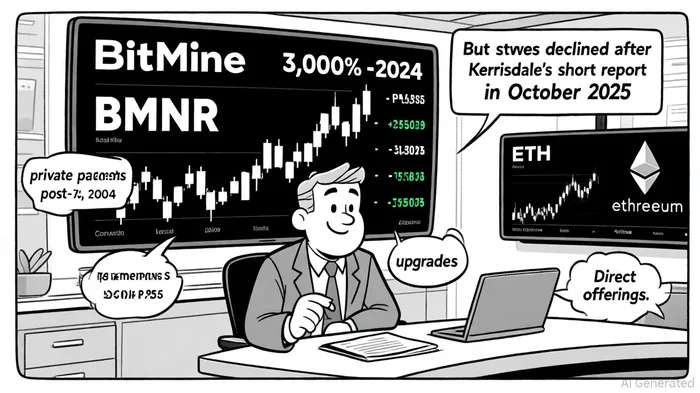





Comentarios
Aún no hay comentarios