
BitMine Immersion's Strategic Prowess in U.S. Crypto Infrastructure: Pioneering Dividend Innovation and Long-Term Value Creation
Strategic Positioning: The MAVAN Initiative and U.S. Market Dominance
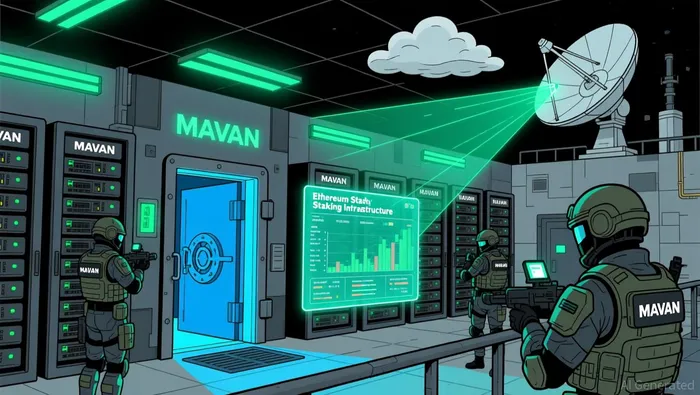
BitMine's "Made-in-America Validator Network" (MAVAN) represents a calculated move to capitalize on Ethereum's post-merge staking potential while aligning with U.S. regulatory priorities. By launching this dedicated staking infrastructure in Q1 2026, BMNR is addressing two critical gaps: the need for geographically diversified validator nodes and the demand for institutional-grade security according to reports and as industry analysis indicates. The pilot tests with three leading institutional staking providers underscore the network's readiness to scale, positioning BMNR as a trusted custodian for institutional ETH holdings in a market projected to grow as Ethereum's proof-of-stake model gains traction according to market projections.
This initiative is particularly significant in a U.S.-centric context. As regulators tighten compliance frameworks, BMNR's emphasis on "Made-in-America" infrastructure-likely including data sovereignty and adherence to SEC guidelines-creates a competitive moat. By anchoring its validator network within U.S. borders, the company is not only mitigating geopolitical risks but also appealing to domestic institutions wary of offshore custodians according to industry analysis.
Dividend Innovation: A New Benchmark for Crypto Companies
BMNR's declaration of a $0.01 annual dividend marks a watershed moment. As the first large-cap crypto company to distribute dividends, BitMine is bridging the gap between traditional equities and crypto assets, offering investors a hybrid model of capital appreciation and income generation according to reports and as industry experts note. This move is not merely symbolic; it reflects a strategic pivot toward financial conservatism in an industry historically dominated by speculative narratives.
While historical data reveals that BitMine had not paid dividends in the previous 25 years according to financial records, the 2025 announcement signals a recalibration of priorities. By allocating a portion of its $328 million net income to shareholders, BMNR is demonstrating fiscal discipline and long-term commitment to value retention. This approach could attract a broader investor base, including income-focused retirees and institutional funds previously hesitant to enter the crypto sector according to market analysis.
Long-Term Value Creation: Staking, Reserves, and Shareholder Trust
The synergy between BMNR's staking infrastructure and dividend strategy is where its long-term value proposition crystallizes. By building ETH reserves through staking rewards and operational efficiency, the company is creating a tangible asset base that can be reinvested or distributed to shareholders. The FY25 results, which include a fully diluted EPS of $13.39, validate this model according to financial reports.
Moreover, BMNR's dividend innovation aligns with broader industry trends. As Ethereum's annual yield stabilizes around 4-5% post-merge, staking infrastructure providers like BMNR are uniquely positioned to capture a portion of this revenue stream while maintaining operational flexibility. The company's decision to prioritize shareholder returns also enhances transparency, a critical factor in building trust with a market still grappling with legacy issues like FTX's collapse according to industry experts.
Conclusion: A Model for the Future of Crypto Infrastructure
BitMine Immersion's 2025-2026 roadmap exemplifies the next phase of crypto infrastructure development: a focus on regulated, scalable solutions that deliver both technological and financial value. With MAVAN set to launch in early 2026 and a dividend strategy that redefines investor expectations, BMNR is not just adapting to a maturing market-it is leading its transformation. For investors seeking exposure to a sector poised for institutional adoption, BMNR's dual emphasis on innovation and accountability offers a compelling case for long-term investment.







Comentarios
Aún no hay comentarios