
BitMine's 2M ETH Treasury and Institutional Accumulation Signal a New Era for Ethereum as Corporate Reserve Asset
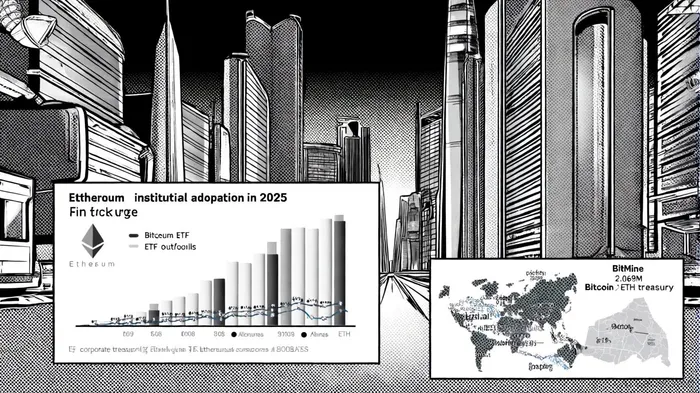
The EthereumETH-- landscape in 2025 is undergoing a seismic shift, driven by institutional forces that are redefining the cryptocurrency's role in global finance. At the forefront of this transformation is BitMine ImmersionBMNR-- (BMNR), whose recent accumulation of over 2.069 million ETH—valued at $9.21 billion—has cemented its position as the world's largest Ethereum treasury holder[1]. This milestone is not an isolated event but a harbinger of a broader trend: Ethereum's emergence as a corporate reserve asset, supported by macroeconomic tailwinds and institutional validation.
Institutional Accumulation: A Strategic Bet on Ethereum's Future
BitMine's aggressive accumulation strategy, including a $358 million purchase of 80,325 ETH from Galaxy DigitalGLXY-- and FalconX[4], underscores its conviction in Ethereum's long-term value. The company's treasury now holds 1.55% of Ethereum's circulating supply[2], with a stated goal of acquiring 5% of the total supply—a target it frames as “the alchemy of 5%”[1]. This approach mirrors the strategies of traditional institutional investors, who allocate capital to assets with durable scarcity and utility.
The rationale is clear: Ethereum's dual role as a growth asset and a yield-bearing instrument (via staking) offers a compelling alternative to traditional fixed-income investments. With staking yields averaging 3–5% annually[1], Ethereum provides a hedge against fiat depreciation while generating passive income. BitMine's chairman, Tom Lee, has likened Ethereum's current trajectory to Bitcoin's 2017 consolidation phase, suggesting a period of quiet accumulation before a significant price breakout[4].
Macroeconomic Tailwinds: Dovish Policy and Regulatory Clarity
The Federal Reserve's dovish pivot in 2025 has further amplified Ethereum's appeal. As interest rates decline, the opportunity cost of holding non-yielding assets like cash or bonds rises, pushing institutional investors toward alternatives that offer both capital appreciation and income. Ethereum's staking mechanisms and tokenized real-world assets (RWAs) align perfectly with this demand[3].
Regulatory clarity has also played a pivotal role. The passage of the GENIUS Act in July 2025, which established a framework for payment stablecoins, has legitimized Ethereum's role in the financial system. Given Ethereum's dominance in hosting $67 billion in USDTUSDC-- and $35 billion in USDC[3], the Act has indirectly bolstered Ethereum's utility as a settlement layer. Meanwhile, the Senate Banking Committee's anticipated crypto market structure legislation could further integrate digital assets into traditional finance[4].
Ethereum's Ecosystem: The Infrastructure of the Future
Beyond macroeconomic factors, Ethereum's technological evolution is reshaping its institutional adoption. The Pectra upgrade, Layer-2 solutions like Lido and Rocket Pool, and the proliferation of RWAs have enhanced Ethereum's scalability and versatility[1]. For instance, 60,000 active wallet addresses now support 163 distinct RWA tokens on Ethereum[3], demonstrating its capacity to tokenize real-world assets such as real estate and commodities.
BitMine's $20 million investment in Eightco HoldingsOCTO-- (OCTO), a firm adopting Worldcoin (WLD) as its primary treasury asset, exemplifies its broader vision to support Ethereum's ecosystem[1]. This “Moonshot” strategy reflects a belief in Ethereum's convergence with artificial intelligence and decentralized infrastructure, positioning it as the backbone of the next financial revolution.
A New Paradigm for Corporate Treasuries
The shift toward Ethereum as a corporate reserve asset is not speculative. Companies like FiscalNoteNOTE-- are exploring cryptocurrencies to diversify balance sheets and hedge against fiat volatility[4]. BitMine's treasury, with its $266 million in unencumbered cash and 192 BTC[1], serves as a blueprint for how corporations can allocate capital to digital assets while maintaining liquidity.
Moreover, Ethereum's performance in August 2025—rising 16% while BitcoinBTC-- declined—highlights its growing institutional preference[4]. Exchange-traded products (ETPs) tracking Ethereum have seen substantial inflows, contrasting with Bitcoin's outflows, as investors bet on Ethereum's utility-driven growth[4].
Conclusion: The Alchemy of 5% and Beyond
BitMine's 2M ETH treasury is more than a milestone; it is a catalyst for Ethereum's institutionalization. By aligning with macroeconomic trends, regulatory progress, and technological innovation, Ethereum is transitioning from a speculative asset to a foundational pillar of corporate finance. If BitMine achieves its 5% target, it could not only influence Ethereum's price but also accelerate the blockchain's role in reshaping global financial infrastructure. For investors, this represents a rare confluence of strategic accumulation, macroeconomic tailwinds, and ecosystem-driven growth—a new era where Ethereum's alchemy becomes reality.





Comentarios
Aún no hay comentarios