
BitGo's Path to Public Markets and Crypto Infrastructure Dominance
The crypto custody sector has emerged as a cornerstone of institutional adoption, and BitGo stands at the forefront of this transformation. With $4.19 billion in revenue for the first half of 2025—a near fourfold increase from $1.12 billion in H1 2024—BitGo has demonstrated explosive growth driven by surging demand for secure digital assetDAAQ-- infrastructure[1]. As the company prepares for its NYSE listing under the ticker “BTGO,” supported by underwriters like Goldman SachsGS-- and Citigroup[2], investors are scrutinizing its financials, security protocols, and competitive positioning to assess its long-term viability.
Revenue Surge and Operational Challenges
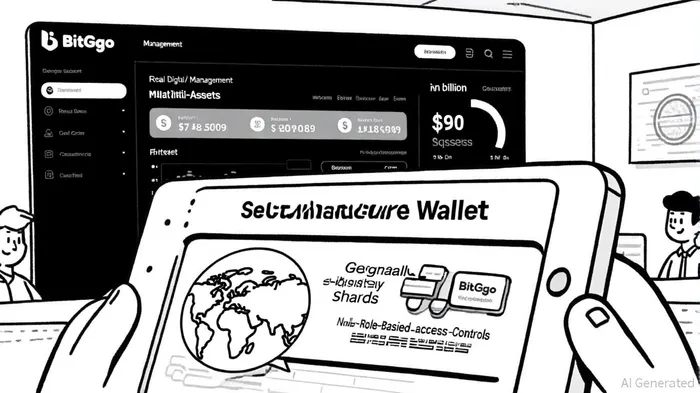
BitGo's revenue explosion reflects the maturation of the crypto market, where institutional players increasingly prioritize custody solutions. Managing over $90 billion in assets across 4,600 clients[3], the firm has capitalized on its institutional-grade security framework, including CCSS Level 3 certification (the highest under the Cryptocurrency Security Standard) and SOC 2 Type 2 compliance[4]. However, this rapid scaling has come at a cost: net income fell to $12.6 million in H1 2025 from $30.9 million in H1 2024[5]. The decline is attributed to rising operational expenses, a trade-off for expanding infrastructure to meet demand. While this raises short-term concerns, the investment in scalability aligns with BitGo's IPO strategy to fund further technology development and acquisitions[6].
Institutional-Grade Security as a Competitive Edge
BitGo's dominance in crypto custody hinges on its security architecture. Its multi-signature wallet system, geographically distributed key shards, and $250 million in insurance coverage for cold storage assets[7] set a high bar for competitors. For comparison, CoinbaseCOIN-- Custody offers insured cold storage but lacks BitGo's CCSS Level 3 certification[8], while Anchorage relies on Multi-Party Computation (MPC) for security[9]. BitGo's alignment with regulatory frameworks like the EU's MiCA and its pursuit of a U.S. banking charterCHTR-- further solidify its appeal to risk-averse institutions[10].
Market Share and IPO Implications
Despite Coinbase Custody's 20.2% mindshare in the crypto custody sector[11], BitGo's 15.8% share[12] underscores its growing influence. The firm's IPO could disrupt the market by raising capital to expand into trading, lending, and staking services[13], diversifying its revenue streams beyond custody. This aligns with broader industry trends: Gemini, Bullish, and Galaxy DigitalGLXY-- are also pursuing public listings, signaling crypto infrastructure's transition into mainstream finance[14]. BitGo's $100 billion in assets under custody (AUC)—up from $60 billion in late 2024[15]—further validates its scalability.
Risks and Governance Concerns
BitGo's risk profile includes asset concentration in BitcoinBTC--, SolanaSOL--, and Ethereum[16], exposing it to market volatility. Additionally, its dual-class share structure grants CEO Michael Belshe significant voting control, potentially limiting shareholder influence post-IPO[17]. Regulatory shifts, particularly in the U.S., could also impact its banking charter ambitions. However, the firm's proactive compliance stance and diversified client base mitigate some of these risks.
Investment Thesis
BitGo's IPO represents a pivotal moment for crypto infrastructure. While its declining net income and competitive pressures pose challenges, its institutional-grade security, regulatory alignment, and strategic expansion into global markets position it as a leader in a sector projected to grow alongside institutional crypto adoption. For investors, the key question is whether BitGo can sustain its revenue momentum while navigating operational costs and market dynamics—a bet on the future of digital asset custody.





Comentarios
Aún no hay comentarios