
Bitfarms' Strategic Transition to AI-Driven Data Centers: Assessing the Financial and Operational Viability
Bitfarms (BITF) is undergoing a dramatic strategic shift, pivoting from BitcoinBTC-- mining to high-performance computing (HPC) and artificial intelligence (AI) infrastructure. This transition, announced in Q3 2025, reflects a calculated response to the volatile profitability of cryptocurrency mining and the surging demand for AI-driven computational power. While the company's financials reveal significant short-term challenges, the long-term potential of its AI infrastructure bets could redefine its value proposition. This analysis evaluates the feasibility of Bitfarms' pivot, balancing its current financial strain with the projected margins and scalability of its new business model.
Financial Performance: Growth Amid Margin Pressures
Bitfarms reported $69 million in revenue from continuing operations in Q3 2025, a 156% year-over-year increase driven by Bitcoin mining activities. However, the company's gross mining margin plummeted to 35%, a 1,100-basis-point decline from the prior year, due to operational costs tied to exiting lower-margin assets in Latin America and upgrading infrastructure for AI workloads. This margin compression, coupled with a $29 million operating loss and a $46 million net loss, underscores the immediate financial strain of the transition.
Despite these losses, Bitfarms' adjusted EBITDA rose to $20 million, or 28% of revenue, up from just $2 million in the same period in 2024. This improvement suggests that while Bitcoin mining remains a cash-flow generator, its profitability is increasingly overshadowed by the capital-intensive demands of the AI pivot.
Operational Shift: Capitalizing on AI Infrastructure
Bitfarms' strategic realignment centers on converting its North American energy and data center assets into high-margin AI infrastructure. Key projects include:
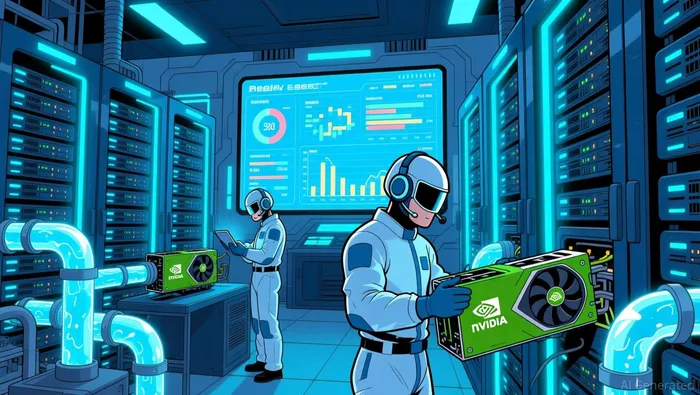
1. Washington Site Conversion: A $128 million binding agreement has been signed to retrofit the 18 MW facility with NVIDIA's next-generation Vera Rubin GPUs and advanced liquid cooling, targeting operational readiness by December 2026.
2. Panther Creek Expansion: The Pennsylvania campus is pursuing a firm power agreement to boost capacity to over 500 MW, positioning it to support high-lease-rate AI workloads.
3. Energy Portfolio Optimization: Bitfarms' 2.1 GW North American energy assets, with 341 MW currently energized, are being repositioned to meet the energy-intensive demands of AI infrastructure.
These projects are funded by a $588 million convertible note offering and a $300 million credit facility with Macquarie, leaving the company with $814 million in liquidity as of November 2025. Management anticipates that AI infrastructure will yield significantly higher margins than Bitcoin mining, with lease rates projected to rise from $140–$150 per kilowatt per month to $180 as construction progresses.
Margin Comparison: Bitcoin Mining vs. AI Infrastructure
The profitability of Bitfarms' new ventures hinges on the stark contrast between Bitcoin mining's declining margins and AI infrastructure's potential. In Q3 2025, Bitcoin mining's all-in cost per coin reached $82,400, far exceeding the average Bitcoin price during the quarter. By contrast, AI infrastructure projects-such as GPU-as-a-Service (GPUaaS)-are expected to generate higher free cash flow, with management citing the potential for "operational income surpassing previous Bitcoin mining operations".
However, the transition is not without risks. The capital expenditures required for AI infrastructure are substantial, and delays in project execution could prolong margin pressures. For instance, the Washington site's $128 million retrofit is a critical test of Bitfarms' ability to deliver scalable, high-margin AI solutions.
Strategic Rationale and Market Positioning
Bitfarms' pivot aligns with broader industry trends. The global AI infrastructure market is projected to grow exponentially, driven by demand for advanced computational power in machine learning and data analytics. By leveraging its North American energy assets and strategic partnerships with NVIDIA, BitfarmsBITF-- aims to capture a share of this market. CEO Ben Gagnon emphasized that the GPUaaS model will allow the company to demonstrate its capabilities as both a developer and operator in the HPC/AI space.
 Yet, the company's success depends on executing its vision without further operational setbacks. The Q3 2025 net loss of $46 million highlights the immediate financial risks, though Bitfarms' liquidity position-$814 million in cash and unencumbered Bitcoin-provides a buffer.
Conclusion: A High-Risk, High-Reward Transition
Bitfarms' strategic shift to AI infrastructure is ambitious and timely, but its viability remains contingent on execution. The company's short-term financials reflect the costs of transformation, yet its long-term prospects are bolstered by the scalability of AI workloads and the potential for higher margins. Investors must weigh the immediate risks-such as project delays and margin compression-against the growing demand for AI infrastructure. If Bitfarms can successfully convert its energy and data center assets into a profitable HPC/AI platform, it may unlock significant value. However, the path to profitability will require disciplined capital allocation and operational excellence.







Comentarios
Aún no hay comentarios