
Bitfarms' Strategic Exit from Latam and Reinvestment into North American HPC/AI Infrastructure: A Capital Reallocation Play for Shareholder Value and Long-Term Growth
Bitfarms' recent announcement of its complete exit from Latin America (Latam) marks a pivotal shift in its capital allocation strategy, signaling a deliberate pivot toward North American high-performance computing (HPC) and artificial intelligence (AI) infrastructure. By selling its 70 MW BitcoinBTC-- mining site in Paso Pe, Paraguay, to the Sympatheia Power Fund (SPF) for up to $30 million, the company has realigned its energy portfolio to 100% North American operations, with 90% of its 2.1 GW multi-year pipeline now based in the U.S. according to investor reports. This move, coupled with aggressive reinvestment into HPC/AI, underscores a strategic bet on the long-term growth of the AI infrastructure sector-a market projected to expand exponentially as global demand for computational power intensifies.
Capital Reallocation: From Latam to North American HPC/AI
The sale of the Paso Pe site, which includes an upfront $9 million cash payment and a $21 million deferred payment over 10 months, provides BitfarmsBITF-- with critical liquidity to fund its North American expansion according to investor reports. The company's decision to exit Latam-a region plagued by regulatory uncertainty and operational complexity-reflects a focus on optimizing capital efficiency. With 341 MW of energized capacity and 430 MW under active development, Bitfarms is now primed to leverage its North American footprint to capitalize on the surging demand for HPC/AI infrastructure.
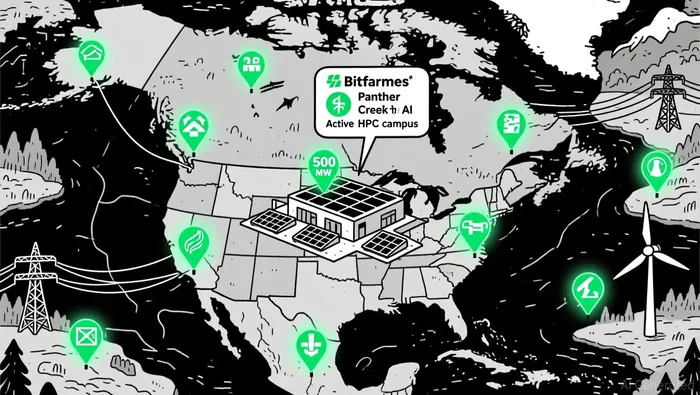
A key component of this reallocation is the Panther Creek AI and HPC campus, a 350 MW project positioned as a leveraged play on U.S. hyperscaler demand. The project, part of a 1.3 GW development pipeline, is designed to meet the needs of cloud providers and AI firms seeking scalable, energy-efficient infrastructure. Additionally, Bitfarms plans to convert its 18 MW Washington State Bitcoin mining facility into an HPC/AI site by December 2026, supported by a fully funded $128 million agreement. These projects are not speculative; they are underpinned by pre-arranged financing structures, including the conversion of its $300 million Macquarie facility to project-level funding and an additional $50 million draw.
Shareholder Value: Buybacks and Strategic Partnerships
Bitfarms has also taken steps to directly enhance shareholder value. The company announced a share buyback initiative targeting 10% of its float between July 2025 and July 2026, a move that signals management's confidence in its valuation and commitment to returning capital to investors. Complementing this is a partnership with T5 Data Centers in Pennsylvania, which strengthens Bitfarms' ability to execute its HPC/AI development roadmap according to market analysis. These actions, combined with the liquidity from the Latam exit, demonstrate a disciplined approach to capital deployment.
However, the transition is not without short-term challenges. Q3 2025 saw a sharp decline in gross mining margins due to higher operational costs and the repositioning of mining assets. Analysts, including Nick Giles of B. Riley and Northland, acknowledge these pressures as temporary, emphasizing that the long-term execution of HPC/AI infrastructure will drive margin improvements. The company's ability to navigate this transition will be critical to maintaining investor confidence.
Long-Term Growth: Aligning with the AI Infrastructure Boom
The strategic reallocation of capital aligns Bitfarms with one of the most transformative trends in technology: the exponential growth of AI. As hyperscalers and enterprises invest heavily in computational infrastructure, Bitfarms' North American HPC/AI projects are well-positioned to capture this demand. Analysts have raised price targets for the company, citing its ability to secure project financing and its alignment with the AI infrastructure market. For instance, the Panther Creek campus is expected to generate stronger returns on capital compared to Bitcoin mining, which faces ongoing volatility from cryptocurrency price swings and regulatory scrutiny.
That said, risks remain. Near-term volatility could intensify if AI demand or cloud partnership deals slow, as some analysts caution. Additionally, the success of Bitfarms' HPC/AI projects hinges on timely execution and the ability to secure long-term contracts with hyperscalers. The company's track record in energy infrastructure development and its partnerships with established players like T5 Data Centers suggest it is well-equipped to mitigate these risks.
Conclusion: A Calculated Bet on the Future
Bitfarms' strategic exit from Latam and reinvestment into North American HPC/AI infrastructure represents a calculated bet on the future of computing. By reallocating capital to high-growth, energy-efficient projects and enhancing shareholder value through buybacks, the company is positioning itself to capitalize on the AI infrastructure boom. While short-term margin pressures persist, the long-term potential for margin expansion and revenue diversification is compelling. For investors, the key will be monitoring the execution of its 2.1 GW pipeline and the pace of hyperscaler demand adoption. If successful, Bitfarms could emerge as a pivotal player in the next phase of the digital economy.







Comentarios
Aún no hay comentarios