
Bitfarms Ltd.: Operational Efficiency and Strategic Expansion Position It as a Key Player in the Evolving Bitcoin Mining Landscape
In the post-halving BitcoinBTC-- mining landscape of 2025, operational efficiency has emerged as the defining metric for long-term profitability. Bitfarms Ltd.BITF-- (BITF) has positioned itself as a standout player in this arena, leveraging technological optimization and strategic infrastructure investments to outpace industry benchmarks.
Operational Efficiency: A Sustained Competitive Edge
Bitfarms' operational efficiency metrics underscore its leadership in energy optimization. By Q2 2025, the company achieved a fleet efficiency of 17 watts per terahash (w/TH), a 40% improvement from December 2024 and significantly below the industry average of 28 w/TH, according to Bitfarms' Q2 2025 results. This progress reflects disciplined hardware management and a focus on high-efficiency ASICs, such as the latest models from Bitmain and MicroBT, as noted in a Cointelegraph analysis.
The company's efficiency gains are not isolated but part of a broader trend. For instance, BitfarmsBITF-- reported a 1% improvement in energy efficiency and a 5% reduction in direct hash costs during Q2 2025, according to a Blockspace recap. These metrics are critical in an environment where the 2024 halving reduced block rewards by 50%, tightening profit margins across the sector - a dynamic discussed in the Cointelegraph analysis - and by minimizing energy consumption per hash Bitfarms mitigates the impact of rising mining difficulty (now at an all-time high of 123T, as the Cointelegraph analysis details) and maintains cost discipline.
Strategic Expansion into High-Performance Computing
Beyond efficiency, Bitfarms is diversifying its revenue streams through its Panther Creek campus, which will transition megawatts from Bitcoin mining to high-performance computing (HPC) and AI services, as noted in the Blockspace recap. This pivot aligns with industry peers like MARA Holdings and Riot Platforms, which have similarly invested in HPC to hedge against Bitcoin's price volatility; Bitfarms discussed this strategy in its Q2 report. The $300 million private debt facility secured with Macquarie Group, reported in the Blockspace recap, underscores the company's commitment to this dual-use strategy, enabling it to capitalize on the growing demand for compute power in AI and enterprise applications.
This diversification is not merely speculative. The global hashrate surge to 894.5 EH/s by July 2025, cited in Bitfarms' Q2 report, highlights the sector's reliance on scale and infrastructure. Bitfarms' ability to repurpose existing facilities for HPC positions it to generate stable cash flows even if Bitcoin's price fluctuates.
Industry Context and Risks
While Bitfarms' efficiency metrics are impressive, the company faces headwinds. U.S. miners, including Bitfarms, contend with industrial electricity costs averaging over $0.10 per kWh, compared to subsidized rates as low as $0.035–$0.045/kWh in the UAE and Oman, as noted in a Uminers article. Although Bitfarms reported a 2% improvement in average electricity prices in Q2 2025 in the Blockspace recap, its lack of disclosure on exact kWh costs remains a transparency risk for investors, according to a MarketBeat report.
Moreover, the industry's focus on operational benchmarks-such as hashrate under management and hash cost-intensifies competition. Companies like CleanSpark and IREN achieved 50 EH/s in Q2 2025 (reported in the MarketBeat report), while Hut 8 and TeraWulf secured long-term power agreements to stabilize costs, as Bitfarms' Q2 report notes. Bitfarms' 19.5 EH/s hashrate in April 2025, reported in the Blockspace recap, is robust but must continue to scale to maintain its market share.
Conclusion: A Model for Sustainable Growth
Bitfarms' combination of operational efficiency, strategic diversification, and infrastructure investment paints a compelling case for long-term profitability. Its 17 w/TH benchmark cited in Bitfarms' Q2 report and ongoing HPC expansion described in the Blockspace recap demonstrate a forward-looking approach that addresses both the energy constraints and revenue volatility inherent in Bitcoin mining. However, investors must monitor its electricity cost structure and the pace of HPC adoption to assess whether these advantages translate into durable margins.
As the industry navigates a post-halving reality, Bitfarms' ability to balance efficiency with innovation will be pivotal. For now, its track record suggests it is well-positioned to thrive in an increasingly competitive and capital-intensive sector.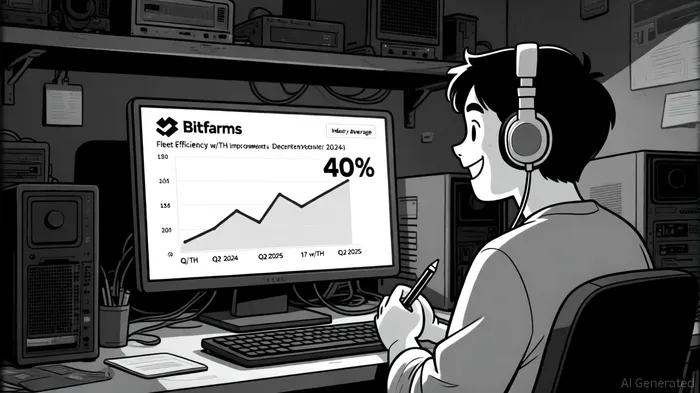





Comentarios
Aún no hay comentarios