
Is Bitfarms' 34% Portfolio Allocation Justified Amid a 70% Stock Drawdown?
The question of whether a 34% portfolio allocation to BitfarmsBITF-- (BITF) is justified amid a 70% drawdown in its stock price hinges on a critical pivot: the company's transition from BitcoinBTC-- mining to high-performance computing (HPC) and AI infrastructure. While the drawdown reflects short-term pain, the strategic repositioning suggests long-term potential. Let's break it down.
The Pain of the Drawdown
Bitfarms' financials tell a story of turbulence. In Q4 2024, the company posted a $15 million net loss, and by Q3 2025, the operating loss had ballooned to $29 million, including a $9 million impairment charge. These numbers are a direct result of operational inefficiencies in Bitcoin mining, higher administrative costs, and the strategic exit of lower-margin operations in Argentina and Paraguay. The drawdown is real, but it's also a byproduct of a deliberate shift in focus.
The Strategic Shift: From Bitcoin to AI
Here's where the narrative flips. Bitfarms is no longer just a Bitcoin miner-it's positioning itself as a North American leader in AI and HPC infrastructure. The company's $588 million convertible note offering in 2025 wasn't just a liquidity play; it was a funding lifeline for a bold transformation. Key projects include:
- Washington State: A $128 million agreement to convert an 18 MW Bitcoin site into an HPC/AI hub with liquid cooling and compatibility for NVIDIA's GB300 GPUs.
- Panther Creek, Pennsylvania: A 60 MW energy supply agreement with PPL, expandable to 500 MW, to power AI infrastructure according to reports.
These moves are not speculative-they're capital-intensive, project-specific investments. 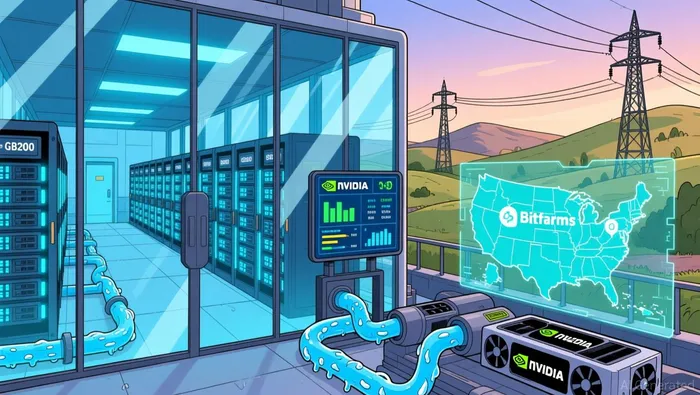 The company's 2.1 GW power portfolio in the U.S. and Canada provides the backbone for this transition, and its $814 million liquidity (including $177 million in unencumbered Bitcoin) ensures it can fund these projects without overleveraging.
Capital Deployment: Efficiency or Overreach?
Critics might argue that Bitfarms is spreading itself too thin, but the data tells a different story. The company's ability to secure project financing-such as converting its $300 million Macquarie facility to fund Panther Creek-demonstrates disciplined capital deployment. Moreover, its 1.3 GW development pipeline according to market analysis is a testament to its execution capability.
The risks? Operational delays and underperformance in HPC/AI demand could pressure margins. But management's focus on "GPU-as-a-Service" and cloud monetization strategies as analysts point out suggests a clear path to profitability. Analysts from B. Riley and Northland have raised price targets as market sentiment shifts, betting on Bitfarms' ability to capture U.S. hyperscaler demand.
The 34% Allocation: A Calculated Bet
A 34% allocation to Bitfarms is a bold move, but it's not irrational. The company's transition to AI infrastructure aligns with a structural trend: global demand for compute resources is expected to outstrip supply by 2027 according to industry forecasts. Bitfarms' vertically integrated model-low-cost energy, modular infrastructure, and strategic locations in data center hotspots-positions it to outperform peers.
However, investors must balance the long-term vision with near-term volatility. The 70% drawdown reflects skepticism about Bitcoin's role in the business, but the pivot to AI mitigates that risk. As CFO Jonathan Mir noted, the company's liquidity provides "substantial financial flexibility" as reported in Q3 2025 earnings, a critical buffer during the transition.
Final Verdict: Conviction in the Long Game
Bitfarms' 34% allocation is justified if you believe in the AI infrastructure boom and the company's ability to execute its capital-intensive projects. The drawdown is a short-term hurdle, not a death knell. For investors with a 3–5 year horizon, this is a high-conviction play on a sector poised for explosive growth. Just don't expect a smooth ride-this is a rollercoaster.





Comentarios
Aún no hay comentarios