
Bitdeer's Strategic Expansion Toward 500 MW Hash Rate Capacity: Assessing Scalability and Long-Term Profitability in Bitcoin Mining
In the post-halving BitcoinBTC-- mining landscape of 2025, operational efficiency and energy cost optimization have become existential imperatives. Bitdeer TechnologiesBTDR--, a once-pure-play mining hardware supplier, has pivoted aggressively into self-mining and infrastructure development, aiming to secure a top-five position in global hashrate capacity. With a 500 MW power pipeline and a roadmap to 60 EH/s by year-end, the company's strategic expansion raises critical questions: Can BitdeerBTDR-- scale sustainably? Will its financial discipline and technological innovation offset the headwinds of a tightening profit margin environment?
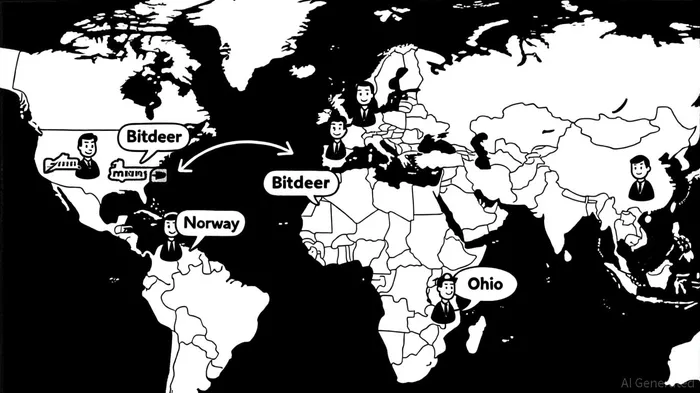
Infrastructure Expansion: Global Footprint and Energy Arbitrage
Bitdeer's infrastructure strategy hinges on geographic diversification and energy arbitrage. By Q3 2025, the company had energized 361 MW of datacenter capacity, with a total global power pipeline of 3 GW[1]. Key projects include:
- Jigmeling, Bhutan: 500 MW fully energized by September 2025, leveraging low-cost hydroelectricity[1].
- Tydal, Norway: 175 MW operational, with plans to convert the site into an AI data center by Q4 2026[1].
- Ohio, U.S.: The Clarington site's 570 MW capacity will be available by Q3 2026 (a year earlier than planned), while the Niles site's 300 MW is slated for Q1 2029[1].
These projects underscore Bitdeer's focus on regions with abundant, low-cost energy. For instance, Bhutan's hydroelectric resources and Norway's renewable grid provide a stark contrast to U.S. industrial electricity rates, which often exceed $0.10 per kWh[5]. By securing interconnection agreements with utilities like FirstEnergy and leveraging hydro-cooling technology at its Texas facility[1], Bitdeer mitigates energy costs-a critical factor in an industry where hashprice (revenue per terahash) has plummeted to $0.049 by April 2025[1].
Technological Innovation: SEALMINER A3/A4 and Efficiency Gains
Bitdeer's proprietary SEALMINER rigs are central to its profitability thesis. The A3 series, with power efficiencies of 12.5–13.5 J/TH[1], is now in mass production, while the A4 model targets a groundbreaking 5 J/TH by Q4 2025[1]. This trajectory aligns with industry demands for efficiency post-halving, where network difficulty hit an all-time high of 123T[5].
The company's vertical integration-spanning ASIC design, wafer production, and data center construction-has reduced hardware costs and improved margins[3]. For example, Bitdeer's self-mining hashrate surged to 30 EH/s in August 2025, with a target of 40 EH/s by October[1]. Such growth is underpinned by improved wafer supply and the deployment of SEALMINER A2 rigs in the U.S., Norway, and Bhutan[4].
Financial Health: Revenue Surge vs. Profitability Erosion
Bitdeer's Q2 2025 unaudited financials reveal a paradox: revenue surged to $155.6 million, driven by self-mining and SEALMINER A2 sales[4], yet the company reported a $147.7 million net loss, largely due to non-operating items like $108.5 million in fair value losses on TetherUSDT-- warrants[4]. Operationally, gross margin compressed to 8.2%[4], reflecting rising depreciation, energy costs, and the Bitcoin halving's impact on mining economics.
Despite these challenges, Bitdeer maintains $299.8 million in cash reserves[2] and projects $260–290 million in 2025 capital expenditures[2]. Its leverage ratio of 5.6 and return on equity of -0.83%[2] signal financial strain, but the company's $32 million investment from Tether[1] and strategic partnerships (e.g., NVIDIA for AI) provide liquidity buffers[6].
Historically, Bitdeer's stock has demonstrated a positive edge following earnings releases. A backtest of its performance from 2022 to 2025 reveals that the stock outperformed benchmarks with an average cumulative return of +28.2% over 30 days post-earnings, compared to +10.4% for the broader market[4]. By day 30, the win rate reached ~76%, and statistically significant out-performance emerged from day 4 onward[4]. This suggests that while the company's recent financials show operational losses, its stock has historically rewarded investors with strong momentum post-earnings.
Diversification: AI and HPC as a Hedge Against Volatility
To mitigate Bitcoin's price volatility, Bitdeer is pivoting to high-performance computing (HPC) and AI. By Q4 2026, it aims to operate 200 MW of AI computing capacity, with a revenue run-rate exceeding $2 billion[1]. The Tydal and Clarington sites are being reconfigured for AI data centers, which offer more predictable cash flows compared to mining[1].
This pivot is timely. AI cloud services grew 157% quarter-on-quarter in Q2 2025[4], and Bitdeer's GPU cloud offerings could capture a slice of the $50 billion global AI infrastructure market[6]. However, self-mining still accounts for over 50% of revenue[4], exposing the company to Bitcoin's cyclical nature.
Challenges and Risks
Bitdeer's expansion is not without risks. Supply chain bottlenecks, regulatory uncertainties (e.g., U.S. energy policies), and rising global electricity prices could erode margins[4]. Additionally, the Niles, Ohio site's 2029 energization timeline introduces execution risk, as does the conversion of Tydal into an AI data center[1].
Analysts remain divided. While 10 analysts have set bullish price targets (average: $14.60)[5], others caution that Bitdeer's net debt-to-equity ratio of 75.4%[6] and operational losses could deter long-term investors.
Conclusion: A High-Stakes Bet on Efficiency and Diversification
Bitdeer's 500 MW expansion and AI pivot position it as a formidable player in the Bitcoin mining and HPC sectors. Its geographic diversification, proprietary hardware, and energy optimization strategies address key scalability challenges. However, the company's financial leverage, operational losses, and reliance on Bitcoin price movements pose significant risks.
For investors, the key question is whether Bitdeer can execute its roadmap without compromising profitability. If the company successfully balances capital expenditures with revenue diversification-while navigating regulatory and energy market volatility-it could emerge as a leader in a sector increasingly defined by institutionalization and technological innovation.





Comentarios
Aún no hay comentarios