
Bitcoin's End-of-Year Price Outlook: Decoding Arthur Hayes' Bold Prediction
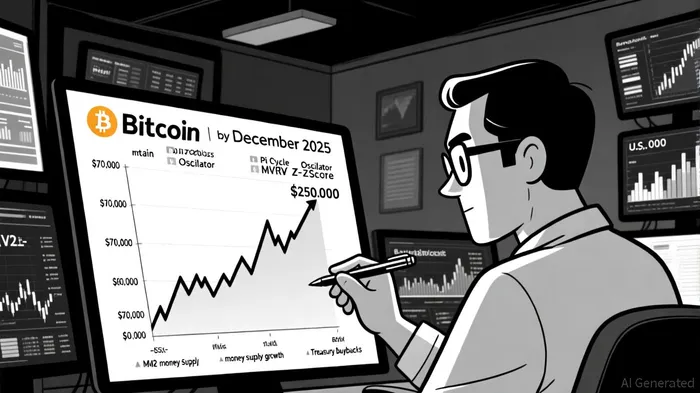
Arthur Hayes, co-founder of BitMEX and a prominent figure in the cryptocurrency space, has made a striking prediction: BitcoinBTC-- could surge to $250,000 by the end of 2025. This forecast, while audacious, is underpinned by a confluence of macroeconomic tailwinds, on-chain metrics, and institutional dynamics. As the year draws to a close, investors are scrutinizing whether the market conditions align with Hayes' thesis.
Market Sentiment: A Bullish Consensus
The current market sentiment for Bitcoin is overwhelmingly bullish, driven by a combination of speculative fervor and fundamental analysis. Post-halving dynamics have created a supply-constrained environment, with 74% of Bitcoin's circulating supply deemed illiquid and 75% of coins inactive for six months, signaling extreme hoarding behavior[1]. This reduced float amplifies upward price pressure, as even modest demand surges can trigger significant price movements.
On-chain metrics further reinforce this narrative. The Network Value to Transaction (NVT) golden-cross at 1.51 suggests that Bitcoin's valuation is grounded in real transactional activity rather than speculative hype[1]. Meanwhile, the MVRV (Market Value to Realized Value) ratio at 2.3× and a SOPR (Spent Output Profit Ratio) of 1.03 indicate moderate profit-taking without panic selling, a sign of a healthy accumulation phase[1]. Exchange outflows remain deeply negative, reflecting strong institutional and whale accumulation, which, while increasing short-term volatility risk, also sets the stage for sharp price rallies[1].
Macroeconomic Tailwinds: Liquidity Expansion and Policy Shifts
Hayes' prediction hinges on a critical macroeconomic shift: the Federal Reserve's potential pivot from quantitative tightening (QT) to quantitative easing (QE). This transition, he argues, would flood the market with liquidity, creating a favorable environment for Bitcoin as a hedge against inflation and fiat devaluation[1]. The U.S. Treasury's stealth liquidity injections—such as bond buybacks—further support this thesis by expanding credit availability without the political backlash associated with traditional stimulus measures[2].
The return of Donald Trump to the White House has added another layer of complexity. Hayes posits that Trump's “wartime economy” policies, which prioritize industrial output and defense manufacturing, could drive credit expansion and asset inflation[3]. This aligns with broader trends: the U.S. deficit is rising, tax revenue is declining, and political gridlock may compel the Fed to ease liquidity to stabilize markets[2]. Additionally, the weakening U.S. Dollar Index and a reversal in global M2 money supply contraction—driven by central bank money printing—historically correlate with Bitcoin surges[2].
On-Chain Metrics: A Technical Green Light
On-chain data provides a technical roadmap for Bitcoin's potential ascent. The Pi Cycle Oscillator, a tool for identifying market cycle tops and bottoms, shows renewed bullish momentum as its 111-day and 350-day moving averages begin trending upward—a historical precursor to near-term peaks[2]. The MVRV Z-Score, currently at levels comparable to May 2017, suggests significant upside potential before the market reaches overextension[2].
Stock-to-Flow (S2F) models, which estimate Bitcoin's scarcity value, project a price range of $248K to $369K by year-end[1]. These models, combined with the NVT golden-cross, indicate that Bitcoin's valuation is supported by both supply-side fundamentals and transactional utility. Institutional adoption, including ETF inflows and regulatory clarity, further strengthens the case for higher prices. For instance, Grayscale's ETF and BlackRock's $524 million in daily inflows are absorbing sell pressure, while the U.S. GENIUS Act aims to reduce regulatory uncertainty by formalizing stablecoin rules[1].
Risks and Counterarguments
Despite the bullish consensus, risks persist. Trump's proposed tariffs and concerns over stagflation could dampen risk appetite, creating headwinds for Bitcoin[3]. Additionally, the $110K–$115K price zone remains a critical psychological barrier; sustained institutional demand and whale accumulation will be essential to overcome it[3]. Analysts from Standard Chartered, Bernstein (Goldman), and VanEck, however, forecast year-end prices between $150K and $200K, suggesting a convergence of on-chain metrics, macroeconomic support, and institutional adoption[1].
Conclusion: A Pivotal Moment for Bitcoin
Arthur Hayes' $250K target for Bitcoin by year-end is not merely speculative—it is a synthesis of macroeconomic shifts, on-chain dynamics, and institutional behavior. While challenges remain, the alignment of liquidity expansion, supply constraints, and policy tailwinds creates a compelling case for a multi-digit price surge. As the year progresses, investors must monitor key indicators: the Fed's policy trajectory, institutional ETF inflows, and on-chain accumulation patterns. For those willing to navigate the volatility, Bitcoin's end-of-year outlook presents a high-conviction opportunity.






Comentarios
Aún no hay comentarios