
Bitcoin's Year-End Price Gravity: How $100K Options Expiry Will Shape Volatility and Positioning in Q1 2026
The BitcoinBTC-- market is entering a critical juncture as Q4 2025 options expiries loom, with the $100K strike price emerging as a gravitational anchor for volatility and institutional positioning. This level, now a focal point for derivatives activity, will likely dictate Bitcoin's trajectory into Q1 2026. By dissecting open interest, put-call ratios, and institutional hedging patterns, we can anticipate how this expiry will shape market dynamics and identify strategic entry points for investors.
The $100K Strike: A Derivatives Battleground
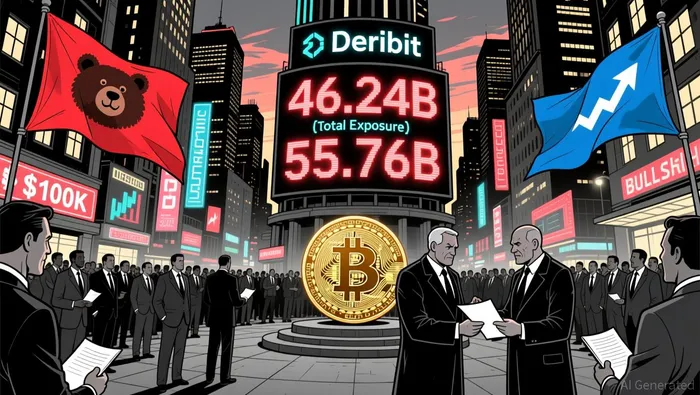
Bitcoin's options market has seen a surge in activity around the $100K strike price, particularly for December 2025 expiries. Deribit, the largest crypto derivatives exchange, hosts approximately $46.24 billion in open interest for these contracts, with the max-pain price-where the greatest number of options expire worthless-sitting precisely at $100K. This concentration reflects a structural inflection point: dealers are hedging heavily between $86K and $110K, creating a "gravity well" that could amplify price swings as the expiry approaches.
The put-call ratio for these options is 1.16, indicating a bearish bias among traders. While this suggests demand for downside protection, it also signals a fragile equilibrium. If Bitcoin breaks below $100K, the resulting liquidation cascade could accelerate the move toward $80K–$90K support levels. Conversely, a retest of $112K–$113K-a key short-term holder cost basis-could reignite bullish momentum.
Institutional Positioning: Hedging vs. Speculation
Institutional activity underscores the $100K level's significance. Over $55.76 billion in total Bitcoin options open interest is now concentrated on Deribit, with regulated funds and basis traders on the CMECME-- adding another layer of complexity. Institutions are employing multi-leg strategies, including portfolio margining to offset delta exposure using perpetual futures, reducing margin requirements by up to 50% in some cases. This efficiency allows for tighter risk management but also increases sensitivity to macro shocks, such as the Fed's rate decisions or geopolitical tensions.
Notably, the CBOE's upcoming continuous futures for Bitcoin and EtherETH--, launching December 15, 2025, will provide U.S.-regulated, perpetual-style exposure, further institutionalizing the market. This development could shift liquidity dynamics, potentially reducing volatility as more capital enters structured hedging rather than speculative bets.
Volatility Mechanics and Strategic Entry Timing
Bitcoin's volatility profile is tightening as the $100K expiry nears. Implied volatility has fallen to historic lows, reflecting maturation in institutional adoption. However, this calm is deceptive. The $100K expiry could trigger a "volatility shock" if Bitcoin straddles the strike price at expiry, forcing dealers to unwind large directional positions. Historical patterns suggest such events often result in sharp, short-term price dislocations.
For investors, this creates a binary scenario:
1. If Bitcoin holds above $100K: A retest of $112K–$113K could attract aggressive buying from institutions, particularly if macroeconomic data (e.g., dovish Fed signals) improves. ETF inflows, which rebounded with $240 million in November 2025, may further stabilize the price.
2. If Bitcoin breaks below $100K: A pullback to $85K–$90K could present a strategic entry point, especially for long-term holders. MicroStrategy and El Salvador have already signaled intent to accumulate during dips, and on-chain data shows exhausted selling pressure at these levels.
Positioning for Q1 2026: A Playbook
Given the gravity of the $100K expiry, investors should adopt a dual strategy:
- Short-Term Hedging: Buy put options with a $95K–$98K strike to protect against a breakdown, while maintaining a core long position. The elevated put demand (put-call ratio of 1.16) suggests this is a cost-effective hedge.
- Long-Term Accumulation: Target dips below $95K for spot purchases, leveraging the structural support from short-term holders and ETF inflows. Institutional buyers have historically stepped in during such corrections, as seen in late 2025.
Conclusion
Bitcoin's $100K expiry is not just a technical milestone-it's a structural fulcrum for institutional positioning and volatility. As Q1 2026 approaches, the interplay between derivatives activity, macroeconomic signals, and on-chain fundamentals will determine whether this level acts as a floor or a ceiling. Investors who recognize the gravity of this expiry and position accordingly will be well-placed to capitalize on the inevitable volatility.





Comentarios
Aún no hay comentarios