
Bitcoin's Four-Year Cycle: Is It Still Valid Amid Evolving Political and Monetary Dynamics?
Bitcoin's four-year cycle, historically tied to halving events and institutional adoption, has long been a cornerstone of bullish narratives. However, as the cryptocurrency enters its next critical phase ahead of the 2026 U.S. midterm elections, structural market drivers are increasingly entangled with political and monetary dynamics. Markus Thielen, founder of 10x Research, has sounded alarms about a potential 60% drawdown for BitcoinBTC-- during this period, citing historical patterns, on-chain imbalances, and shifting Fed policy. This analysis examines whether Bitcoin's cyclical framework remains intact-or if it is being reshaped by macroeconomic forces.
The Traditional Four-Year Cycle: Structural Drivers vs. Flawed Models
The stock-to-flow (S2F) model, which posits that Bitcoin's scarcity premium drives its price, has been a dominant narrative. Yet Thielen has critiqued S2F and liquidity models for oversimplifying Bitcoin's behavior. He argues that these models fail to account for real-time on-chain data, such as wallet-level underwater positions and institutional flow shifts. For instance, newer wallets currently hold Bitcoin at a 10% to 20% loss, creating a "forced selling" risk as holders seek to cut losses. This dynamic, absent in traditional models, underscores the growing influence of behavioral and liquidity factors over purely structural ones.
Thielen also highlights the erosion of long-term holder conviction. Data from 10x Research shows that long-time Bitcoin holders have offloaded approximately 400,000 BTC, signaling a shift from leveraged selling to steady spot market dumping. Such imbalances suggest that the market is no longer driven solely by halving-driven scarcity but by a more complex interplay of conviction, leverage, and macroeconomic sentiment.
Political Cycles and Historical Selloffs
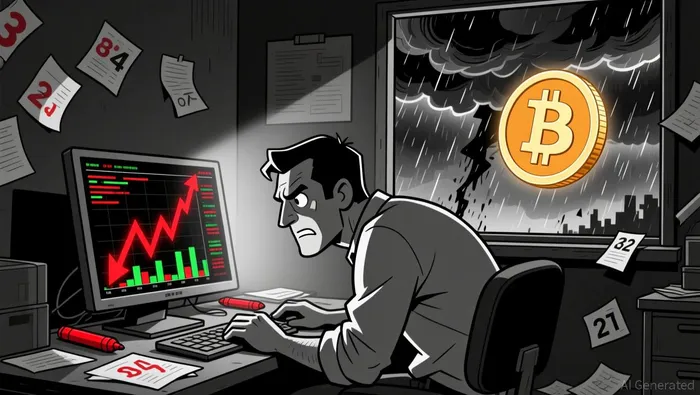
Bitcoin's price history reveals a troubling pattern during U.S. midterm elections. Thielen notes that the cryptocurrency has historically dropped by ~60% during such periods, a trend he attributes to institutional risk-off behavior and policy uncertainty. The 2026 midterms, in particular, could amplify this risk if inflationary pressures persist or if a new Fed chair adopts a hawkish stance.
This political influence contrasts with the traditional four-year cycle, which assumes a decoupling from macroeconomic events. Yet the 2024 election cycle already demonstrated Bitcoin's sensitivity to political narratives, with price swings correlating to Trump vs. Biden policy debates. As Thielen warns, the 2026 cycle may see similar volatility, with political polarization and regulatory shifts acting as tail risks.
Fed Policy: A Double-Edged Sword
The Federal Reserve's stance remains a critical variable. While a dovish Fed could cushion Bitcoin's downside by lowering borrowing costs and boosting risk assets, a hawkish pivot would exacerbate selloffs. Thielen emphasizes that the Fed's policy trajectory-potentially shaped by a new chair in 2026-could determine whether Bitcoin's four-year cycle plays out as expected. This introduces a layer of uncertainty absent in earlier cycles, where monetary policy was less directly tied to political outcomes.
Strategic Positioning for 2026
Investors must now navigate a hybrid landscape where structural drivers (halvings, institutional adoption) coexist with political and monetary risks. Thielen's analysis suggests hedging against a 60% drawdown by prioritizing liquidity, avoiding over-leveraged positions, and monitoring on-chain metrics like wallet underwater rates. Additionally, positioning in deflationary assets or Fed-sensitive sectors could mitigate downside risks if policy shifts amplify market stress. This analysis was originally published on Cryptobriefing.
Conclusion
Bitcoin's four-year cycle is not obsolete but evolving. Structural factors like halvings and scarcity remain relevant, yet they are increasingly overshadowed by political cycles and Fed policy. As 2026 approaches, investors must adopt a nuanced framework that accounts for both long-term fundamentals and short-term macroeconomic catalysts. The key takeaway: Bitcoin's future is no longer dictated by code alone-it is now a barometer of global political and monetary dynamics.






Comentarios
Aún no hay comentarios