
Bitcoin's Four-Year Cycle: A New Era of Institutional Influence and Macroeconomic Integration
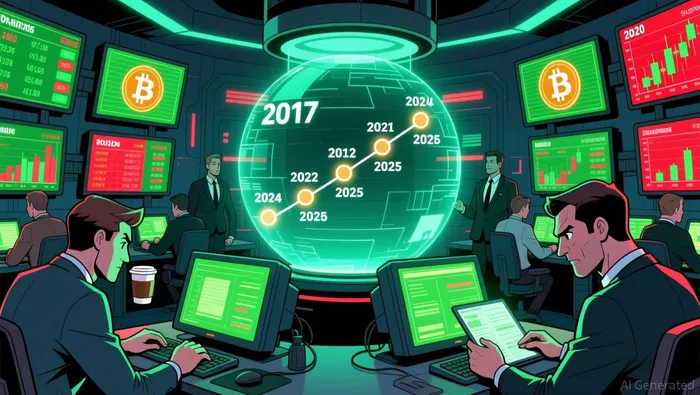
Bitcoin's price dynamics have long been tethered to its four-year halving cycle, a mechanism designed to reduce the rate of new coin creation and artificially constrain supply. Historically, these events have catalyzed sharp price surges, as seen in 2012, 2016, and 2020. However, the 2024 halving-marking the fourth iteration of this cycle-produced a muted response, with BitcoinBTC-- trading between $80,000 and $90,000 in the year following the event, the weakest post-halving performance on record. This divergence raises a critical question: Is Bitcoin's traditional four-year cycle broken, or is it evolving under the weight of institutional adoption and macroeconomic forces?
The Rise of Institutional Adoption: A Structural Shift
Institutional adoption has emerged as a dominant force reshaping Bitcoin's price dynamics. By 2025, 68% of institutional investors had either invested in or planned to invest in Bitcoin exchange-traded products (ETPs), while 86% had exposure to digital assets or intended to allocate capital by 2025. Regulatory clarity, including the U.S. SEC's approval of spot Bitcoin ETFs in January 2024, has normalized Bitcoin as a legitimate asset class. For instance, BlackRock's iShares Bitcoin Trust ETF alone accumulated over $50 billion in assets, reflecting the scale of institutional interest.
This shift is not merely speculative. Institutions are integrating Bitcoin into corporate treasuries, pension funds, and digital asset infrastructure. With global institutional assets exceeding $100 trillion, a 2-3% allocation to Bitcoin could generate $3 trillion in demand by 2025. This dwarfs the $77 billion in new Bitcoin supply from mining activities, creating a 40-to-1 supply-demand imbalance. Such structural demand, driven by diversification strategies and inflation hedging, has reduced Bitcoin's reliance on the halving cycle as the primary price driver.
Macroeconomic Correlations: From Scarcity to Systemic Integration
Bitcoin's price is increasingly influenced by macroeconomic indicators, blurring the lines between its role as a digital commodity and a macro-sensitive asset. Studies show a strong correlation (0.78) between Bitcoin's price and global M2 money supply growth, with a 90-day lag effect observed between 2020 and 2023. This aligns with Bitcoin's positioning as a hedge against currency devaluation, particularly in an era of persistent inflation and geopolitical uncertainty.
The 2024 halving occurred against a backdrop of heightened macroeconomic volatility. The Economic Policy Uncertainty Index averaged 317 in Q1 2025, compared to 107 in 2012 and 109 in 2016. Rising interest rates and liquidity constraints, which traditionally dampen speculative assets, further muted the halving's impact. Yet, Bitcoin's price resilience-surging from $34,667 in October 2023 to $126,296 in October 2025-demonstrates its growing integration into institutional portfolios, where it is valued for risk-adjusted returns rather than speculative bets.
The Evolving Cycle: Scarcity Meets Institutional Infrastructure
While the halving cycle remains a foundational element of Bitcoin's supply dynamics, its influence is now intertwined with institutional infrastructure. The 2028 halving, which will reduce new Bitcoin supply by half, will occur at a time when institutional adoption is projected to peak. This creates a compounding effect: as demand outpaces supply, Bitcoin's price is likely to reflect both its inherent scarcity and the operational demand from pension funds, asset managers, and corporate treasuries.
Moreover, the introduction of custody solutions and lending platforms has transformed Bitcoin from a speculative asset into an operational one. This shift reduces volatility and aligns Bitcoin's price trajectory with broader financial market trends, such as equity indices and inflation expectations. For example, Bitcoin's correlation with the S&P 500 has strengthened in 2025, reflecting its integration into diversified portfolios.
Conclusion: A New Regime, Not a Broken Cycle
Bitcoin's four-year cycle is not broken-it is evolving. Institutional adoption and macroeconomic integration have redefined the interplay between supply constraints and demand drivers. While halvings still create scarcity, their price impact is now mediated by institutional infrastructure and global monetary trends. The 2024 halving's muted response underscores this transition: Bitcoin's future is no longer dictated by algorithmic scarcity alone but by its role in a maturing financial ecosystem.
For investors, this means Bitcoin's price dynamics will increasingly mirror those of traditional assets, with macroeconomic indicators and institutional allocations serving as key barometers. As the 2028 halving approaches, the combination of structural demand and dwindling supply may propel Bitcoin into a new regime-one where its value is anchored not just by code, but by capital.





Comentarios
Aún no hay comentarios