
Is Bitcoin's Four-Year Cycle Dead or Just Evolving?
Bitcoin's four-year halving cycle has long been a cornerstone of crypto market analysis. Historically, these events have triggered predictable price surges, driven by scarcity mechanics and speculative fervor. But in the wake of the 2024 halving, a critical question emerges: Is the four-year cycle dead, or is it evolving into a new paradigm shaped by structural demand and institutional adoption?
The 2024 Halving: A New Market Regime
The 2024 halving, which reduced block rewards from 6.25 to 3.125 BTC, marked a pivotal shift in Bitcoin's market dynamics. While the asset's price surged 31% in the year following the event, reaching $83,671 by April 2025, this performance was notably muted compared to prior cycles. For instance, the 2012 and 2016 halvings saw multi-year bull runs with returns exceeding 100% within 12–18 months. The 2024 cycle, however, unfolded in a context of maturing institutional adoption and macroeconomic integration, reshaping how the market interprets scarcity events.
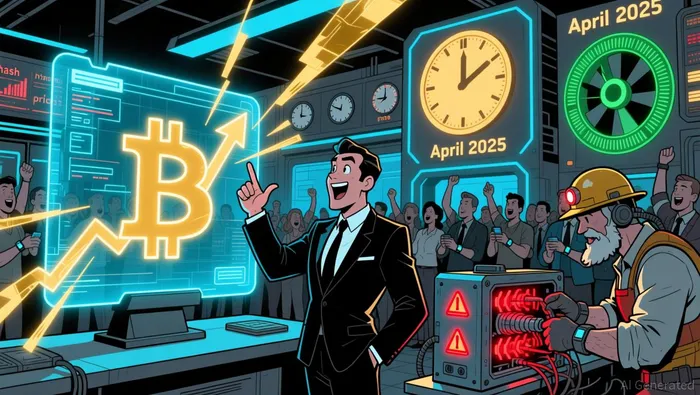
Miners adapted to reduced block rewards by innovating operational strategies, such as adopting next-generation ASICs and diversifying into AI/HPC workloads. Meanwhile, Bitcoin's network hash rate exceeded one zetta hash per second in April 2025, reflecting resilience despite a 60% drop in hash price. These structural adaptations suggest that the mining industry is evolving beyond mere reliance on halving-driven tailwinds.
Institutional Adoption: A Structural Game-Changer
The most profound shift post-2024 halving is the structural demand introduced by institutional investors. The approval of spot BitcoinBTC-- ETFs in the U.S. and other jurisdictions in 2024 unlocked nearly $60 billion in assets under management, with major funds like BlackRock's IBIT and Fidelity's FBTC leading the charge. By 2025, institutional ownership accounted for 31% of known Bitcoin holdings, a stark contrast to pre-2024 cycles where retail speculation dominated.
This institutional influx has transformed Bitcoin's role in portfolios. No longer viewed as a speculative trade, it is now a strategic allocation for hedging macroeconomic risks and enhancing risk-adjusted returns. For example, Bitcoin's market dominance-now exceeding 72.4% (excluding stablecoins)-underscores its outperformance against altcoins like EthereumETH-- and SolanaSOL--. This dominance is further reinforced by its correlation with traditional assets like the S&P 500 and Nasdaq, particularly during periods of geopolitical uncertainty.
The Evolution of the Four-Year Cycle
Historically, Bitcoin's four-year cycle has followed a predictable pattern: Accumulation → Growth → Bubble → Crash. The 2024 cycle, however, deviated from this script. While the asset reached a peak of $126,210 in October 2025-12 months post-halving-it closed 2025 lower than its starting price, marking the first-ever negative post-halving year. This anomaly reflects the influence of institutional behavior, which prioritizes liquidity, regulatory clarity, and macroeconomic signals over halving calendars.
Analysts argue that the cycle is not dead but evolving. Institutional investors act as long-term rebalancers, buying during weakness and reducing exposure during sharp rallies, thereby dampening volatility. For instance, Bitcoin's 30-day volatility in 2024–2025 averaged 2.72%, lower than the 3.24% in 2012 and 3.92% in 2020. This maturation of the market suggests that Bitcoin's price is increasingly shaped by structural forces-such as ETF inflows and macroeconomic trends-rather than purely cyclical ones.
Strategic Investment Timing: Balancing Cycles and Structure
For investors, the evolving cycle demands a nuanced approach to timing. While historical patterns still offer guidance (e.g., peaks 12–18 months post-halving), structural demand metrics now carry equal weight. Key indicators include:
1. ETF Inflows: The $191 billion in crypto ETF assets under management as of 2025 highlights institutional confidence.
2. Market Dominance: Bitcoin's 60% dominance in 2025 signals a balanced market, with room for altcoin participation.
3. On-Chain Metrics: A 104% increase in hashrate in 2024 and rising miner profitability through diversified revenue streams (e.g., ordinal inscriptions, Layer 2 projects) indicate network resilience.
Looking ahead, 2026 is positioned as a potential expansion phase, with price targets clustering between $120K and $170K. Institutional investors, treating Bitcoin as a strategic asset, are expected to maintain their presence despite risks like ETF outflows and cybersecurity challenges.
Conclusion: A New Era for Bitcoin
The 2024 halving did not kill the four-year cycle-it redefined it. Bitcoin's market is now a hybrid of cyclical scarcity and structural demand, with institutional adoption acting as the bridge between the two. For investors, this means abandoning rigid adherence to halving calendars in favor of a dual-lens approach: analyzing both Bitcoin's inherent scarcity and the macroeconomic forces shaping institutional behavior.
As the asset transitions from a speculative retail play to a strategic institutional allocation, the question is no longer whether the four-year cycle is dead-but whether investors are ready to evolve with it.






Comentarios
Aún no hay comentarios