
Is Bitcoin's Four-Year Cycle Dead or Evolving?
Bitcoin's four-year price cycle—a narrative rooted in its halving schedule and historical price patterns—has long served as a predictive framework for investors. However, as institutional adoption reshapes Bitcoin's investment dynamics, the question arises: Is this cycle dead, or is it evolving?
The Traditional Cycle: Scarcity and Speculation
Bitcoin's halving events, which reduce blockXYZ-- rewards every four years, have historically triggered bullish phases. The 2024 halving, which cut mining rewards from 6.25 to 3.125 BTC per block, followed this script, with BitcoinBTC-- rising 41.2% from $64,013 to $90,446 between January and November 2024 . Yet this growth lagged behind the explosive gains seen in prior cycles, such as the 2017 and 2021 bull runs. Critics argue that external factors—like the release of seized Mt. Gox coins—introduced supply-side pressures, diluting the scarcity-driven narrative .
Institutional Adoption: A New Catalyst
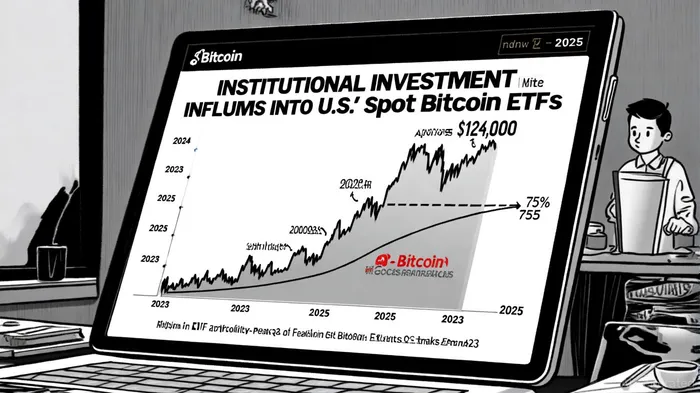
The 2024–2025 period, however, introduced a seismic shift: institutional adoption. The approval of U.S. spot Bitcoin ETFs in January 2024 catalyzed unprecedented inflows. By Q3 2025, these ETFs attracted $118 billion in institutional capital, with BlackRock's IBIT alone managing $86 billion in assets under management . This influx directly correlated with Bitcoin's price surge to $124,000 in mid-August 2025 .
Regulatory clarity further accelerated adoption. The U.S. CLARITY Act and EU's MiCAR framework provided legal certainty, while Bitcoin's inclusion in 401(k) retirement accounts unlocked an $8.9 trillion capital pool . These developments transformed Bitcoin from a speculative asset into a mainstream portfolio staple, reducing its volatility by 75% compared to earlier 2025 levels .
Evolving Dynamics: Beyond Scarcity
The four-year cycle is not dead—it is evolving. Institutional adoption has introduced new variables:
1. Liquidity and Demand: Lower interest rates and pro-crypto policies (e.g., Trump-era regulatory easing) have enhanced Bitcoin's appeal as a hedge against fiat debasement .
2. Supply Constraints: The U.S. federal debt reaching $36.2 trillion and proposed Strategic Bitcoin Reserve initiatives signal tightening supply dynamics .
3. Market Structure: Institutional players now dominate Bitcoin's network, with large, low-frequency transactions replacing retail-driven volatility .
Analysts project Bitcoin could reach $243,000 by 2025 if it follows historical M2 money supply correlations . Tiger Research's Q3 2025 report even targets $190,000, citing record liquidity and institutional demand .
The Verdict: A Living Cycle
Bitcoin's four-year cycle remains intact but is now intertwined with institutional forces. The halving event's scarcity narrative persists, but its expression has shifted from retail speculation to institutional capital allocation. As macroeconomic factors and regulatory frameworks align with Bitcoin's issuance schedule, the cycle evolves—not dies.
For investors, this means the traditional playbook must adapt. The next bear phase (projected for 2026) may be less volatile, given institutional stabilizing effects. Yet the core thesis endures: Bitcoin's scarcity, combined with institutional adoption, will continue to drive long-term value.
Source:
[1] Bitcoin Cycles, Entering 2025 [https://www.ark-invest.com/articles/analyst-research/bitcoin-cycles-entering-2025]
[2] Institutional Capital Floods Crypto Market: Bitcoin ETFs Drive Record Inflows [https://markets.financialcontent.com/stocks/article/marketminute-2025-9-9-institutional-capital-floods-crypto-market-bitcoin-etfs-drive-record-inflows]
[3] Bitcoin's Price Volatility and Institutional Influence [https://www.bitget.com/news/detail/12560604937023]
[4] Bitcoin Forecast & Price Prediction: 200K in 2025? [https://naga.com/ae/news-and-analysis/articles/bitcoin-price-prediction]
[5] Q3 2025 Bitcoin Valuation Report [https://www.chaincatcher.com/en/article/2199982]





Comentarios
Aún no hay comentarios