
Bitcoin's End-of-Year 2025 Demand Dynamics: Macroeconomic Positioning and the Institutional Takeover
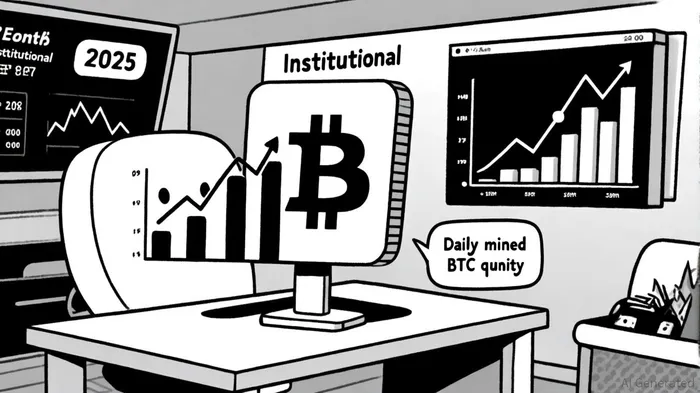
Bitcoin's 2025 narrative has shifted from speculative fervor to institutional inevitability. As macroeconomic pressures and regulatory clarity converge, the cryptocurrency is no longer a fringe asset but a cornerstone of global financial strategy. Michael Saylor, a vocal advocate for Bitcoin's institutionalization, has crystallized this transition in recent commentary, framing BitcoinBTC-- as a “protocol for prosperity” and a hedge against fiat devaluation[1]. By year-end 2025, the interplay of macroeconomic positioning and institutional adoption is poised to redefine Bitcoin's demand dynamics, with implications for both price and systemic financial architecture.
Macroeconomic Positioning: Inflation, Dollar Dynamics, and the Fed's Role
Bitcoin's appeal in 2025 is inextricably tied to macroeconomic conditions. The U.S. dollar's weakening trajectory, exacerbated by persistent inflation and accommodative Federal Reserve policies, has amplified Bitcoin's role as a store of value. According to a report by Analytics Insight, Bitcoin's year-to-date price surge of 25% in 2025 was driven by its inverse correlation with the dollar and anticipation of rate cuts[3]. Saylor has underscored this dynamic, arguing that Bitcoin's scarcity—fixed at 21 million coins—positions it as a natural counterbalance to fiat inflation, which erodes purchasing power[4].
The Fed's pivot toward rate cuts, expected to materialize in late 2025, further bolsters Bitcoin's case. Lower interest rates reduce the opportunity cost of holding non-yielding assets like Bitcoin, while also incentivizing institutional investors to seek higher returns amid stagnant traditional markets[5]. Saylor's assertion that Bitcoin will “outperform the S&P 500 by 29% annually over two decades”[3] gains traction in this environment, as macroeconomic liquidity returns drive capital toward alternative assets.
Institutional Adoption: ETFs, Corporate Treasuries, and Supply Constraints
The most transformative force in Bitcoin's 2025 trajectory is institutional adoption. Spot Bitcoin ETFs, approved in the U.S. in early 2025, have unlocked a flood of capital. By September 2025, these funds recorded $642.35 million in net inflows on a single day, with cumulative flows surpassing $56.83 billion[6]. BlackRock's iShares Bitcoin Trust (IBIT) alone attracted $936.5 million in a single April 2025 session, reflecting institutional confidence[6].
Corporate treasuries have mirrored this trend. Companies like MicroStrategy now hold over 1.011 million BTC, valued at $118 billion—approximately 5% of the circulating supply[2]. This surge in corporate demand, combined with ETF purchases, has created a supply shock: institutions and ETFs acquire 1,755 BTC and 1,430 BTC daily, respectively, far exceeding the 900 BTC mined daily[1]. Saylor has highlighted this imbalance as a catalyst for upward price pressure, noting that Bitcoin's supply constraints will amplify its scarcity premium as institutional demand outpaces production[4].
Regulatory clarity has further accelerated adoption. The Office of the Comptroller of the Currency (OCC)'s 2025 guidelines permitting banks to engage in crypto custody and trading[2] have normalized Bitcoin as a legitimate financial instrument. Saylor envisions a future where Bitcoin-backed credit instruments replace traditional debt, offering higher yields with lower risk[4].
Saylor's Strategic Vision: From Speculation to Systemic Infrastructure
Saylor's recent remarks crystallize Bitcoin's evolving role. At the Bitcoin 2025 keynote, he outlined 21 principles for generational wealth, positioning Bitcoin as the “ultimate store of value” and a tool for economic sovereignty[5]. His emphasis on Bitcoin's decreasing volatility—attributed to institutional capital smoothing price swings—signals a shift from retail-driven speculation to macro-driven stability[1].
Saylor's ideological framing of Bitcoin as a “freedom virus”[4] resonates in a climate of geopolitical uncertainty and monetary experimentation, such as President Trump's Strategic Bitcoin Reserve. By reframing Bitcoin as a digital gold-backed credit system, he aligns it with historical financial paradigms while innovating beyond them. This dual narrative—store of value and settlement layer—positions Bitcoin to capture both institutional and sovereign demand.
End-of-Year Outlook: A Convergence of Forces
By late 2025, Bitcoin's demand dynamics will be shaped by three converging forces:
1. Macroeconomic Liquidity: Fed rate cuts and dollar weakness will drive capital toward Bitcoin as a hedge.
2. Institutional Inflows: ETFs and corporate treasuries will continue absorbing Bitcoin's supply, creating upward pressure.
3. Regulatory Legitimacy: Clearer guidelines will reduce friction for banks and asset managers, accelerating adoption.
Price predictions vary, but models incorporating supply shocks and macroeconomic liquidity suggest a range of $69,550 to $144,710 by year-end[1]. Saylor's confidence in Bitcoin's “self-reinforcing cycle of stability and demand”[1] implies that short-term volatility—such as the 1.8% dip ahead of inflation data releases[5]—will be eclipsed by long-term structural trends.
Conclusion
Bitcoin's 2025 journey reflects a maturation of both the asset and the financial system's willingness to embrace it. As macroeconomic pressures and institutional adoption align, Bitcoin is transitioning from speculative curiosity to systemic infrastructure. Saylor's vision—a world where Bitcoin underpins digital gold-backed credit—may soon move from theory to practice. For investors, the end-of-year dynamics underscore a critical inflection point: Bitcoin is no longer a bet on the future but a fixture of the present.






Comentarios
Aún no hay comentarios