
Bitcoin Whales Pivoting to AI-Driven Crypto: A Strategic Play for the AI Revolution
Market Dynamics: Bearish Shorts and Bullish Longs
Bitcoin's price volatility has created diverging strategies among whales. On one hand, a whale on Hyperliquid opened $140 million in short positions against Bitcoin and XRPXRP-- with 20x leverage, netting $3.1 million as prices dipped slightly, according to Decrypt. This aggressive bearish bet reflects fears of a prolonged downturn, exacerbated by the Crypto Fear & Greed Index hitting 21 and institutional firms like Galaxy lowering Bitcoin price targets, according to Coinotag.
Conversely, HyperUnit, a whale with a storied history of navigating bear markets, placed $55 million in long positions on Bitcoin and EthereumETH--, betting on a rebound after the October correction, according to LiveBitcoinNews. Their track record-turning $850 million in 2018 Bitcoin buys into a $10+ billion portfolio-underscores a conviction that the current dip is a buying opportunity, according to CoinMarketCap. These contrasting moves highlight a market at a crossroads, where AI's rise may dictate the next phase of crypto capital flows.
AI Infrastructure: The New Gold Rush
The AI sector's explosive growth is reshaping global investment priorities. OpenAI, the creator of ChatGPT, projected $20 billion in annualized revenue for 2025, up from $13 billion in September, while securing $1.4 trillion in infrastructure deals for data centers, according to Parameter. Meanwhile, Uzbekistan launched a tax-free zone in Karakalpakstan, offering tax exemptions and discounted electricity to AI and data center projects investing $100 million or more until 2040, according to Daily Sabah.
These developments signal a global race to dominate AI infrastructure, with blockchain-based AI projects emerging as critical players. For instance, Fetch.ai launched ASI-1 Mini, a compact AI model for Web3 automation, while SingularityNET expanded its decentralized AI marketplace into healthcare and robotics, according to InvestingHaven. Render further democratized AI development by enabling GPU power sharing for AI workloads, with job completions surging in 2025, according to InvestingHaven.
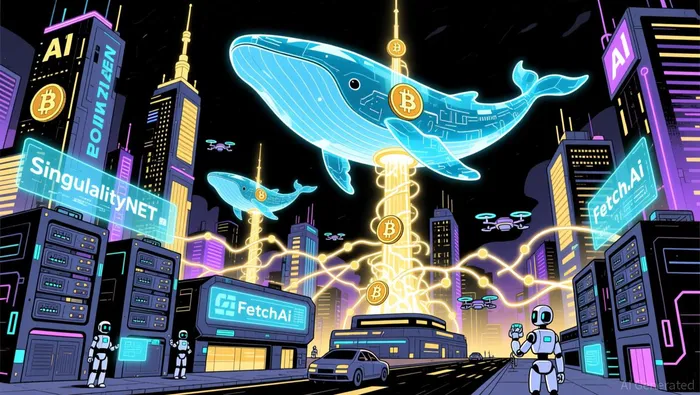
Strategic Reallocation: From BTC to AI-Driven Crypto
While direct transaction data on Bitcoin whales investing in AI crypto projects remains opaque, broader trends suggest a reallocation. The $140 million short against Bitcoin and XRP Decrypt and HyperUnit's $55 million long LiveBitcoinNews indicate whales are hedging against macro risks while positioning for AI's long-term potential.
Consider the logic: Bitcoin's dominance has waned as AI infrastructure gains traction. Whales like HyperUnit, who thrived during the 2018 bear market, are likely diversifying into AI-driven crypto to capture compounding returns. For example, Matador Technologies raised $100 million to acquire Bitcoin, aiming to hold 6,000 BTC by 2027, according to AmbCrypto. Such moves mirror institutional strategies to lock in Bitcoin while exploring AI's high-growth opportunities.
The High-Conviction Play: Why AI-Driven Crypto?
AI-driven crypto projects offer a unique value proposition: they combine the scalability of blockchain with AI's transformative potential. For instance, SingularityNET's decentralized AI marketplace allows developers to monetize models, creating a self-sustaining ecosystem, according to InvestingHaven. Similarly, Fetch.ai's autonomous agents are being tested in logistics and travel, proving real-world utility, according to InvestingHaven.
Whales reallocating capital into these projects are not merely speculating-they're investing in infrastructure that will underpin the AI economy. As OpenAI's Sam Altman noted, AI's success hinges on robust data centers and decentralized networks, according to Parameter. By funding these projects, whales align with the AI revolution's infrastructure layer, securing first-mover advantages.
Conclusion: Positioning for the AI-Driven Future
The reallocation of Bitcoin whale capital into AI-driven crypto is a strategic response to macroeconomic uncertainty and technological inevitability. While direct transaction data remains sparse, the broader narrative-OpenAI's revenue surge, Uzbekistan's tax incentives, and the rise of AI-focused blockchain projects-paints a clear picture: AI is the new gold, and whales are staking their claims.
For investors, the lesson is clear: the AI revolution is not a passing trend but a structural shift. By following the whales into AI-driven crypto, high-conviction investors can position themselves to multiply wealth as these projects scale.






Comentarios
Aún no hay comentarios