
Why Bitcoin's Whale Selling in November 2025 Signals a Late-Cycle Buying Opportunity, Not a Meltdown
The Anatomy of Whale Selling: Profit Realization, Not Panic
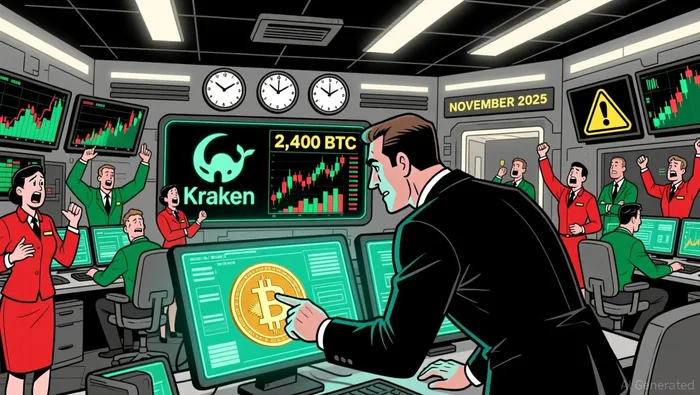
Bitcoin's long-term holders-often dubbed "whales"-have been steadily offloading their positions in November 2025. Daily outflows have averaged 26,000 BTC, a deliberate pace that contrasts sharply with the frenetic selling seen during market tops in 2018 or 2022. A single transaction of 2,400 BTC ($237 million) sent to Kraken in the past week exemplifies this trend, underscoring the methodical nature of these distributions.
This behavior aligns with historical bull-market cycles. In 2017 and 2021, older cohorts of BitcoinBTC-- holders began selling once prices hit psychological resistance levels, not out of fear but to lock in gains. The current cycle mirrors this pattern: the October 6, 2025, all-time high occurred exactly 1,050 days after the prior low-a four-year rhythm eerily similar to past peaks.
On-Chain Metrics: Stability Amidst Distribution
The net unrealized profit (NUP) ratio, a critical on-chain metric, currently sits at 0.476. This suggests that while short-term holders may be realizing losses, the broader market's unrealized gains remain resilient. Analysts like Vincent Liu of Kronos Research argue that this metric signals a stabilization of short-term lows, not a breakdown. In other words, the market is absorbing whale selling without triggering a cascade of panic-driven liquidations.
Moreover, the frequency and size of these transactions indicate a "liquidity-supporting" strategy. By spacing out sales over weeks, whales avoid overwhelming the order book-a tactic observed in prior cycles. This structured approach benefits the ecosystem: it provides retail and institutional buyers with steady access to Bitcoin while preventing abrupt price dislocations.
Late-Cycle Parallels and the ETF Factor
Bitcoin's 2025 bull run is unfolding against a backdrop of maturing institutional adoption. Unlike 2017 or 2021, this cycle is being fueled by ETF approvals, corporate treasury allocations, and macroeconomic tailwinds. These factors act as a buffer against traditional late-cycle volatility. For instance, even as whales distribute profits, institutional demand has shown remarkable stickiness. A single $10 billion ETF inflow in October 2025 offset weeks of whale outflows, demonstrating that demand-side fundamentals remain robust.
Historically, late-cycle whale selling has coincided with the entry of new capital. In 2021, for example, as older holders sold, micro-investors and institutional buyers stepped in, creating a "distribution to accumulation" handoff. The same dynamic appears to be at play in 2025, with on-chain data showing a 15% increase in new addresses holding less than 1 BTC since September.
Why This Is a Buying Opportunity
The key takeaway for investors is simple: whale selling in late cycles is not a harbinger of doom but a sign of market maturity. When whales distribute profits methodically, it often reflects confidence in Bitcoin's long-term value. The current environment-marked by stable NUP ratios, resilient ETF demand, and a four-year cycle peak-suggests that this is a consolidation phase, not a crash.
For those with a multi-year horizon, the recent dip in whale activity (despite the outflows) presents an opportunity to accumulate at prices that still reflect bullish sentiment. As one analyst put it, "Whales aren't fleeing-they're parking their gains. The real action starts when they stop selling and start buying again."
Conclusion
Bitcoin's November 2025 whale selling is a textbook late-cycle event. Far from signaling a meltdown, it reflects a market in the process of rebalancing-distributing gains to long-term holders while institutional and retail demand steps in to sustain momentum. For investors, the lesson is clear: stay focused on the fundamentals, trust the on-chain signals, and view this as a chance to position for the next leg of the cycle.






Comentarios
Aún no hay comentarios